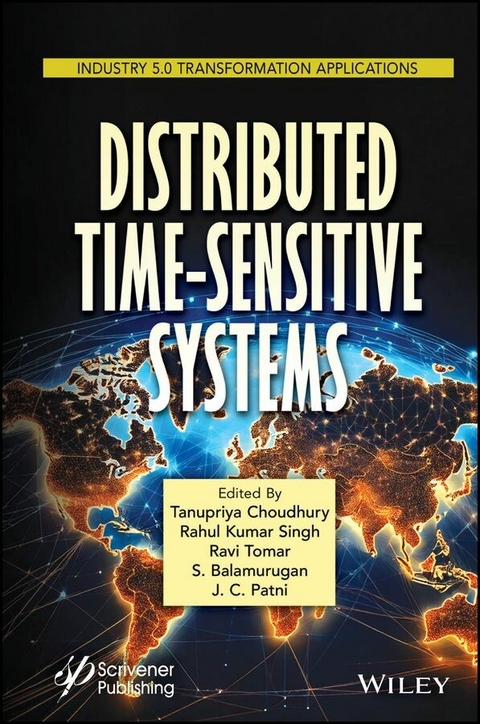
Distributed Time-Sensitive Systems (eBook)
535 Seiten
Wiley-Scrivener (Verlag)
978-1-394-19777-4 (ISBN)

The book provides invaluable insights into cutting-edge advancements across multiple sectors of Society 5.0, where contemporary concepts and interdisciplinary applications empower you to understand and engage with the transformative technologies shaping our future.
Distributed Time-Sensitive Systems offers a comprehensive array of pioneering advancements across various sectors within Society 5.0, underpinned by cutting-edge technological innovations. This volume delivers an exhaustive selection of contemporary concepts, practical applications, and groundbreaking implementations that stand to enhance diverse facets of societal life. The chapters encompass detailed insights into fields such as image processing, natural language processing, computer vision, sentiment analysis, and voice and gesture recognition and feature interdisciplinary approaches spanning legal frameworks, medical systems, intelligent urban development, integrated cyber-physical systems infrastructure, and advanced agricultural practices.
The groundbreaking transformations triggered by the Industry 4.0 paradigm have dramatically reshaped the requirements for control and communication systems in the factory systems of the future. This revolution strongly affects industrial smart and distributed measurement systems, pointing to more integrated and intelligent equipment devoted to deriving accurate measurements. This volume explores critical cybersecurity analysis and future research directions for the Internet of Things, addressing security goals and solutions for IoT use cases. The interdisciplinary nature and focus on pioneering advancements in distributed time-sensitive systems across various sectors within Society 5.0 make this thematic volume a unique and valuable contribution to the current research landscape.
Audience
Researchers, engineers, and computer scientists working with integrations for industry in Society 5.0
The book provides invaluable insights into cutting-edge advancements across multiple sectors of Society 5.0, where contemporary concepts and interdisciplinary applications empower you to understand and engage with the transformative technologies shaping our future. Distributed Time-Sensitive Systems offers a comprehensive array of pioneering advancements across various sectors within Society 5.0, underpinned by cutting-edge technological innovations. This volume delivers an exhaustive selection of contemporary concepts, practical applications, and groundbreaking implementations that stand to enhance diverse facets of societal life. The chapters encompass detailed insights into fields such as image processing, natural language processing, computer vision, sentiment analysis, and voice and gesture recognition and feature interdisciplinary approaches spanning legal frameworks, medical systems, intelligent urban development, integrated cyber-physical systems infrastructure, and advanced agricultural practices. The groundbreaking transformations triggered by the Industry 4.0 paradigm have dramatically reshaped the requirements for control and communication systems in the factory systems of the future. This revolution strongly affects industrial smart and distributed measurement systems, pointing to more integrated and intelligent equipment devoted to deriving accurate measurements. This volume explores critical cybersecurity analysis and future research directions for the Internet of Things, addressing security goals and solutions for IoT use cases. The interdisciplinary nature and focus on pioneering advancements in distributed time-sensitive systems across various sectors within Society 5.0 make this thematic volume a unique and valuable contribution to the current research landscape. Audience Researchers, engineers, and computer scientists working with integrations for industry in Society 5.0
1
Analytical Survey of AI Data Analysis Techniques
Divyansh Singhal1, Roohi Sille1*, Tanupriya Choudhury2, Thinagaran Perumal3 and Ashutosh Sharma4
1SOCS, UPES, Dehradun, India
2School of Computer Sciences (SoCS), University of Petroleum and Energy Studies (UPES), Dehradun, Uttarakhand, India
3Department of Computer Science, University Putra, Selangor, Malaysia
4Henan University of Science and Technology, Henan, China
Abstract
The tasks carried out by humans are automated using artificial intelligence algorithms. The intelligence that AI has given through continuous learning from regularly trained models is the primary reason it is employed in every element and sector. Understanding and analyzing data is the most crucial and difficult task, if there is a lot of it. Data science is also popular right now and deals with complicated problems analytically. The data are broken up into smaller pieces, so that the trends and behaviors may be understood. The handling of vast amounts of data is the main challenge in data science.
The processing of enormous amounts of data using various AI algorithms is a subject of intense investigation. The great compute capacity, rapid processing speed, and very effective models required by the AI techniques used for processing enormous volumes of data are necessary to prevent errors in the management of the data.
In this study, the various hardware and software resources needed for the handling and analysis of massive amounts of data will be examined. This will also provide more detail on the work that various researchers have done in using AI models for data analytics. Within this chapter, a comparative examination of all the machine learning and deep learning models utilized for data analytics will be critically performed.
Keywords: Deep learning, data analytics, deep neural networks, artificial intelligence, data handling
1.1 Introduction
When discussing data analysis, one thing that becomes immediately clear is when it is crucial. This occurs when we have a large amount of data that we can use to improve our services and generate revenue for the business, or when we can extract critical information. Big Data analytics will now play a part. Why Big Data, you ask? Because it strives to enhance the decision-making process, big data isn’t only about tables and charts; it also refers to a variety of data, including communications, social media posts, and other examples. The most effective way to grow any industry is to increase the volume of clients, and this tactic proved to be just that [1]. Data, function, and design are integrated in digital video. For companies to display the data, DV is necessary. Different types of graphs or charts can be used to create this visualization. Gains and losses made by any company or organization will be easier to see; thanks to this visualization. Choosing the appropriate chart or graph is the main challenge in data visualization. Prior to presenting the data, decide on your objectives. Decide then, what information you require to accomplish your objective. Continuing with data collection, choosing the appropriate graph and data, and moving forward.
1.2 Survey on Various AI Techniques in Multiple Data Inputs
1.2.1 AI Techniques in E-Commerce
E-commerce is the topic of discussion in this section. So, let’s first look at what e-commerce is from that perspective. E-commerce is nothing more than moving stores online. With the aid of the internet, clients who once had to make a trip to a store to make a purchase may now do it with just one click and no effort. So, if we summarize the concept of e-commerce, it generally refers to a process in which two parties (vendors and customers) are involved and where the selling of products or services is accomplished through the use of the internet, or we may say digitally [2]. However, despite the fact that numerous research papers have been published on this topic across a variety of domains from the point of view of both parties, i.e., from the consumer and the vendor, there is still a gap that makes it challenging for researchers to draw a conclusion or gain knowledge on this subject. Integrating AI research with e-commerce is essential if we want to take the initiative in learning more, and offering a solid foundation on which to create and test new theories in the field of study [3–7].
The negotiation phase is one of the most crucial components in company. We always bargain over everything, from little things to huge things. For instance, if we buy fruits or vegetables, we always bargain with the vendor. We also bargain when two businesses are trying to come to an agreement. To maintain your consumer base in business, negotiation is a need. As is common knowledge, the majority of business is now conducted online, which is known as e-commerce. E-main commerce’s benefit is that it has made life easier for everyone involved, whether they are the buyer or the seller. In the past, negotiations took place face-to-face; however, as more businesses have gone online and those that can’t keep up with the demand for frequent online trading, automated businesses are something that will boost the effectiveness of e-commerce and allow customers to conduct transactions at the lowest possible cost or at any desired cost [8].
From the standpoint of the customer, we discussed the importance of negotiating in the paragraph above. Now, if we discuss the company’s perspective as to why they should implement negotiation in online commerce, or we can say why e-negotiation is vital, then this is the response. As a result of the rapid advancement of technology, businesses are increasingly engaged in business-to-consumer (B2C) transactions, where they are compelled to reinvent or re-innovate their services to maintain their current clientele and draw in new ones to expand their clientele. To maintain their business running smoothly, a company or organization basically needs to consider client happiness, and bargaining is one of those services. This makes “negotiating” a crucial topic to consider. The next question that emerges is how a business may offer its clients the best bargains,+ so that they have no reason to object to the amount the business is charging. As was already stated, the solution is straightforward and involves large data analysis. If one wonders why data analysis is necessary, the answer is that it will expedite the negotiation process for both the business and the client, which is advantageous to both [8].
Now let’s hunt for the parameter or parameters that will allow for successful e-negotiation using big data. The amount of data provided is the only parameter we need. The volume of information obtained must be enormous because this alone will determine the company’s success or failure. Since the business will learn the method, the client uses to contact them, they will be able to close the deal in the client’s best interests. Since the data we receive is in raw form, the most important aspect of B2C e-negotiation is the use of the proper algorithm to achieve the best outcomes. This data should be processed in the proper sequence before being analyzed.
In the recent years, negotiating has been thoroughly researched. One of the frequently used methods in trade, or you might say in negotiations, is artificial intelligence. Different AI methods are being created and used for training and research. Game theory, Bayesian networks, evolutionary computation, and distributed AI models are the techniques at play. Many negotiation models, however, have fallen short, making them unsuitable for actual electronic negotiations. The cause is the need for vast amounts of memory and high processing power for complex calculations, even though we know that there are more attributes to consider when making a judgement [8].
The biggest flaw with electronic negotiation models is that they base negotiations solely on price, although in reality, negotiations take into account various elements, including price, quantity, quality, market rate, and so on.
1.2.1.1 Benefits of Using AI in Ecommerce Companies
We used to purchase on the Amazon website, so it should come as no surprise that it employs AI to improve UX, logistics, and customer product selection. Better marketing and advertising, higher customer retention rates, and seamless automation are all advantages of employing AI in e-commerce.
Improved advertising and marketing, target people, who in the past, used to buy items based only on what a firm was promoting. However, because the time has changed, everyone wants to buy what they can and what they see. Any company that aims for long-term success must be aware of what each and every customer wants from them. They want to see anything related to them, as that will make them more likely to buy it. This means that rather than proceeding in a static fashion, they must make everything dynamic, allowing users to view what they want to see. Only then can we declare that the company is on the correct course. Everyone desires their own unique space in their lives, and the same is true here. Everyone wants to perceive things their own way, which is referred to as personalization.
Personalization is crucial, and each organization should focus their attention and efforts on it first. A small number of businesses have, nevertheless, successfully personalized their users’ experiences. The ability for users to customize their needs and what they really want...
| Erscheint lt. Verlag | 25.4.2025 |
|---|---|
| Reihe/Serie | Industry 5.0 Transformation Applications |
| Sprache | englisch |
| Themenwelt | Mathematik / Informatik ► Informatik ► Theorie / Studium |
| ISBN-10 | 1-394-19777-2 / 1394197772 |
| ISBN-13 | 978-1-394-19777-4 / 9781394197774 |
| Informationen gemäß Produktsicherheitsverordnung (GPSR) | |
| Haben Sie eine Frage zum Produkt? |
 EPUB (Adobe DRM)
Kopierschutz: Adobe-DRM
Adobe-DRM ist ein Kopierschutz, der das eBook vor Mißbrauch schützen soll. Dabei wird das eBook bereits beim Download auf Ihre persönliche Adobe-ID autorisiert. Lesen können Sie das eBook dann nur auf den Geräten, welche ebenfalls auf Ihre Adobe-ID registriert sind.
Details zum Adobe-DRM
Dateiformat: EPUB (Electronic Publication)
EPUB ist ein offener Standard für eBooks und eignet sich besonders zur Darstellung von Belletristik und Sachbüchern. Der Fließtext wird dynamisch an die Display- und Schriftgröße angepasst. Auch für mobile Lesegeräte ist EPUB daher gut geeignet.
Systemvoraussetzungen:
PC/Mac: Mit einem PC oder Mac können Sie dieses eBook lesen. Sie benötigen eine
eReader: Dieses eBook kann mit (fast) allen eBook-Readern gelesen werden. Mit dem amazon-Kindle ist es aber nicht kompatibel.
Smartphone/Tablet: Egal ob Apple oder Android, dieses eBook können Sie lesen. Sie benötigen eine
Geräteliste und zusätzliche Hinweise
Buying eBooks from abroad
For tax law reasons we can sell eBooks just within Germany and Switzerland. Regrettably we cannot fulfill eBook-orders from other countries.
aus dem Bereich