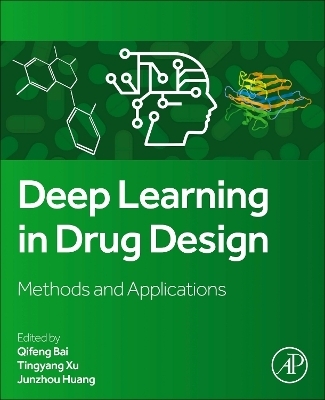
Deep Learning in Drug Design
Academic Press Inc (Verlag)
978-0-443-32908-1 (ISBN)
Deep Learning in Drug Design: Methods and Applications is particularly helpful to undergraduate, graduate, and doctoral students in need of a practical guide to the principles of the discipline. Established researchers in the area will benefit from the detailed case studies and algorithms presented.
Qifeng Bai is a professor in School of Basic Medical Sciences of Lanzhou University. He is also an associate editor in the journal named Frontiers in Chemistry. He is interested in drug design by developing new algorithms, software, machine learning, and deep learning. He is also good at conformation transition studies of receptors (e.g. kinases and G protein-coupled receptors) by performing molecular dynamics simulations. He has developed the software MolAICal which has been widely used to design drugs based on deep learning and traditional algorithms. Tingyang Xu is a Senior Researcher in AI for Science Group at DAMO Academy, Alibaba, and Hupan Lab since 2024. He earned his Master's degree and Ph.D. from University of Connecticut and his Bachelor's degree from Shanghai Jiaotong University. His research encompasses deep learning applications for de novo drug design, generation of medical images, and AI for Science. His work has been published in top-tier data mining and machine learning conferences, including NeurIPS, ICML, SIGKDD, VLDB, Nature Communications (NC), Internet of Things (IoT), and Annuals of Surgery. Additionally, Dr. Xu has served as a reviewer for prestigious conferences and journals, and as the Industrial Track Chair for BIBM 2019. Junzhou Huang is the Jenkins Garrett Professor in the Computer Science and Engineering department at the University of Texas at Arlington. He received the Ph.D. degree in Computer Science at Rutgers, the State University of New Jersey. His major research interests include machine learning, computer vision, medical image analysis, and bioinformatics. His research has been recognized by several awards including UT STARs Award, NSF CAREER Award, Google TensorFlow Model Garden Award, IBM Watson Emerging Leaders, four Best Paper Awards (MICCAI'10, FIMH'11, STMI'12, and MICCAI'15) as well as two Best Paper Nominations (MICCAI'11 and MICCAI'14). He is a Fellow of AIMBE.
PART 1: Deep learning theories and methods for drug design
1. CHAPTER 1 Molecular representations in deep learning
2. CHAPTER 2 CNNs in drug design
3. CHAPTER 3 GNNs in drug design
4. CHAPTER 4 RNNs and LSTM in drug design
5. CHAPTER 5 Deep reinforcement learning in drug design
6. CHAPTER 6 Transformer and drug design
7. CHAPTER 7 Generative models for drug design
8. CHAPTER 8 Geometric graph learning for drug design
9. CHAPTER 9 Self-supervised learning for drug discovery
10. CHAPTER 10 Transfer learning and meta-learning for drug discovery
11. CHAPTER 11 Explainable artificial intelligence for drug design models
12. CHAPTER 12 Large models in drug design
PART 2: Deep learning applications in drug design
13. CHAPTER 13 Deep learning for protein secondary structure prediction
14. CHAPTER 14 Deep learning in protein structure prediction
15. CHAPTER 15 Deep learning for affinity prediction and interface prediction in molecular interactions
16. CHAPTER 16 Deep learning for complex structure prediction in molecular interactions
17. CHAPTER 17 Deep learning in chemical synthesis and retrosynthesis
18. CHAPTER 18 Deep learning for ADME prediction
19. CHAPTER 19 Deep learning for toxicity prediction
20. CHAPTER 20 Deep learning for TCR-pMHC binding prediction
21. CHAPTER 21 Deep learning for B-cell epitope prediction and receptor-antigen binding
prediction
22. CHAPTER 22 Deep learning for antigen-specific antibody design
23. CHAPTER 23 Ethical and regulatory of artificial intelligence in drug design
| Erscheinungsdatum | 07.10.2025 |
|---|---|
| Verlagsort | San Diego |
| Sprache | englisch |
| Maße | 191 x 235 mm |
| Gewicht | 450 g |
| Themenwelt | Informatik ► Theorie / Studium ► Künstliche Intelligenz / Robotik |
| Medizin / Pharmazie ► Medizinische Fachgebiete ► Pharmakologie / Pharmakotherapie | |
| ISBN-10 | 0-443-32908-7 / 0443329087 |
| ISBN-13 | 978-0-443-32908-1 / 9780443329081 |
| Zustand | Neuware |
| Informationen gemäß Produktsicherheitsverordnung (GPSR) | |
| Haben Sie eine Frage zum Produkt? |
aus dem Bereich