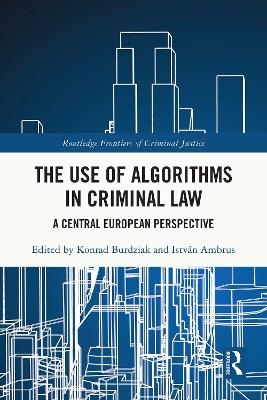
The Use of Algorithms in Criminal Law
Routledge (Verlag)
978-1-032-87183-7 (ISBN)
After a primer on how AI can be used in law enforcement to enhance operational effectiveness and improve public safety, chapters offer a comprehensive look at the current status of the use of new technologies in the criminal law of the Central and Eastern European countries. When appropriate, contributors formulate concrete postulates for the change of the current legal regulations as well as offer advice on how to use such technologies to one’s advantage or how to defend against their abuse by public authorities.
Navigating the intersection of technology and criminal justice, this book is invaluable for anyone with an interest in whether and how computers will shape the fate of criminal suspects and the operation of criminal justice systems. It is essential reading for scholars and students of comparative criminal justice, criminology, sociology, politics, and socio-legal studies.
Konrad Burdziak is attorney at law, assoc. prof., PhD in legal sciences (dr. habil.), certified suicidologist and a long-time employee of scientific and research institutions (University of Szczecin; Institute of Justice). He completed a three-month research internship at the University of Tallinn (Estonia), where he carried out a research project funded by the Polish National Science Centre, and a two-week query in the UK, where he carried out a research project funded by VisegradGrants. He is author or co-author of several dozen scientific publications (including eight scientific monographs) and more than 40 papers at national and international scientific conferences and participated in Polish and international research projects (e.g. Polish-Hungarian Research Platform or the Algorithms used in the field of criminal sciences project financed by VisegradGrants). He is an expert at the Centre for Advanced Research on Integrity, Rights and Inclusion of the Child (Estonia). He specialises in criminal law, constitutional law, and theory and philosophy of law. He collaborates with specialists from Poland and abroad. István Ambrus is an assoc. prof., PhD in legal sciences (dr. habil.) and a Hungarian lawyer specialising in criminal law and criminology. He currently serves as the head of the Department of Criminology at the Faculty of Law at Eötvös Loránd University (ELTE) in Budapest and is also a lecturer in the Department of Criminal Law at the same institution. In 2022, he was awarded the title of “Promising Researcher of ELTE” for his scientific achievements. His research focuses on the responses of criminal law to modern technological challenges, such as artificial intelligence and cybercrime. In 2021, he published a monograph titled “Digitalization and Criminal Law,” summarising his research in this field. In addition to his academic work, István Ambrus actively participates in international research projects. In 2022–2023, he led a project titled “Algorithms used in the field of criminal sciences” funded by the Visegrad Fund. His dedication to studying the impact of modern technologies on criminal law makes him one of the leading experts in this field in Hungary.
Part I Foreword
Foreword,
Konrad Burdziak and István Ambrus
Part II Introduction
Violence Risk Assessment Algorithms in Criminal Justice
Melissa Hamilton
Part III The Polish perspective
1. Sentencing with the use of algorithms in Polish criminal proceedings: an analysis from the perspective of the basic principles of sentencing
Konrad Burdziak
2. Using algorithms in Polish criminal law: useful tools or risk of bias
Magdalena Kowalewska-Łukuć
3. Artificial intelligence algorithms in the context of cybersecurity: AI Act and the national cybersecurity system – opportunities and challenges for social and economic development in the Republic of Poland
Dominika Skoczylas
Part IV The Hungarian perspective
4. Using algorithms during the imposition of sanctions in Hungary
István Ambrus
5. Artificial Intelligence and contemporary questions from the aspect of Hungarian Criminal Law
Máté Hodula
6. Automated judicial decisions: Is it possible?
Noémi Komporday-Orosz
7. Regulating Law Enforcement Facial Recognition and Safeguarding Against Misuse: European Union and Hungarian Perspectives
Kitti Mezei
Part V The Czech perspective
8. The use of artificial intelligence by Police and courts with a focus on Czech law
Lukáš Bohuslav
9. Use of algorithms in securing electronic evidence in the Czech Republic
Radka Čihulková
10. Algorithmic Automation in Criminal Proceedings: A General Discussion and Czech Perspective
Daniel Oborák
Part VI. The Slovak perspective
11. Perspectives of use of algorithms in criminal proceedings in Slovakia
Radovan Blažek
12. Using artificial intelligence in combatting cyber harassment and cyber bullying
Lenka Miklóssyová
13. Perspectives of using algorithms in assessing violent behaviour and recidivism in convicts – current state and future in Slovak prisons
Lucia Vasilik
| Erscheinungsdatum | 06.08.2025 |
|---|---|
| Reihe/Serie | Routledge Frontiers of Criminal Justice |
| Zusatzinfo | 1 Line drawings, black and white; 1 Illustrations, black and white |
| Verlagsort | London |
| Sprache | englisch |
| Maße | 152 x 229 mm |
| Gewicht | 600 g |
| Themenwelt | Mathematik / Informatik ► Informatik ► Theorie / Studium |
| Recht / Steuern ► EU / Internationales Recht | |
| Recht / Steuern ► Privatrecht / Bürgerliches Recht ► IT-Recht | |
| Recht / Steuern ► Strafrecht ► Kriminologie | |
| Recht / Steuern ► Strafrecht ► Strafverfahrensrecht | |
| ISBN-10 | 1-032-87183-0 / 1032871830 |
| ISBN-13 | 978-1-032-87183-7 / 9781032871837 |
| Zustand | Neuware |
| Informationen gemäß Produktsicherheitsverordnung (GPSR) | |
| Haben Sie eine Frage zum Produkt? |
aus dem Bereich