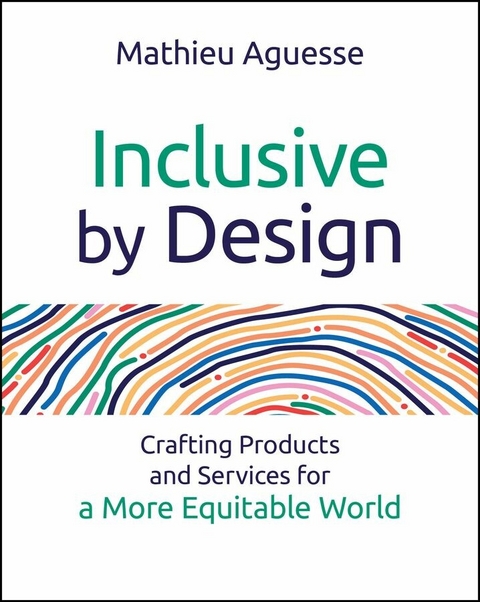
Inclusive By Design (eBook)
497 Seiten
Wiley (Verlag)
978-1-394-31006-7 (ISBN)
Discover how to incorporate DEI principles into your everyday life and environment
In Inclusive By Design: Crafting Products and Services for a More Equitable World, diversity, equity, and inclusion (DEI) strategist and designer Mathieu Aguesse delivers a powerful and practical new playbook for equitable design. He walks you through the concepts and practices that will help you integrate your DEI goals into your community and workplace.
You'll learn about the principles that undergird inclusive design, how to apply them in real-world scenarios-from the drawing room to the classroom and boardroom-and how to advocate for systemic change within your environment. You'll also discover:
- Engaging case studies that span a wide range of sectors and demographics
- Actionable insights and methodologies tailored to help you apply the concepts discussed in the book
- Strategies for intentional design that can influence, enhance, and benefit society by implementing DEI principles into everyday practices
Perfect for design professionals, educators, strategists, and corporate and business leaders seeking realistic techniques for incorporating DEI into the real-world, Inclusive By Design is also an essential read for DEI professionals looking for on-the-ground guidance on how to improve the world around them.
MATHIEU AGUESSE is an award-winning lecturer at UC Berkeley and MIT, where his groundbreaking courses on Inclusive and Equitable Design have inspired the next generation of leaders and innovators. As a global expert, Mathieu has worked across continents, partnering with hundreds of companies to shape strategies and products that drive sustainability, inclusivity, and societal impact. Renowned for his ability to bridge corporate strategy with pressing global challenges, he has developed multiple design frameworks that leverage Design as a powerful tool to tackle the most urgent issues of our time. He started a company in Silicon Valley in 2018 and as the CEO of Schoolab his work continues to redefine how businesses and institutions can create a more inclusive and equitable world.
Discover how to incorporate DEI principles into your everyday life and environment In Inclusive By Design: Crafting Products and Services for a More Equitable World, diversity, equity, and inclusion (DEI) strategist and designer Mathieu Aguesse delivers a powerful and practical new playbook for equitable design. He walks you through the concepts and practices that will help you integrate your DEI goals into your community and workplace. You'll learn about the principles that undergird inclusive design, how to apply them in real-world scenarios from the drawing room to the classroom and boardroom and how to advocate for systemic change within your environment. You'll also discover: Engaging case studies that span a wide range of sectors and demographics Actionable insights and methodologies tailored to help you apply the concepts discussed in the book Strategies for intentional design that can influence, enhance, and benefit society by implementing DEI principles into everyday practices Perfect for design professionals, educators, strategists, and corporate and business leaders seeking realistic techniques for incorporating DEI into the real-world, Inclusive By Design is also an essential read for DEI professionals looking for on-the-ground guidance on how to improve the world around them.
Introduction
Growing up as a left-handed person, I was exposed early on to a world where many objects and systems were simply not designed for me. One of my first memorable encounters with this reality came when I was about five years old and in kindergarten. My teacher, determined to teach me how to cut with scissors, insisted that I use my right hand—completely ignoring my natural left-handedness. Although I wouldn't have called it this at the time, it was my first direct experience with what I now recognize as a non-inclusive design.
Yet I never felt like a victim. In fact, I remember an instance when I was tinkering with my grandfather and we needed to screw two boards together in a tight cupboard space. The awkward angle made it nearly impossible for a right-handed person, and he turned to me, saying, “This is a task for you—only a left-handed person can do it!” In that moment, what could have been a limitation became a unique advantage, showing me how context could shift perception.
At the same time, my childhood in South Africa during the mid-1990s gave me a front-row seat to one of the most profound movements for equality in modern history. It was 1995, and Nelson Mandela had just taken office as the country's president. The dismantling of apartheid—a deeply entrenched and systematic form of inequality—was underway. Yet as transformative as those changes were, decades later, South Africa remains riddled with inequalities. The visible infrastructure of inequality may have been dismantled, but deeper, systemic layers continue to perpetuate disparities.
One of those layers is Design: the way products, services, and systems are created. Design has a profound ability to either support inclusion and equality or reinforce barriers and inequities. For me, this realization sparked a deep interest in how intentionality in design could be a force for social good.
The physical ergonomics of objects are often the first things that come to mind when thinking about inclusive design. From scissors that are impossible to use with the left hand to stairs-only pathways that exclude wheelchair users and parents with strollers, poor physical design can create unnecessary barriers. But inclusion extends far beyond ergonomics.
Take accessibility of services, for instance. The location and hours of public services can alienate individuals who work long shifts or live in areas without reliable transportation. Similarly, digital services requiring fast and stable internet access often exclude those in underserved or rural areas. These barriers highlight how poor design decisions can restrict access to critical resources.
Education and literacy levels are another overlooked design factor. Consider financial services: someone raised in a privileged environment may find concepts like credit, interest, and savings intuitive. But for someone with little financial literacy, this jargon can be overwhelming, further distancing them from opportunities for economic stability.
These examples reveal how poor design can perpetuate exclusion and inequality. As the saying goes, “Design is the intention behind an outcome.” Inclusive Design, at its core, is about intentionality: creating products, services, and experiences that break down barriers and empower those who face the most challenges. It's not just about functionality but about fostering equity and inclusion through thoughtful, empathetic creation.
We live in a very interesting time where we have access to more information than ever and the ability to draw better conclusions from history and leverage science to anticipate some of the threats ahead of us. Yet we are also experiencing a widespread rejection of democracy and progressive ideologies. Recent elections in the Western world demonstrate growing disapproval of elites, a sentiment likely fueled by unprecedented levels of inequality in wealth and power.
As of early 2024, in the United States, the wealth disparities in society are stark. The top 10% of households by wealth control an astounding 67% of total household wealth. Meanwhile, the bottom 50% of households collectively hold just 2.5% of total wealth. This disparity is not a recent phenomenon but part of a long-term trend; the wealth gap between America's richest and poorest families more than doubled from 1989 to 2016, highlighting the deep structural inequities at play.[1, 2]
Racial wealth disparities in the United States remain significant. According to a 2023 report by the Pew Research Center, in 2021, the typical White household had $201,700 more in wealth than the typical Hispanic household, up from a $168,800 gap in 2019. Similarly, data from the Federal Reserve Bank of St. Louis in 2024 indicates that Black families, on average, owned about 23 cents for every dollar of White family wealth, and Hispanic families owned about 19 cents per dollar. These figures reflect a persistent pattern of wealth concentration and systemic exclusion, with profound implications for social cohesion, democratic stability, and economic mobility.[3, 4]
In such an environment, it is unsurprising that frustrations are mounting, further driving divisions and skepticism toward established systems and institutions.
The risks posed by deep and persistent inequalities are immense and often underestimated in modern society. History provides us with stark warnings: major civilizational crises and eventual collapses often occurred when societies became profoundly stratified. In such scenarios, a small elite accumulated power and resources, and the majority of the population was left vulnerable. When these societies faced hardships such as prolonged droughts, economic stagnation, or other climate-related catastrophes, their resilience eroded, and the imbalance prevented effective collective responses.
Take the breakdown of Rwanda in the 1990s, for instance. As Jared Diamond discusses in Collapse: How Societies Choose to Fail or Succeed (2011, Penguin Publishing Group), extreme inequalities in land ownership and resource distribution, combined with rapid population growth, created unsustainable pressure on an already fragile system. The severe competition for land exacerbated deep-rooted ethnic tensions, ultimately leading to the 1994 genocide, one of the most devastating societal collapses in modern history. Similarly, the Roman Empire, despite its immense power, succumbed in part to growing economic disparity—a widening gap between the wealthy elite and the struggling lower classes—alongside environmental stress and external invasions. As the rich consolidated power and resources, the empire lost the social cohesion and adaptability necessary to withstand external shocks.
These examples illustrate a dangerous pattern: when inequalities deepen, societies lose their resilience, their ability to adapt to crises, and their sense of collective purpose. Without inclusive and equitable systems, civilizations become brittle—prone to internal strife and incapable of withstanding external pressures, ultimately leading to their downfall.
In today's world, these lessons are especially relevant. Climate change, resource depletion, and political instability are pressing global threats. If left unaddressed, growing disparities in wealth and power could undermine collective efforts to mitigate these challenges. A society where large portions of the population feel excluded or disenfranchised lacks the solidarity and trust needed to navigate crises. Inequality is not just an ethical issue; it is a structural weakness that threatens the very fabric of civilization.
The purpose of this book is to showcase how thoughtful design can act as a powerful tool to create a more inclusive and equitable society. By drawing on a wide range of projects I've been involved in over the years, I aim to demonstrate the tangible ways in which Design, when approached with intention, can break down barriers and empower underserved communities. Through my teaching roles at two of the world's most prestigious institutions—UC Berkeley and MIT—and collaborations with some of the largest global companies, I've developed a framework and philosophy tailored to inspire and guide leaders, decision-makers, and designers alike.
Since graduating from graduate school, I have been intensely focused on elevating the role of Design in the business world. My driving obsession has been to challenge the status quo, where designers are often undervalued and perceived as creators of visually appealing artifacts rather than contributors to strategic decision-making. Too often, designers are excluded from the processes where overarching strategies are defined, leaving them to execute decisions made by others. Over the past 12 years, I've worked tirelessly to prove this perspective wrong and to demonstrate that Design is not just a tool for execution but a vital strategic imperative for businesses and institutions.
Operating at the intersection of studio design, strategic consulting, and education, I have combined creative insights, business acumen, and pedagogical methods to shift perspectives. My goal has been to convince those in positions of power that Design deserves a central role in shaping strategy. By merging these approaches, I've been able to show that when Design is harnessed effectively, it becomes a transformative force that can drive innovation and inclusivity on a broad scale. This book is the culmination of that journey: a roadmap for those who seek to use Design as a catalyst for societal progress.
This book is not merely a collection of ideas but also...
| Erscheint lt. Verlag | 15.4.2025 |
|---|---|
| Sprache | englisch |
| Themenwelt | Mathematik / Informatik ► Informatik ► Theorie / Studium |
| Schlagworte | dei • dei book • dei design • dei education • DEI implementation • dei products • dei strategy • dei trends • Diversity, Equity, and inclusion • equitable design • inclusive design • Inclusive Education • Inclusive leadership • organizational dei strategy |
| ISBN-10 | 1-394-31006-4 / 1394310064 |
| ISBN-13 | 978-1-394-31006-7 / 9781394310067 |
| Informationen gemäß Produktsicherheitsverordnung (GPSR) | |
| Haben Sie eine Frage zum Produkt? |
 EPUB (Adobe DRM)
Kopierschutz: Adobe-DRM
Adobe-DRM ist ein Kopierschutz, der das eBook vor Mißbrauch schützen soll. Dabei wird das eBook bereits beim Download auf Ihre persönliche Adobe-ID autorisiert. Lesen können Sie das eBook dann nur auf den Geräten, welche ebenfalls auf Ihre Adobe-ID registriert sind.
Details zum Adobe-DRM
Dateiformat: EPUB (Electronic Publication)
EPUB ist ein offener Standard für eBooks und eignet sich besonders zur Darstellung von Belletristik und Sachbüchern. Der Fließtext wird dynamisch an die Display- und Schriftgröße angepasst. Auch für mobile Lesegeräte ist EPUB daher gut geeignet.
Systemvoraussetzungen:
PC/Mac: Mit einem PC oder Mac können Sie dieses eBook lesen. Sie benötigen eine
eReader: Dieses eBook kann mit (fast) allen eBook-Readern gelesen werden. Mit dem amazon-Kindle ist es aber nicht kompatibel.
Smartphone/Tablet: Egal ob Apple oder Android, dieses eBook können Sie lesen. Sie benötigen eine
Geräteliste und zusätzliche Hinweise
Buying eBooks from abroad
For tax law reasons we can sell eBooks just within Germany and Switzerland. Regrettably we cannot fulfill eBook-orders from other countries.
aus dem Bereich