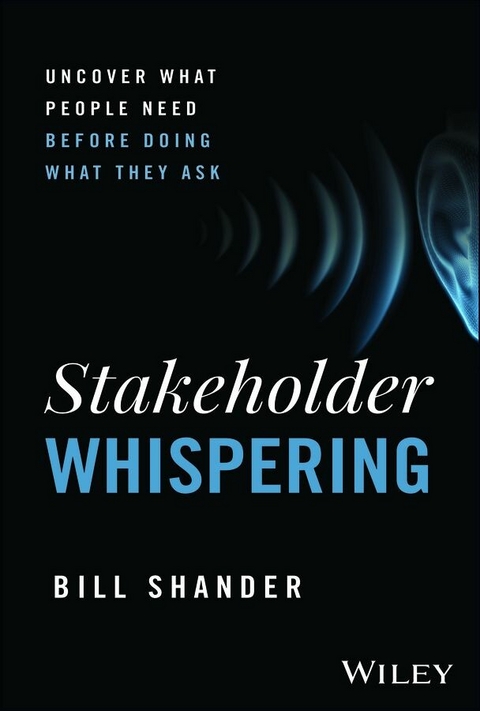
Stakeholder Whispering (eBook)
312 Seiten
Wiley (Verlag)
978-1-394-28953-0 (ISBN)
Learn to uncover what your managers, clients, customers and other stakeholders need before doing what they ask
People don't know what they need. The wants we communicate to others are shaped by our subconscious and the familiar, and limited by what we think is possible. But they don't always reflect our actual needs.
In Stakeholder Whispering: Uncover What People Need Before Doing What They Ask, author Bill Shander demonstrates how to get from your stakeholders' 'order'-what they're asking for-to what they really need. You'll learn how to uncover the needs and desires of your clients, colleagues, bosses, customers, and other stakeholders based on what they ask for and how they ask for it, and how to deliver products and services that meet those needs.
Inside the book:
- Help your stakeholders accomplish their goals and make the best decisions possible by helping them see what they really need
- Shift from executing on tactics driven by others' commands, to strategic action driven by underlying needs
- Transform your organization from one filled with 'order-takers' into one where people work collaboratively to meet goal-oriented requirements
Perfect for managers, executives, and other business leaders, Stakeholder Whispering will also earn a place on the bookshelves of entrepreneurs, founders, designers, product and project managers, UX experts, data and business analysts, and anyone else hoping to better meet the expectations of their coworkers, managers, clients, and customers.
BILL SHANDER is an information designer. For over 30 years, he has been helping clients turn their data into compelling visual (and often interactive) experiences. Clients include the World Bank, United Nations, Starbucks, PwC, MIT, multiple U.S. government agencies, and many more. He's also spent the past 10 years as an educator teaching these skills.
Learn to uncover what your managers, clients, customers and other stakeholders need before doing what they ask People don't know what they need. The wants we communicate to others are shaped by our subconscious and the familiar, and limited by what we think is possible. But they don't always reflect our actual needs. In Stakeholder Whispering: Uncover What People Need Before Doing What They Ask, author Bill Shander demonstrates how to get from your stakeholders' "e;order"e; what they're asking for to what they really need. You'll learn how to uncover the needs and desires of your clients, colleagues, bosses, customers, and other stakeholders based on what they ask for and how they ask for it, and how to deliver products and services that meet those needs. Inside the book: Help your stakeholders accomplish their goals and make the best decisions possible by helping them see what they really need Shift from executing on tactics driven by others' commands, to strategic action driven by underlying needs Transform your organization from one filled with "e;order-takers"e; into one where people work collaboratively to meet goal-oriented requirements Perfect for managers, executives, and other business leaders, Stakeholder Whispering will also earn a place on the bookshelves of entrepreneurs, founders, designers, product and project managers, UX experts, data and business analysts, and anyone else hoping to better meet the expectations of their coworkers, managers, clients, and customers.
Whisper While You Work
James Sullivan, who possessed the art of training the most furious horse, by being permitted to be alone with him for a short space of time, is thus recorded in the “Survey of the County of Cork,” by Townsend, who justly remarks, that, although the following facts appear almost incredible, yet they are nevertheless true, as he was an eye-witness to them: “James Sullivan was a native of the county of Cork, and an awkward ignorant rustic of the lowest class, generally known by the appellation of the Whisperer, and his profession was horse-breaking. The credulity of the vulgar bestowed that epithet upon him, from an opinion that he communicated his wishes to the animal by means of a whisper; and the singularity of his method gave some colour to the superstitious belief. As far as the sphere of his control extended, the boast of Veni, Vidi, Vici, was more justly claimed by James Sullivan, than by Caesar, or even Bonaparte himself. How this art was acquired, or in what it consisted, is likely to remain forever unknown, as he has lately left the world without divulging it.
– The Catholic Standard and Times, 18341
The first “horse whisperer,” James Sullivan, would shut himself in a barn with a horse, doors closed, and when the doors opened 30 minutes later, the previously wild horse would be fully under his control. He could be seen whispering in the horse’s ear from time to time, thus the appellation. As described in The Art of Taming and Educating the Horse by D. Magner, “Many people, even of intelligence, supposed that Sullivan’s control was supernatural…. It is stated as a fact that the parish priest, whenever he saw Sullivan coming toward him in the street, believing he was in league with the devil, would cross himself and take the opposite side, to protect himself from his supposed Satanic influence.”2
An American named Denton Offutt, who also happens to have been Abraham Lincoln’s first boss, was the best-known horse whisperer here in the United States. There is an excerpt from his book called Dialogue Between Man and Horse, meant to demonstrate what happens during horse whispering, reprinted in Magner’s book:
Man: Why do you pull back when I go into your stall?
Horse: I am fearful of you; if you will put your hand on my hip before you come in, and let me know you will not hurt me, I will stand.
Man: You appear to have been displeased with this stall ever since you got hurt and scared here.
Horse: I never like misfortune nor the places that cause them, for it is a bad memory that forgets them.
…
Man: Why are you fearful of the bridle?
Horse: My mouth has been hurt by it and the fingers, my ears pulled, sometimes my eyes – flies have hurt them; I am trying to take care.
Man: I will put on the bridle to let you know my will; check reins, martingale, and crupper to hold all fast; so you are compelled to hold still; then quietly handle the ears and lips; I find there is no hurt, all is right. I will in this case put on and take off another bridle over this until all is right. It may be important in some cases to do so with other things, or to spread a blanket over them, and over the head, and one down the back to the heels.
Horse: I am more cautious than fearful. I do not fear the blanket; after examining it closely you may fasten it to my tail after putting it over the head and down the back to the heels, and letting it fall at the heels and sides; but be careful in opening and spreading it over the body, and frequently letting it go to the tail; if it does not cause me to stir up the dust, or in some degree tend to alarm me, you may know it is all right. If you wish it to drag after me, first let there be a piece of cloth hung on each side of me, some six or eight yards long, so as to rub each side of me at the same time; after this is done, fasten it to my tail. Let me be as wild as I may in all cases, have me by the bridle, and rub me in the face, speaking kindly to me, and not make me move only by my own will.
Notice the use of questions, the detailed descriptions, the discussion of things that might be easy to make assumptions about, but that are clarified fully in a collaborative, respect-filled, rapport-based, trust-driven, two-way dialog between equals. This is a great conversation. It is a lot like the (capital W) Whispering I’ll be describing and advocating in this book. Lower-case w whispering is a very special mode of communication worth considering on its own.
Lowercase “w” whispering
Picture a boisterous holiday dinner table. Everyone is eating, drinking, laughing, and happily shouting over each other. One person at the end of the table, who hasn’t spoken much yet that evening, leans forward and captures everyone’s attention. The rooms quiets in anticipation. And she starts to whisper. Everyone else leans in and listens very carefully. The next person to chime in is much more likely to whisper themselves in response. A whisper demands attention (more than a shriek in some ways) and induces others to follow suit.
Walk into a church/mosque/temple or a patient’s hospital room and what do you do? You use that gentlest of spoken utterances not just to maintain the peace and quiet, but to show respect, to embody reverence.
For all of these reasons, we whisper. And humans are the only species known to whisper to communicate with each other.3
Uppercase “W” Whispering
But this is neither a horse taming nor a linguistics book. It’s about business. Well, really it’s about work, since this applies whether you’re in business, government, an NGO, or any other type of organization. You should be Whispering when you do what you do.
It could have helped Coors avoid its catastrophic ad campaign for its beer in Spain, which had a slogan that worked fine in English (“Turn it Loose”), but which didn’t work so well when translated into Spanish (“Suffer from Diarrhea”).4 A very simple conversation between the Coors execs and the advertising team on the ground in Spain could have avoided that one! Not sure that would even have required true Whispering.
It’s also about how to evaluate products like Google Glass, an augmented reality technology that was ahead of its time. People might have said they wanted the ability to see their email hands-free at all times and to check out reviews for a restaurant while reading the menu. But they seemingly didn’t want to spend obscene amounts of money to do it while looking like a nerdy idiot from a bad movie about the future. Whispering could definitely have helped with this one, although the technology wasn’t there (still isn’t) to improve much on it – useful AR/VR for most of us remains a bit out of reach. (Although, as I was writing this, META’s Orion AR glasses were announced; we’ll see if they live up to the hype but they still…seem…not…quite…there.)
There are plenty of books that teach things like putting the user at the center of a design process, managing and engaging stakeholders, working collaboratively as a team, yadda, yadda, yadda. But you almost never hear about how to conduct those conversations. That is what this book is about, along with a healthy dose of why it is so critical. Hopefully you will see everything you do differently after reading it.
How to Read This Book
Before we dive in further, I want to provide some guidance on how to read this book. “Who is this guy, telling me how to read this book?” you might think. “Start on page 1 and go, amiright?” Pretty much – I’m sure you know what you’re doing. But, indulge me for a moment.
The entire premise of this book is captured in words often attributed to Henry David Thoreau: “Any fool can make a rule, and any fool will mind it.” Rules, instructions, tasks delegated by stakeholders, advice from me on how to read a book, they may be helpful sometimes, and other times they can be safely ignored, but they should always be investigated. This book is about how to conduct that investigation. And my advice about how to read this book (it’s obviously not a “rule” or a “requirement”) will help.
What’s a Stakeholder?
First, let me define stakeholder, which is a loaded term and implies different things to different people.
University of Virginia Professor R. Edward Freeman created stakeholder theory, the idea that there are multiple people and groups interested in everything an organization does, and you need to address all of their concerns in one way or another. As he wrote in his seminal work on the topic, Strategic Management: a Stakeholder Approach, “a stakeholder is any group or individual who can affect, or is affected by, the achievement of the corporation’s purpose. Stakeholders include employees, customers, suppliers, stockholders, banks, environmentalists, governments and other groups who can help or hurt the corporation.”5 This was a business idea written by a business school professor. Stakeholders trigger different ideas in different contexts. For instance, a PR representative for a mining company might think of stakeholders as the residents of the town where a proposed mine is being...
| Erscheint lt. Verlag | 9.4.2025 |
|---|---|
| Sprache | englisch |
| Themenwelt | Mathematik / Informatik ► Informatik ► Theorie / Studium |
| Schlagworte | anticipating customer demand • anticipating customer needs • anticipating customer wants • anticipating demand • anticipating needs • innovating products • innovating services • Innovation • Product design • product innovation • UX Design • ux innovation |
| ISBN-10 | 1-394-28953-7 / 1394289537 |
| ISBN-13 | 978-1-394-28953-0 / 9781394289530 |
| Informationen gemäß Produktsicherheitsverordnung (GPSR) | |
| Haben Sie eine Frage zum Produkt? |
 EPUB (Adobe DRM)
Kopierschutz: Adobe-DRM
Adobe-DRM ist ein Kopierschutz, der das eBook vor Mißbrauch schützen soll. Dabei wird das eBook bereits beim Download auf Ihre persönliche Adobe-ID autorisiert. Lesen können Sie das eBook dann nur auf den Geräten, welche ebenfalls auf Ihre Adobe-ID registriert sind.
Details zum Adobe-DRM
Dateiformat: EPUB (Electronic Publication)
EPUB ist ein offener Standard für eBooks und eignet sich besonders zur Darstellung von Belletristik und Sachbüchern. Der Fließtext wird dynamisch an die Display- und Schriftgröße angepasst. Auch für mobile Lesegeräte ist EPUB daher gut geeignet.
Systemvoraussetzungen:
PC/Mac: Mit einem PC oder Mac können Sie dieses eBook lesen. Sie benötigen eine
eReader: Dieses eBook kann mit (fast) allen eBook-Readern gelesen werden. Mit dem amazon-Kindle ist es aber nicht kompatibel.
Smartphone/Tablet: Egal ob Apple oder Android, dieses eBook können Sie lesen. Sie benötigen eine
Geräteliste und zusätzliche Hinweise
Buying eBooks from abroad
For tax law reasons we can sell eBooks just within Germany and Switzerland. Regrettably we cannot fulfill eBook-orders from other countries.
aus dem Bereich