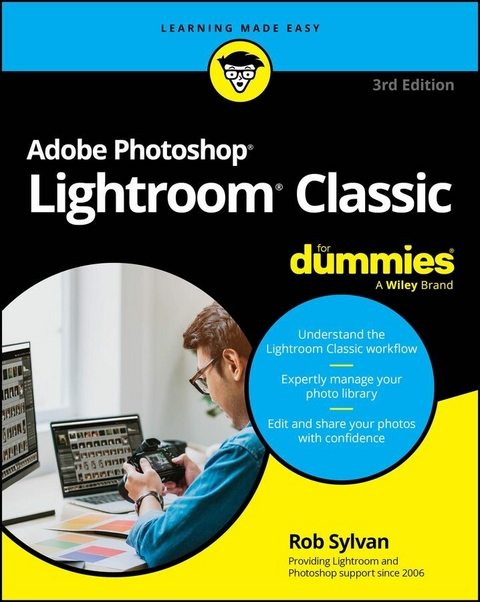
Adobe Photoshop Lightroom Classic For Dummies (eBook)
568 Seiten
For Dummies (Verlag)
978-1-394-28463-4 (ISBN)
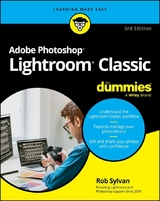
The most up-to-date manual for using Adobe's gold standard photo workflow software
Adobe Photoshop Lightroom Classic For Dummies is the perfect companion for photographers looking to make the most of this powerhouse software. Lightroom Classic lets you edit, organize, and share large volumes of digital photos, so you can spend less time in front of the computer and more time behind the lens. With this book, you'll learn the program's fundamentals and discover the latest features and updates'including improved Masking tools, AI-based tools, and the new Lens Blur feature. Discover the tools and processes that make the most sense for you, and get pro tips for taking your photos to the next level.
- Learn your way around the Lightroom Classic interface
- Expertly manage your photo library
- Edit and share your photos with confidence
- Make your photos even better with new editing tools
This popular Dummies guide is great for anyone who needs a primer on the essentials of Lightroom Classic for personal or professional use.
Rob Sylvan is a photographer, educator, and author. Rob has created tutorials found within the Lightroom desktop application, is a Canon Product Educator, and teaches at photography conferences such as Adobe MAX, Photoshop World, Lightroom Summit, and more.
The most up-to-date manual for using Adobe's gold standard photo workflow software Adobe Photoshop Lightroom Classic For Dummies is the perfect companion for photographers looking to make the most of this powerhouse software. Lightroom Classic lets you edit, organize, and share large volumes of digital photos, so you can spend less time in front of the computer and more time behind the lens. With this book, you'll learn the program's fundamentals and discover the latest features and updates'including improved Masking tools, AI-based tools, and the new Lens Blur feature. Discover the tools and processes that make the most sense for you, and get pro tips for taking your photos to the next level. Learn your way around the Lightroom Classic interface Expertly manage your photo library Edit and share your photos with confidence Make your photos even better with new editing tools This popular Dummies guide is great for anyone who needs a primer on the essentials of Lightroom Classic for personal or professional use.
Chapter 1
Getting to Know Adobe Photoshop Lightroom Classic
IN THIS CHAPTER
Understanding which version is right for you
Understanding the subscription model
Getting to know the Lightroom Classic interface
Preparing for installation
When I wrote the first edition of this book, the only product available was Adobe Photoshop Lightroom, and the iPhone had just been introduced. The intervening years have brought a boon to camera technology, mobile technology, software capabilities, and the Internet. Adobe has responded to these advances by spinning off a new version of the original Lightroom (while adding Classic to the old version) in a way that leverages the ubiquity of mobile devices, cloud storage, and always-connected Internet. This has resulted in more choice but also a bit of confusion.
In this chapter, I aim to clarify the key distinctions between the two versions of Lightroom to help you choose the version that is right for you. I encourage you to go back and read the book’s Introduction to get a big-picture view of how this book is organized and clarity on how I refer to the two versions of Lightroom throughout the book. To get some historical context on the evolution of Lightroom, I encourage you to read my blog post on Adobe’s original announcement of the new version: https://lightroomkillertips.com/new-lightroom-whole-new-ecosystem.
The Two Versions of Lightroom
At the time of this writing, Adobe provides two separate but similar programs with the name Lightroom in the title. In a nutshell, the key differences are that
- Lightroom Classic uses a catalog (more on that later) that is stored on your computer, which references photos that can be stored on your computer, an external drive, a network-attached storage device, or any combination of those local storage options. It has been evolving since 2007 and will feel most familiar to anyone who has used a previous version of Lightroom. Lightroom Classic is the main focus of this book.
- Lightroom stores everything (photos, information about the photos, and all adjustments) in the cloud (storage that is accessible only through an Internet connection and paid for through your Adobe Creative Cloud subscription), and by virtue of everything being stored in the cloud, you can access all your work from any device (laptop, desktop, tablet, or smartphone) that runs Lightroom (available for the macOS, Windows, iOS, and Android platforms). Because everything is stored in the cloud, you can even access your Lightroom photos from a web browser. Lightroom has fewer features than Lightroom Classic (although Adobe adds more all the time) and is designed for use in our always-connected mobile world. I introduce you to Lightroom in Part 5, where I explore how Lightroom on a mobile device can be a useful companion to Lightroom Classic.
This book focuses on Lightroom Classic because this version is the most mature of the two versions, has the most features, and doesn’t require an Internet connection to access your photos. In my view, Lightroom Classic is the most powerful version of Lightroom and makes the most sense for most people looking to manage a growing photo library over time. It also provides the greatest variety of output possibilities (prints, books, slideshows, web galleries, and more). Lightroom Classic is what I use, and I will continue to use it into the foreseeable future.
I don’t want you to think that I am not a fan of the new Lightroom; I am very excited about the opportunities it offers people who don’t need everything Lightroom Classic offers, who want a simpler interface, and who place a premium on being able to access their photo library from any laptop, desktop, or mobile device. In fact, I devote three chapters at the end of this book to Lightroom to help you see its potential. That said, if you want to use just Lightroom on all your devices, this is not the book for you. Because Lightroom is new and simpler and has far fewer features than Lightroom Classic, you can get by just fine using the web-based training from Adobe: https://helpx.adobe.com/lightroom-cc/tutorials.html.
Just about all of Adobe’s software has moved from a pay-one-price perpetual license model to a new subscription-based model, which Adobe calls the Creative Cloud (often shortened to CC). Both versions of Lightroom are available only through a subscription plan. Let’s dive into this topic a little deeper.
Understanding the Creative Cloud
Adobe coined the name Creative Cloud in 2011, but the term took on new meaning in 2013 when Adobe moved away from the old Creative Suite of products and made its flagship products (like Photoshop) available for licensing only through a monthly or annual subscription. All programs are still installed locally to your computer and function in the same way they always had; the only difference with the Creative Cloud (CC) is how you pay for the software.
While paying monthly or annually for the use of software may seem like a drag, Adobe has made it pretty affordable for photographers through the CC Photography Plan (more on that in the next section). The subscription model offers a few benefits, including the following:
- Access to the latest version of included software the moment Adobe releases it, without additional cost
- Periodic updates, which include new features as well as new camera support and bug fixes
- Able to be installed on as many computers as you own, although you can be logged into only two at a time
- Cross-platform compatible, so no special hoops to jump through if you have both a Mac and a Windows computer
The Creative Cloud subscription model provides a few benefits. Notably, Adobe frequently releases updates that include new features, new camera support, and bug fixes. With the subscription service, you can access these features immediately instead of waiting 18 to 24 months to see new features added.
There are a few CC plans to choose from, and due to the somewhat fluid nature of how these plans evolve, I’m going to direct you to Adobe’s website to read up on what’s included and the various prices. Head over to https://blog.adobe.com/en/publish/2024/12/15/all-new-photography-innovations-pricing-updates to learn more.
Considering the Creative Cloud Photography Plan
Within the various subscription options, the plan that makes the most sense for photographers who are new to Adobe subscriptions is the 1TB Photography Plan, which goes for $19.99/month and includes the latest versions of Lightroom Classic, Lightroom, and Photoshop, 1TB of online storage, and more (like a free online portfolio), so check the link in the preceding section to get the full understanding of recent changes to plan options.
Adobe Photoshop is the prime tool to complement Lightroom Classic and Lightroom. It gives you the most power and offers the greatest functionality and tightest integration with both versions of Lightroom. In fact, when you consider all the features in Lightroom Classic, you may find you don’t need anything else for most of your work.
Adobe also offers a Lightroom plan, which as of January 2025 is $11.99/month (or prepaid annually for $119.88/year to save $24 over paying monthly), and includes Lightroom and Lightroom Classic (but it doesn’t include Photoshop) and 1 terabyte (TB) of online storage (which is enough for hundreds of thousands of JPG photos). If you don’t ever plan on using Photoshop this could be a good option for using Lightroom Classic and Lightroom together.
From here, I assume that as a reader of Adobe Photoshop Lightroom Classic For Dummies, with a focus on Lightroom Classic, you have (or will be using) either plan that includes Lightroom Classic.
Figuring out whether Lightroom Classic is right for you
If you have used any older version of Lightroom in the past ten years, you will feel the most comfortable in Lightroom Classic. Due to its maturity as a software product, Lightroom Classic has substantially more features and capabilities than Lightroom, and this alone may be the deciding factor for some people. For example, Lightroom Classic has an entire module devoted to printing, and Lightroom has no local print function.
Lightroom Classic is best used if you have a high volume of photos stored in your library and plan to continue adding photos to that library. Lightroom Classic stores all your photos locally, so this is a much more affordable option for anyone with over 1TB of storage. Hard drives are relatively cheap, so adding more space to store more photos is affordable and easy.
Lightroom Classic plays nicely with third-party plug-ins. Let’s face it, you can find lots of outstanding photo editing programs out there from companies like On1, Topaz, DxO, and more. You can configure Lightroom Classic to send copies to these editors (and to Photoshop, too!) and have those copies automatically added back to Lightroom Classic.
If you like to create photo books, you will enjoy using Lightroom Classic’s Book module. If you need to create slideshows, check out Lightroom Classic’s Slideshow module. Lightroom Classic supports a high-volume workflow, so it has a greater array of output options for when you need to create copies for any reason.
Lightroom Classic and Lightroom share the same powerful...
| Erscheint lt. Verlag | 8.4.2025 |
|---|---|
| Sprache | englisch |
| Themenwelt | Informatik ► Grafik / Design ► Photoshop |
| Informatik ► Office Programme ► Outlook | |
| Schlagworte | Adobe Lightroom • Adobe PhotoShop • Adobe Photoshop Lightroom • Lightroom Classic • lightroom classic book 2025 • lightroom for dummies 2025 • lightroom photo editing software • photo editing • Photoshop Lightroom • photoshop lightroom book |
| ISBN-10 | 1-394-28463-2 / 1394284632 |
| ISBN-13 | 978-1-394-28463-4 / 9781394284634 |
| Informationen gemäß Produktsicherheitsverordnung (GPSR) | |
| Haben Sie eine Frage zum Produkt? |
 EPUB (Adobe DRM)
Kopierschutz: Adobe-DRM
Adobe-DRM ist ein Kopierschutz, der das eBook vor Mißbrauch schützen soll. Dabei wird das eBook bereits beim Download auf Ihre persönliche Adobe-ID autorisiert. Lesen können Sie das eBook dann nur auf den Geräten, welche ebenfalls auf Ihre Adobe-ID registriert sind.
Details zum Adobe-DRM
Dateiformat: EPUB (Electronic Publication)
EPUB ist ein offener Standard für eBooks und eignet sich besonders zur Darstellung von Belletristik und Sachbüchern. Der Fließtext wird dynamisch an die Display- und Schriftgröße angepasst. Auch für mobile Lesegeräte ist EPUB daher gut geeignet.
Systemvoraussetzungen:
PC/Mac: Mit einem PC oder Mac können Sie dieses eBook lesen. Sie benötigen eine
eReader: Dieses eBook kann mit (fast) allen eBook-Readern gelesen werden. Mit dem amazon-Kindle ist es aber nicht kompatibel.
Smartphone/Tablet: Egal ob Apple oder Android, dieses eBook können Sie lesen. Sie benötigen eine
Geräteliste und zusätzliche Hinweise
Buying eBooks from abroad
For tax law reasons we can sell eBooks just within Germany and Switzerland. Regrettably we cannot fulfill eBook-orders from other countries.
aus dem Bereich