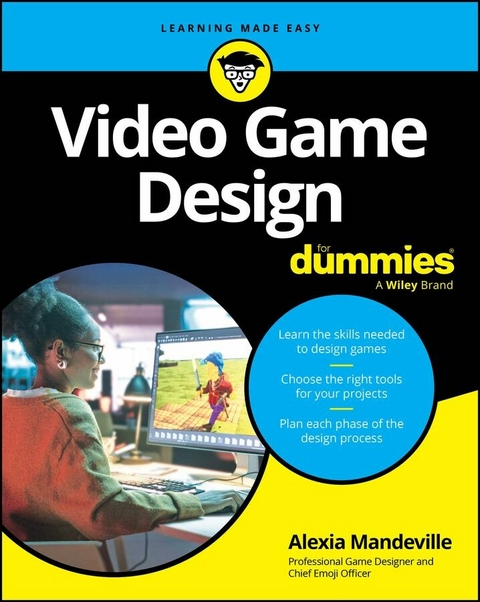
Video Game Design For Dummies (eBook)
449 Seiten
For Dummies (Verlag)
978-1-394-30818-7 (ISBN)

Learn what it takes to design a video game, as a hobby or as a career!
Video Game Design For Dummies teaches you what it takes to design games from concept to completion. You'll learn the theory behind great gaming experiences, and you'll discover tools you can use to bring your game ideas to life. An experienced video game developer teaches you the basics of game design and how to motivate and engage players. Choose the right game engines and design tools for any project and get step-by-step advice on testing and debugging the games you've made.
Thinking of pursuing game design as a career path and want to know where to start? This Dummies guide has your back. With this easy-to-understand book, you can dip your toes into the world of video game design and see where it takes you. And if you end up wanting to release your game to the masses, you'll find everything you need to know, right here.
- Learn the step-by-step process video game designers use to create great games
- Design characters, worlds, and storylines that will keep players engaged
- Pick a game engine that's right for you and plan out your game development process
- Playtest your video game, then publish it and market it on social media
This book is a practical guide for beginners who want to start designing games and want to know exactly where to begin. Design a game from concept to completion, with Video Game Design for Dummies.
Alexia Mandeville is a co-founder and game designer at Bodeville, an independent studio creating narrative games. She's an Assistant Professor of Game Design at ArtCenter College of Design, a private university in Pasadena, California. She's a former Game Designer at Niantic and Meta.
Learn what it takes to design a video game, as a hobby or as a career! Video Game Design For Dummies teaches you what it takes to design games from concept to completion. You'll learn the theory behind great gaming experiences, and you'll discover tools you can use to bring your game ideas to life. An experienced video game developer teaches you the basics of game design and how to motivate and engage players. Choose the right game engines and design tools for any project and get step-by-step advice on testing and debugging the games you've made. Thinking of pursuing game design as a career path and want to know where to start? This Dummies guide has your back. With this easy-to-understand book, you can dip your toes into the world of video game design and see where it takes you. And if you end up wanting to release your game to the masses, you'll find everything you need to know, right here. Learn the step-by-step process video game designers use to create great games Design characters, worlds, and storylines that will keep players engaged Pick a game engine that's right for you and plan out your game development process Playtest your video game, then publish it and market it on social media This book is a practical guide for beginners who want to start designing games and want to know exactly where to begin. Design a game from concept to completion, with Video Game Design for Dummies.
Chapter 1
Introducing the Art of Game Design
IN THIS CHAPTER
Learning what game design is
Thinking like a game designer
Overviewing how game design became more accessible
Leaning into the fun
Making your first game
I’m so excited for you to dive into this book, break down the mysteries of game design, and maybe even start working on your own game. Maybe you’re just getting started or maybe you’re already deep into a project. Either way, this chapter can help you understand what game design really is, how it’s evolved, and how you can use it to design your games.
Discovering What Game Design Is
When I think back to all the work I’ve done on games and the work I see my colleagues doing, it’s clear that being a game designer means wearing a lot of hats. Sure, most jobs require a mix of skills, but a game designer is kind of like the general manager in construction. You need to know a little bit about a lot of different things. And the things you need to know differ from genre to genre. Because every genre has its unique elements, many game designers specialize in one area, like level design or progression, and build their expertise from there.
Game design is making a thousand little decisions that add up to one amazing experience, like the following:
- Tweaking how many items drop from a chest
- Deciding why some items are rare and making them feel special and hard to get
- Designing levels that guide players without them realizing they’re being guided
- Balancing abilities so that no one character or strategy dominates the game
- Writing lore that makes players care about the world and its characters
- Mapping out progression systems that keep players coming back for “just one more level”
- Deciding how fast a character runs and how high they jump
- Choosing the perfect sound effect for picking up a coin
- Testing and re-testing mechanics until they feel “just right”
- Creating tutorials that teach without boring or frustrating players
- Ensuring that the game is accessible so everyone can play and enjoy it
- Crafting choices that make players stop and think about the consequences
When someone takes on the role of a game designer, they are responsible for orchestrating all these decisions, building frameworks to guide them, and crafting systems that streamline the decision-making process. See Chapter 4 for more about what it takes to become a game designer.
Looking at a Brief History of Game Design
I frame this section around notable moments in history when game design and development became more accessible and how these changes shaped the way we make and play games, working back from today. I stick to the last 30ish years or so, just because the internet became mainstream and available in many U.S. households in that time frame. Ever since then, games have been growing at an exponential rate.
As of 2025, it’s incredibly simple to get started in game design. You can download game engines like Unity, Unreal Engine, or Godot for free access resources like free asset libraries, and learn new skills through platforms like YouTube.
Software like Blender (a free tool for 3-D modeling) or Procreate (for digital art) allows creators to produce their own assets, and platforms like Itch.io let anyone publish games for free, often within minutes. And once you publish a game, social media lets you promote it to people who may want to play it. The barriers to entry for game design today are time, practice, and dedication rather than expensive tools or access to industry secrets and publishers.
The result is an explosion of creativity and people who publish games:
- More than 89,000 games were published on Steam as of January 2025.
- Thousands of genres and user-generated tags describe a diverse array of experiences, from “frog detective mysteries” to “farming horror simulators.”
The democratization of tools and knowledge enables everyone to shape the industry, instead of a select few dictating what games are. Just like you can take many different paths to make a game, you also can define what a game is in many different ways. At the time that I’m writing this, the industry is having a difficult time. Many companies are doing layoffs, and larger projects are having trouble getting funded. But making games on your own and sending them off into the world has never been more accessible.
Time to go back in time, starting with 2016:
- 2016: Pokémon GO was released, which was a global hit. This game took advantage of what mobile phones have to offer like most other games hadn’t: portability to explore the world and their camera. Ingress, the game made by Niantic prior to Pokémon GO, has done this as well, but adding in Pokémon was lightning in a bottle for Niantic. For me, Pokémon GO inspired me to focus my graduate work on augmented reality (AR) and map-based mobile gaming. I eventually got to work with some of the people who made the first version of Pokémon GO when I designed Peridot at Niantic, a fortunate time in my career.
- 2014: Facebook (now Meta) acquired Oculus, making VR a mainstream focus for tech and gaming. This acquisition has since really changed the VR landscape! For example, I was in a Target the other day and walked past an aisle end cap holding new Quests for sale. You never would have seen that in 2014. Alongside their hardware efforts, tools like Horizon Worlds and other accessible VR platforms are making it easier for smaller teams to experiment with VR and AR game design with a built-in audience.
- 2013: The launch of the PS4 and Xbox One gave indie developers easier access to console publishing thanks to digital storefronts like the PlayStation Store and Xbox Live Arcade. However, to this day, some friction exists in publishing on consoles due to factors such as platform-specific certification processes, higher development costs for console-ready builds, and strict licensing agreements. Additionally, console publishers often require developers to secure development kits, which can be expensive or difficult for people to access.
- 2010s: Kickstarter, a crowdsourcing platform for new products, took off. This enabled board game designers and video game designers to post their game online and get some funding to work on their game. Big games like Cards Against Humanity came from Kickstarter. And it wasn’t until 2012 that Oculus launched its first Kickstarter for the Oculus Rift, sparking widespread interest in virtual reality (VR) gaming.
- 2009: People became more aware that a small team or even a solo developer could release something that could become huge when they saw Minecraft. The developer, Notch, became a great example of a solo developer who achieved global success with a release on the internet.
-
2007: The launch of the iPhone and the App Store introduced a new era of mobile gaming. It wasn’t until 2009 that some mobile games become phenomena like Angry Birds and Fruit Ninja. Mobile phones also introduced the free-to-play (F2P) model, allowing developers to monetize games through in-app purchases and ads, which is now big business.
Also in 2007, Facebook opened its platform to developers, leading to the rise of social games like FarmVille (2009) and Mafia Wars by Zynga. These games pioneered new ways of engaging players through social mechanics and microtransactions.
- 2003: Valve did something really big and launched Steam. This made it easier for indies to release their games alongside all the larger studios out there. Back in those days, there were way fewer games being published on Steam. A year after release in 2004, only 65 games were published. But, obviously, that took off between then and now!
- 1990s: Last, but certainly not least, the internet became accessible to lots of households in the United States. Dial-up became the standard for home internet connections, using telephone lines to connect to the internet. This enabled games to be created and shared with people outside of your household without a publisher. Dial-up began to decline in the 2000s with broadband internet, but I’ll never forget all the times my friends were over at my house playing some game we found on the internet, hogging the phone line from my parents.
Trekking back to today, top genres of games include open-world role playing games like The Witcher and cozy games like Stardew Valley. There’s been a rise in more niche genres in the last few years such as narrative-driven indie games like Disco Elysium, and experimental puzzle games like Gorogoa.
In the future, and with technology like AI and social platforms progressing, we can look forward to more dynamic gameplay, more cross-platform experiences, and better tools to empower both game creators and players/streamers.
You can learn a lot from the history of games and game development. I like to work on the beginning bits of a game and get it off the ground, so understanding how other teams started and what games looked like in the early part of their life has helped me set expectations for development and scope. Games like World of Warcraft (WoW) may be huge now,...
| Erscheint lt. Verlag | 8.4.2025 |
|---|---|
| Sprache | englisch |
| Themenwelt | Mathematik / Informatik ► Informatik ► Grafik / Design |
| Informatik ► Office Programme ► Outlook | |
| Schlagworte | Computer game design • Game Design • game development dummies • Game Programming • game storyboarding • how to make a video game • make roblox • making video games • video game career • video game design • Video Game Developer • video game software |
| ISBN-10 | 1-394-30818-3 / 1394308183 |
| ISBN-13 | 978-1-394-30818-7 / 9781394308187 |
| Informationen gemäß Produktsicherheitsverordnung (GPSR) | |
| Haben Sie eine Frage zum Produkt? |
 EPUB (Adobe DRM)
Kopierschutz: Adobe-DRM
Adobe-DRM ist ein Kopierschutz, der das eBook vor Mißbrauch schützen soll. Dabei wird das eBook bereits beim Download auf Ihre persönliche Adobe-ID autorisiert. Lesen können Sie das eBook dann nur auf den Geräten, welche ebenfalls auf Ihre Adobe-ID registriert sind.
Details zum Adobe-DRM
Dateiformat: EPUB (Electronic Publication)
EPUB ist ein offener Standard für eBooks und eignet sich besonders zur Darstellung von Belletristik und Sachbüchern. Der Fließtext wird dynamisch an die Display- und Schriftgröße angepasst. Auch für mobile Lesegeräte ist EPUB daher gut geeignet.
Systemvoraussetzungen:
PC/Mac: Mit einem PC oder Mac können Sie dieses eBook lesen. Sie benötigen eine
eReader: Dieses eBook kann mit (fast) allen eBook-Readern gelesen werden. Mit dem amazon-Kindle ist es aber nicht kompatibel.
Smartphone/Tablet: Egal ob Apple oder Android, dieses eBook können Sie lesen. Sie benötigen eine
Geräteliste und zusätzliche Hinweise
Buying eBooks from abroad
For tax law reasons we can sell eBooks just within Germany and Switzerland. Regrettably we cannot fulfill eBook-orders from other countries.
aus dem Bereich