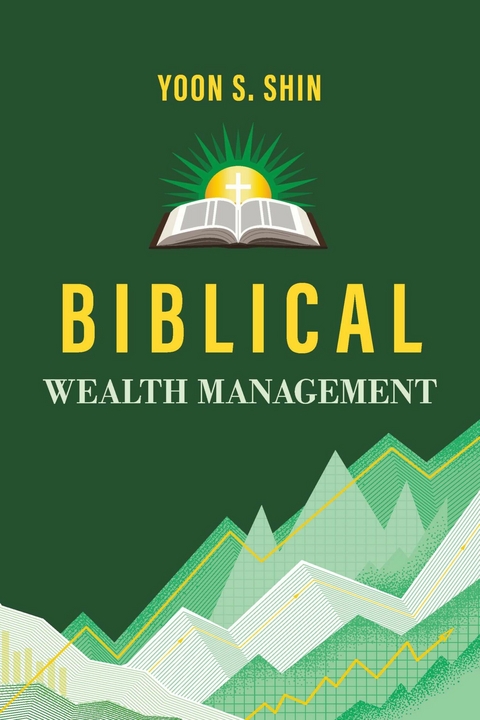
Biblical Wealth Management (eBook)
188 Seiten
Bookbaby (Verlag)
979-8-3509-9385-1 (ISBN)
Yoon S. Shin, PhD Dr. Shin is a Professor of Finance at the Sellinger School of Business and Management at Loyola University Maryland. He is the endowed Travelers Faculty Scholar in Finance and has received several academic scholarship awards, including the FMA (Financial Management Association) Best Paper Award in Fixed Income Research. Dr. Shin has taught Fixed Income securities, Financial Modeling, Financial Institutions and Markets, Investment, and other finance courses in graduate and undergraduate programs for over twenty years. His research focuses on fixed-income securities, corporate governance, and wealth management. Dr. Shin has published his research in academic finance journals such as Financial Management, Journal of Banking and Finance, and Journal of Financial Markets, as well as practical finance journals such as Journal of Fixed Income and Journal of Wealth Management. He received a Ph.D. in Finance from the University of South Carolina. Since 2022, Dr. Shin has taught an 8-week biblical wealth management seminar twice a year at the Church of Philippi in Maryland, USA, of which most members are Korean American immigrants. The seminar is aimed at financial literacy. He also wrote the Korean version of this book, 'Biblical Investment,' to help educate Koreans.
This book uses Bible verses to present the following principles and strategies of biblical wealthmanagement. Invest in public companies where ownership and management are separate. Make a long-term investment with a minimum of 10 years. Apply the principles of asset diversification and time diversification. Do not borrow money to invest. Invest in financial assets with periodic cash flows that can earn compound interest. Invest in pooled financial assets such as mutual funds or exchange-traded funds. Buy index funds in regular intervals to maximize the effect of time diversification. Choose to invest rather than save. Invest in sound businesses. Do not rely on speculation. Maximize earned income in the workplace and invest a portion of the earned income forretirement. Equip with vision and mission from Biblical perspectives and arm oneself with Biblicalwork ethics to maximize earned income. Additionally, this book explains the difference between saving, investing, and speculatingthrough a biblical lens and describes diverse savings instruments. It defines speculation andwarns that buying and selling speculative assets can drive one into poverty, destroying oneselfand one's family. Moreover, this book explains retirement plans such as 401(k) and Roth IRA andteaches how to create private pensions to prepare for the 20% cut of Social Security benefits in2034, when the Social Security Trust Funds will be exhausted. The purpose of biblical wealth management is to be a channel of blessing for Christians throughbiblical investing. According to the Ten Commandments and Matthew 22:36-40, the core valuesof the Bible are love of God and love of neighbor. We often need money to practice love ofneighbor. When we are young, we can use the income we earn from our jobs to help ourneighbors. In retirement, we can use our investment income to help our neighbors. From abiblical perspective, this book teaches us how to maximize earned and investment income. Existing devotional books on finances mainly focus on managing income and spending, includingtithing. They mainly teach Christians to have good biblical values about money. This book, on the other hand, is the first on biblical investing and retirement planning. It'spractical and applicable to real life. This book is a product of interdisciplinary studies betweentheology and finance. The time in which the Bible was written was an agrarian society that required the labor of theentire family. Thus, there was no retirement age. However, in the case of the prophet Isaiah, heretired and established a prophet's school in his hometown of Ramah Nahor (1 Samuel 19:18-24) to train disciples. He required great wealth to provide for his disciples. After retirement, ahealthy Christian should be able to fulfill the ministry God has given them in the second act oflife for more than 20 years, according to current life expectancy. This book can help us preparefinancially for our ministry after retirement. If we do not invest while still earning, we will havefinancial hardship in retirement, making it challenging to fulfill the ministry. Since the Bible was written so long ago, some people say that its teachings are outdated andunappealing to modern life. Of course, I do not think many of these people have read andstudied the Bible correctly. Most churches today emphasize personal salvation over socialsalvation. In this book, I will discuss the incredible power of social salvation through Biblicalwealth management.
Chapter 1
Secrets of Biblical Wealth Management
The difference between saving, investing, and speculating
Before I explain the principles and strategies of Biblical wealth management, I will define some essential terms. First, let us discuss the types of assets and the differences between savings, investments, and speculations. In accounting, an asset is defined as the sum of liabilities and equity. For example, if I buy a home with a market value of $500,000 with a combination of $100,000 of my own money (equity) and $400,000 in mortgage loans (liabilities), I can say that I have $500,000 in assets.
Christians have two types of assets: visible and invisible. The invisible assets are faith and prayer. Christians can overcome any financial difficulty or hardship with prayers. The greatest asset that Jesus left for Christians is the Lord’s Prayer (Matthew 6:9-13).
Visible assets can be categorized into Real Assets, Financial Assets, and Digital Assets. Real Assets are assets that have intrinsic value and tangibility, such as gold, real estate, and commodities, while financial assets are intangible, such as cash, savings, stocks, bonds, and mutual funds. Financial assets are said to be claims on real assets. The 21st century has given rise to cryptocurrencies, including Bitcoin, called Digital Assets. Digital assets have no intrinsic value.
Next, we will examine the differences between saving, investing, and speculating. Saving is holding an asset that is principal-guaranteed and whose future value will increase over its principal because of interest income. The principal is the original amount of investment. When we save, the future value of the asset will be greater than the principal.
When it comes to savings, there is no material distinction between short-term and long-term. Bank deposits and savings accounts are typical short-term savings instruments. Examples of typical short-term savings include money we cannot afford to lose, such as college tuition or a down payment for home purchases. Social security is an essential long-term savings vehicle. Social security is the best way to hedge against the risk of inflation.
In the book of Genesis, we see an example of Noah building an ark and storing food for his family and animals during the flood (Genesis 6:21). The Bible does not say how long Noah spent building the ark. Still, it is estimated that it took him more than 10 years because he needed a lot of food. In Genesis 41:14-57, we read about Joseph becoming prime minister of Egypt and overcoming seven years of famine by saving about 20% of the harvest each year during the seven years of good harvest. Joseph’s story exemplifies how a nation can overcome hardship by saving.
Investing is the long-term holding of financial assets with no guarantee of principal but with an expected return higher than savings. When we invest, we must consider risk. Risk is the possibility that our return will be less than our principal. If there is an economic downturn, such as the 2007-2008 financial crisis, it can take as long as five years, or longer, to recover. Studies have shown that long-term investing in financial assets for 10 years or more can help us avoid losing our principal. Biblical investment is limited to financial assets. My opinions on Biblical investment are specific to investment for individuals in financial assets. Investment for corporations or financial institutions is different from investment for individuals and is not covered in this book.
Speculation is the buying and selling of assets to make a quick profit. Individuals who speculate want to get rich quick and subject themselves to serious risk. They do not care what kind of asset they are speculating on, whether it is real or digital, and they tend to use the money they make to fulfill their personal desires. I will cover investments and speculative products in more detail later.
Risk is the volatility of an investment’s return, and the greater the risk, the higher the probability of losing the principal. This volatility is commonly measured by the standard deviation of the returns of an asset. Standard deviation measures the deviation of the returns of an asset relative to its average return. Higher standard deviation means greater risk. When investing in securities, to lower volatility, we should invest in multiple assets with low correlation in returns, which is called diversification. When calculating one-year period of a stock return, we combine the price appreciation with dividend payments. Price appreciation is the increase in the value of a stock over the period. Dividends are the portion of a company’s profits that is paid to its shareholders. Regarding the one-year period of a bond return, we add the price appreciation to interest payments. A bond is a long-term debt.
The book of Matthew contains more parables than any other gospel. Jesus spoke to his disciples and the crowds in parables because he wanted to reveal in due time the things that have been hidden from the foundation of the world (Matthew 13:34-35; John 16:25). Of all the parables in Matthew’s gospel, the one most often quoted in sermons is the parable of the talents in Matthew 25:14-30. Matthew 25:14-30 is quoted below from the English New International Version (NIV) published.
14 “Again, it will be like a man going on a journey, who called his servants and entrusted his property to them.
15 To one he gave five talents of money, to another two talents, and to another one talent, each according to his ability. Then he went on his journey.
16 The man who had received the five talents went at once and put his money to work and gained five more.
17 So also, the one with the two talents gained two more.
18 But the man who had received the one talent went off, dug a hole in the ground and hid his master’s money.
19 “After a long time the master of those servants returned and settled accounts with them.
20 The man who had received the five talents brought the other five. ‘Master,’ he said, ‘you entrusted me with five talents. See, I have gained five more.’
21 “His master replied, ‘Well done, good and faithful servant! You have been faithful with a few things; I will put you in charge of many things. Come and share your master’s happiness!’
22 “The man with the two talents also came. ‘Master,’ he said, ‘you entrusted me with two talents; see, I have gained two more.’
23 “His master replied, ‘Well done, good and faithful servant! You have been faithful with a few things; I will put you in charge of many things. Come and share your master’s happiness!’
24 “Then the man who had received the one talent came. ‘Master,’ he said, ‘I knew that you are a hard man, harvesting where you have not sown and gathering where you have not scattered seed.
25 So I was afraid and went out and hid your talent in the ground. See, here is what belongs to you.’
26 “His master replied, ‘You wicked, lazy servant! So you knew that I harvest where I have not sown and gather where I have not scattered seed?
27 Well then, you should have put my money on deposit with the bankers, so that when I returned, I would have received it back with interest.
28 “ ‘So take the talent from him and give it to the one who has the ten talents.
29 For everyone who has will be given more, and he will have an abundance. Whoever does not have, even what he has will be taken from him.
30 And throw that worthless servant outside, into the darkness, where there will be weeping and gnashing of teeth.’
Principles and Strategies of Biblical Wealth Management
In Matthew 25:14-30, one talent in Roman times was worth about 27 kilograms of gold, a huge amount of money, equivalent to about 16 years of wages for a single adult at the time. Let us use the words written in Matthew 25:14-30 to illustrate the principles and strategies of investing.
The first principle is that the Bible teaches us to invest in joint stock companies listed in stock exchanges where ownership and management are separate. In the text, the servant is a steward who manages the master’s possessions. The parable of the steward is also found in Luke 16:1-13, where the master represents God, and we are merely stewards who temporarily manage God’s property in this world.
The centerpiece of modern capitalism is the joint-stock corporation. The owners of a corporation are the shareholders, and the managers are merely stewards who manage the company that belongs to the shareholders. Managers who perform poorly or defraud their owners are removed from power through a shareholder meeting. Listed shares are traded daily, in real-time on the stock market, so if we need cash, we can sell our shares immediately. The government also requires listed companies to disclose their financial statements and business performance to investors regularly to protect them. Therefore, listed public companies are more transparent than private companies.
The second strategy is long-term investment. In verse 14 of the text, we see the phrase “a man going on a journey,” since transportation was not developed in Roman times, traveling to another country...
| Erscheint lt. Verlag | 1.1.1900 |
|---|---|
| Sprache | englisch |
| Themenwelt | Mathematik / Informatik ► Informatik ► Netzwerke |
| ISBN-13 | 979-8-3509-9385-1 / 9798350993851 |
| Informationen gemäß Produktsicherheitsverordnung (GPSR) | |
| Haben Sie eine Frage zum Produkt? |
 EPUB (Ohne DRM)
Größe: 628 KB
Digital Rights Management: ohne DRM
Dieses eBook enthält kein DRM oder Kopierschutz. Eine Weitergabe an Dritte ist jedoch rechtlich nicht zulässig, weil Sie beim Kauf nur die Rechte an der persönlichen Nutzung erwerben.
Dateiformat: EPUB (Electronic Publication)
EPUB ist ein offener Standard für eBooks und eignet sich besonders zur Darstellung von Belletristik und Sachbüchern. Der Fließtext wird dynamisch an die Display- und Schriftgröße angepasst. Auch für mobile Lesegeräte ist EPUB daher gut geeignet.
Systemvoraussetzungen:
PC/Mac: Mit einem PC oder Mac können Sie dieses eBook lesen. Sie benötigen dafür die kostenlose Software Adobe Digital Editions.
eReader: Dieses eBook kann mit (fast) allen eBook-Readern gelesen werden. Mit dem amazon-Kindle ist es aber nicht kompatibel.
Smartphone/Tablet: Egal ob Apple oder Android, dieses eBook können Sie lesen. Sie benötigen dafür eine kostenlose App.
Geräteliste und zusätzliche Hinweise
Buying eBooks from abroad
For tax law reasons we can sell eBooks just within Germany and Switzerland. Regrettably we cannot fulfill eBook-orders from other countries.
aus dem Bereich