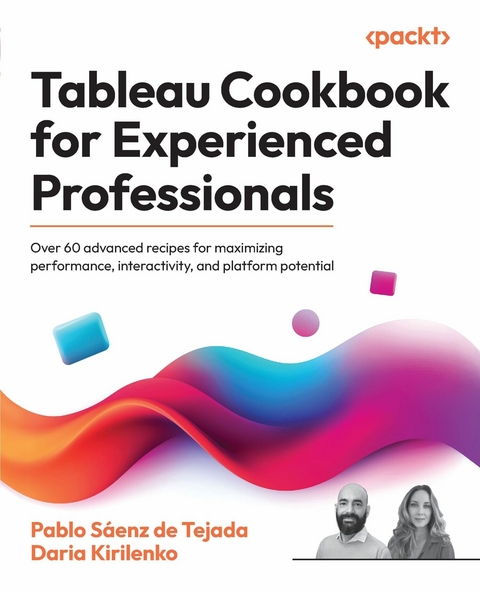
Tableau Cookbook for Experienced Professionals (eBook)
372 Seiten
Packt Publishing (Verlag)
978-1-83546-754-1 (ISBN)
In today's data-driven business world, advanced analytics set organizations apart. Basic visualizations no longer suffice for Tableau developers tackling complex data challenges. Written by Tableau experts who've trained Fortune 500 companies and led global analytics initiatives, this cookbook delivers battle-tested techniques with the perfect blend of technical depth and practical application.
You'll master advanced techniques such as geospatial analysis, data modeling for optimized workflows, and enterprise-scale content management. This book shows you how to leverage Tableau cloud's Data Management capabilities to centralize data sources and ensure data quality for consistent analytics. You'll also explore advanced management features such as the Content Migration Tool in Tableau 2025.1 and beyond.
Bridging the gap between fundamentals and cutting-edge practices, this book extends Tableau's capabilities with APIs, custom LOD expressions, virtual connections, data apps, and TabPy. You'll gain the skills to solve complex business problems, create high-impact dashboards, and seamlessly integrate Tableau into your data strategy, all while adhering to security and governance best practices.
*Email sign-up and proof of purchase required
Push beyond conventional Tableau by mastering advanced geospatial capabilities, unlocking API potential, and fortifying corporate data infrastructure with industry-leading best practicesKey FeaturesTransform dashboards into data apps that drive instant business decisionsBuild robust data models that scale with your dataExtend Tableau with developer tools to automate tasks and integrate with external systemsPurchase of the print or Kindle book includes a free PDF eBookBook DescriptionIn today's data-driven business world, advanced analytics set organizations apart. Basic visualizations no longer suffice for Tableau developers tackling complex data challenges. Written by Tableau experts who've trained Fortune 500 companies and led global analytics initiatives, this cookbook delivers battle-tested techniques with the perfect blend of technical depth and practical application. You ll master advanced techniques such as geospatial analysis, data modeling for optimized workflows, and enterprise-scale content management. This book shows you how to leverage Tableau cloud s Data Management capabilities to centralize data sources and ensure data quality for consistent analytics. You ll also explore advanced management features such as the Content Migration Tool in Tableau 2025.1 and beyond. Bridging the gap between fundamentals and cutting-edge practices, this book extends Tableau s capabilities with APIs, custom LOD expressions, virtual connections, data apps, and TabPy. You ll gain the skills to solve complex business problems, create high-impact dashboards, and seamlessly integrate Tableau into your data strategy, all while adhering to security and governance best practices. This isn t just another Tableau cookbook it s your blueprint for mastering the platform and driving meaningful data-powered transformation. What you will learnBuild advanced, high-performing Tableau data models and tablesTackle data complexities with LOD expressions and table calculationsLeverage zone visibility to build interactive and user-friendly dashboardsOptimize workbook performance for improved user experienceAnalyze geospatial data with map layers, shapefiles, and spatial joinsDevelop a deeper understanding of Tableau's REST API capabilitiesUse Tableau's order of operations to troubleshoot calculationsAdopt industry-standard best practices to secure corporate data assetsWho this book is forThis cookbook is for Tableau professionals,developers, BI administrators, and data analysts ready to explore advanced techniques and deepen their expertise. To make the most of this book, you should either have intermediate to advanced experience with Tableau Desktop and its core functionalities. If you re coming from another BI background, this book will prove invaluable as it demonstrates Tableau s real-world applications. Familiarity with products such as Tableau Cloud and Tableau Server is beneficial, but not a prerequisite for using this book.]]>
Preface
Data is the foundation of modern decision-making. Organizations that effectively harness data rely on it to drive strategy, measure performance, and uncover new opportunities. Tableau has played a transformative role in democratizing data, giving analysts, business leaders, and decision-makers a powerful, intuitive platform to visualize and explore insights. However, as Tableau deployments grow in scale and complexity, businesses often struggle with performance bottlenecks, governance issues, and the need for deeper analytical capabilities.
This book is designed for those who want to stay ahead of the curve. It goes beyond the fundamentals, offering a deep dive into the strategies, techniques, and innovations that will transform the way you build, optimize, and deploy Tableau solutions.
The Tableau Cookbook for Experienced Professionals begins by exploring scalable data architecture and security, ensuring your Tableau environment is not only efficient but also future-proofed for enterprise-level use.
From there, it delves into performance mastery, teaching you how to fine-tune calculations, optimize rendering speeds, and leverage Tableau’s built-in diagnostic tools.
Then, it shifts the focus to interactive analytics, exploring advanced dashboard actions, dynamic zone visibility, and parameter-driven visualizations that create an intuitive, seamless user experience.
Finally, it takes a developer-focused approach, pushing the limits of Tableau through APIs, geospatial techniques, and advanced automation, turning dashboards into fully-fledged data applications.
Whether you’re a consultant, analyst, or business leader, this book will equip you with the real-world, practical skills to drive measurable impact with Tableau, transforming dashboards into decision-making engines that shape business outcomes.
Welcome to the next step in your Tableau journey. Let’s get started!
Who this book is for
This cookbook is tailored for Tableau professionals, BI administrators, developers, and data analysts eager to deepen their expertise and explore advanced techniques:
- Tableau professionals: Individuals with a good grasp of Tableau Desktop who are eager to expand their knowledge with more complex and sophisticated Tableau methods
- BI administrators: Experienced BI administrators who want to expand their knowledge of Tableau’s advanced features and learn how to manage and optimize Tableau environments effectively
- Developers: Developers looking to refine their Tableau skills and implement advanced strategies for building scalable and efficient data applications
- Data analysts: Analysts looking to boost their proficiency with Tableau and apply advanced methods to address common business challenges
What this book covers
Chapter 1, Building Advanced and Efficient Tableau Data Models, provides an overview of how to create robust data models by leveraging logical and physical tables, optimizing relationships, and using multi-fact models. It also covers the differences between Tableau Desktop and Tableau Prep for various data preparation and modeling tasks.
Chapter 2, Managing Content and Security at Scale in Tableau, provides an overview of how to enable users to connect to data and share insights while maintaining security, scalability, and governance. It introduces various techniques for securing data and managing content to improve user trust and adoption on the Tableau platform.
Chapter 3, Leveraging Tableau Cloud’s Data Management and Advanced Management, offers an overview of Tableau’s Data Management and Advanced Management features, emphasizing their role in simplifying content management at scale and improving data governance. It then dives into the key features of the Content Migration Tool, Metadata API, and virtual connections, providing a thorough understanding of how these tools centralize data access and optimize data management processes.
Chapter 4, Maximizing Workbook Performance, provides a comprehensive framework for optimizing workbook performance in Tableau. It introduces best practices to address performance bottlenecks, improve data structures, and streamline calculations, to ensure high performance and greater user engagement.
Chapter 5, Mastering Advanced Calculations to Answer Complex Business Questions, provides an in-depth exploration of Tableau’s calculation types, highlighting their critical role in creating customized metrics and refining data for more insightful analysis. It uses practical examples to solve complex data scenarios with table calculations, Level of Detail (LOD) expressions, and the order of operations framework.
Chapter 6, Creating Interactive Dashboards, focuses on exploring different types of actions in Tableau worksheets and dashboards, such as filter, highlight, parameter, and set actions. It provides practical examples and techniques for using these actions to build advanced, interactive tools that empower users to engage with data in new ways.
Chapter 7, Interactivity and Zone Visibility: From Dashboards to Data Apps, focuses on transforming traditional dashboards into more user-friendly data applications by using features such as Dynamic Zone Visibility (DZV) and interactivity. It demonstrates how to apply DZV and guided analytics to create flexible, dynamic data apps that improve user experience and communication of insights.
Chapter 8, Advanced Geospatial and Mapping Use Cases, demonstrates how to integrate spatial data with traditional analysis to create more insightful visualizations. It covers key spatial functionalities such as working with multiple map layers, performing spatial calculations, and handling Shapefiles to address location-based business questions with practical examples and challenging use cases.
Chapter 9, Extending Tableau with Developer Tools and APIs, offers an overview of how Tableau can be extended using developer tools and APIs to automate tasks, integrate with external systems, and manage resources more efficiently. It covers key features such as using Tableau’s REST API for maintenance task automation, Python and R integration, Metadata API GraphQL, and VizQL Data Service for more powerful data management and unique visualization requirements.
Chapter 10, Core Techniques for Impactful Data Design, focuses on the core principles and best practices for designing impactful dashboards that deliver strategic insights and real value. It explores the basics of audience-centric design, color usage, and the importance of creating a style guide to maintain visual consistency. Additionally, the chapter covers how to create advanced tables, highlighting their role in adding sophistication and depth to your dashboards.
To get the most out of this book
| Software/hardware covered in the book | OS requirements |
| Tableau Desktop 2025.1 or later | Microsoft Windows 8/8.1, Windows 10 (x64), or Windows 11 macOS Big Sur 11.4+, macOS Monterey 12.6+ (for Tableau 2022.3+), macOS Ventura (for Tableau 2022.3+), macOS Sonoma (for Tableau 2022.3+); Apple Silicon machines require the use of macOS Ventura (13+) or newer |
| Tableau Cloud |
| Python version 3.9 to 3.12. |
| R version 4.4.3 |
If you are using the digital version of this book, we advise you to type the code yourself or access the code via the GitHub repository (link available in the next section). Doing so will help you avoid any potential errors related to the copying and pasting of code.
Download the example code files
You can download the example code files for this book from GitHub at https://github.com/PacktPublishing/Tableau-Cookbook-for-Experienced-Professionals. In case there’s an update to the code, it will be updated on the existing GitHub repository.
We also have other code bundles from our rich catalog of books and videos available at...
| Erscheint lt. Verlag | 25.4.2025 |
|---|---|
| Sprache | englisch |
| Themenwelt | Mathematik / Informatik ► Informatik ► Office Programme |
| Informatik ► Theorie / Studium ► Künstliche Intelligenz / Robotik | |
| ISBN-10 | 1-83546-754-7 / 1835467547 |
| ISBN-13 | 978-1-83546-754-1 / 9781835467541 |
| Informationen gemäß Produktsicherheitsverordnung (GPSR) | |
| Haben Sie eine Frage zum Produkt? |
 EPUB (Ohne DRM)
Digital Rights Management: ohne DRM
Dieses eBook enthält kein DRM oder Kopierschutz. Eine Weitergabe an Dritte ist jedoch rechtlich nicht zulässig, weil Sie beim Kauf nur die Rechte an der persönlichen Nutzung erwerben.
Dateiformat: EPUB (Electronic Publication)
EPUB ist ein offener Standard für eBooks und eignet sich besonders zur Darstellung von Belletristik und Sachbüchern. Der Fließtext wird dynamisch an die Display- und Schriftgröße angepasst. Auch für mobile Lesegeräte ist EPUB daher gut geeignet.
Systemvoraussetzungen:
PC/Mac: Mit einem PC oder Mac können Sie dieses eBook lesen. Sie benötigen dafür die kostenlose Software Adobe Digital Editions.
eReader: Dieses eBook kann mit (fast) allen eBook-Readern gelesen werden. Mit dem amazon-Kindle ist es aber nicht kompatibel.
Smartphone/Tablet: Egal ob Apple oder Android, dieses eBook können Sie lesen. Sie benötigen dafür eine kostenlose App.
Geräteliste und zusätzliche Hinweise
Buying eBooks from abroad
For tax law reasons we can sell eBooks just within Germany and Switzerland. Regrettably we cannot fulfill eBook-orders from other countries.
aus dem Bereich