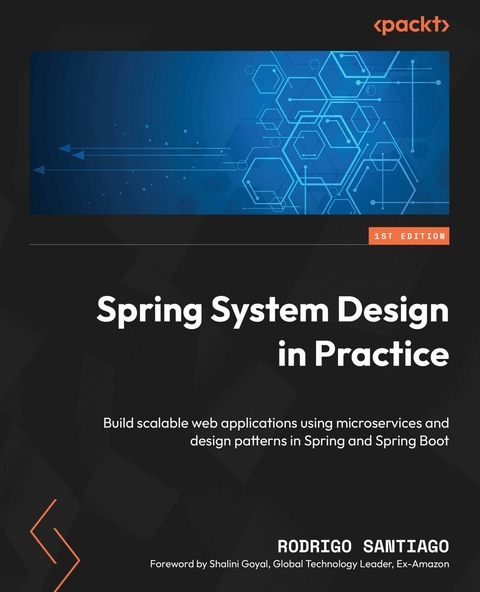
Spring System Design in Practice (eBook)
456 Seiten
Packt Publishing (Verlag)
978-1-80323-988-0 (ISBN)

Software system design goes beyond just writing code-it requires a structured approach to translating real-world requirements into scalable, maintainable solutions. With Rodrigo Santiago's hands-on mentoring style and Java Spring expertise, he makes system design accessible to developers at all levels.
Spring System Design in Practice guides you through building robust software architectures with Spring. From breaking down complex business needs into actionable use cases to implementing services using Spring Boot, this book equips you with the tools and best practices needed for developing secure, high-performance applications. You'll explore inter-service communication, security, and aspect-oriented programming to streamline development. Covering microservices architecture, the book demonstrates how to create self-configuring, resilient, and event-driven services that integrate seamlessly into the cloud. Through hands-on experience, you'll apply best practices to enhance reliability and scalability while tackling complex challenges such as state management, resilience patterns, concurrency issues, and distributed transactions-including bottlenecks related to asynchronous and reactive programming.By the end of this book, you'll have the confidence to analyze system requirements and design well-structured, scalable architectures.
Transform raw requirements into scalable, resilient web applications with Spring, and build secure, high-performance systems from the ground up using expert guidance and best practicesKey FeaturesEstablish yourself as the go-to person for strategic decision-making and solutions design with proven strategiesWrite clean, modular, and testable code with the power of dependency injectionOptimize your development efforts by artfully connecting diverse use cases with the right Spring componentsPurchase of the print or Kindle book includes a free PDF eBookBook DescriptionSoftware system design goes beyond just writing code-it requires a structured approach to translating real-world requirements into scalable, maintainable solutions. With Rodrigo Santiago's hands-on mentoring style and Java Spring expertise, he makes system design accessible to developers at all levels. Spring System Design in Practice guides you through building robust software architectures with Spring. From breaking down complex business needs into actionable use cases to implementing services using Spring Boot, this book equips you with the tools and best practices needed for developing secure, high-performance applications. You'll explore inter-service communication, security, and aspect-oriented programming to streamline development. Covering microservices architecture, the book demonstrates how to create self-configuring, resilient, and event-driven services that integrate seamlessly into the cloud. Through hands-on experience, you'll apply best practices to enhance reliability and scalability while tackling complex challenges such as state management, resilience patterns, concurrency issues, and distributed transactions including bottlenecks related to asynchronous and reactive programming.By the end of this book, you'll have the confidence to analyze system requirements and design well-structured, scalable architectures.What you will learnImplement microservices for scalable, resilient web systemsBreak down business goals into well-structured product requirementsWeigh tradeoffs between writing asynchronous vs. synchronous services and SQL vs. NoSQL storageAccelerate service development and reliability through the adoption of test-driven developmentIdentify and eliminate hidden performance bottlenecks to maximize speed and efficiencyAchieve real-time processing and responsiveness in distributed environmentsWho this book is forIf you're an entry-level IT professional with junior to mid-level Java and Spring experience, this pragmatic guide will fast-track your journey to mastering the Spring ecosystem. Designed to accelerate your career path toward becoming a senior software engineer, system architect, technical lead, or aspiring CTO, it provides clear explanations of the Spring ecosystem and its intricate patterns. For experienced developers or architects, this book offers essential insights and hands-on knowledge to deepen your architectural skills and design resilient web systems.]]>
Preface
Welcome to this journey into the heart of Spring! If you’ve ever stared at a blank IDE, wondering where to even begin when building a robust, scalable service, you’re not alone. The world of software development is full of grand ideas and ambitious goals, but turning those into well-structured, maintainable applications? That’s both an art and a science. This book is here to help you bridge that gap.
We will start with the foundations because great software is built on clarity. We’ll walk through dissecting requirements, distinguishing between functional and non-functional needs, and transforming them into domain objects and solid API contracts. It’s like laying down the blueprint before building a skyscraper—you wouldn’t want your application to topple at the first gust of real-world complexity.
Then, we’ll roll up our sleeves and get into the real magic: building services with Spring. How should interfaces interact with implementations? What’s a clean way to design services that will grow gracefully over time? We’ll answer these questions and propose a practical blueprint for creating new APIs and communicating seamlessly with other systems. And since security is a non-negotiable in today’s world, we’ll dive into user authentication, token creation, and validation using asymmetric keys.
Of course, no journey is complete without a few obstacles. We’ll face them head-on with testing—unit tests, integration tests, and end-to-end tests—ensuring that what we build is not just functional, but reliable. We’ll also explore event-driven architectures, discuss best practices for handling data integrations with SQL and NoSQL databases, and even build a fully-fledged Spring Cloud application.
But what happens when things go wrong? Because, let’s face it, they will. Services fail, networks break, and race conditions lurk in the shadows. That’s why we’ll also talk about designing for resilience: structuring configurations effectively, handling failures gracefully, and resolving concurrency issues like a seasoned architect.
Throughout this book, we’ll keep things practical. This isn’t an abstract tour of Spring 6’s features; it’s a hands-on guide to building applications that work in the real world—applications that scale, recover from failures, and integrate cleanly with the systems around them. We will work from a sample application that we call the HomeIt app, which connects landlords with tenants interested in renting properties.
So, grab your favorite beverage (coffee, tea, or whatever fuels your coding sessions), fire up your IDE, and let’s build something great together. Welcome to the world of Spring!
Who this book is for
Whether you’re taking your first steps into the world of Spring or you’re an experienced system architect looking to refine your approach to scalable web services, this book has something for you.
If you’re new to Spring, you might feel overwhelmed by its vast ecosystem. Where do you start? How do you structure your application? How do all these components fit together? We’ve been there. That’s why this book walks you through the fundamentals—from dissecting requirements to designing APIs, writing services, integrating databases, and handling security. By the time you finish, you’ll have built a fully functional, production-ready Spring application with confidence.
For system architects and experienced developers, this book provides a structured approach to designing scalable, resilient services. We’ll cover best practices for API design, authentication with asymmetric keys, event-driven architectures, and fault tolerance. If you want to ensure your Spring applications can handle real-world complexity while staying maintainable and performant, this book will help you get there.
This book assumes you have some prior experience with an object-oriented programming language and a basic understanding of how to write Java code. You don’t need to be an expert in software development processes—our goal is to provide a clear framework that will help you take high-level requirements and break them down into a resilient family of services that scale effectively.
So, whether you’re just starting out or refining your craft, let’s dive in and build great things together!
What this book covers
Chapter 1, What Are the Product Requirements?, explores how to capture product requirements in a structured, precise way that sets the foundation for well-defined problems and solutions. Every great system starts with a well-defined purpose. You’ll learn how to identify key business needs and translate them into technical goals that guide development from the very beginning.
Chapter 2, Sorting Complex Requirements into Features, Use Cases, and Stories, untangles the complexity of software projects often starting as a tangled web of expectations by breaking down requirements into clear features, use cases, and user stories. This structured approach ensures that we capture what truly matters while keeping the development process manageable and focused.
Chapter 3, LayinDefining Domains for Your Application, explains how, before we write a single line of code, we need to understand the business domain. In this chapter, we’ll use a key domain-driven design (DDD) technique to create visual representations of our system’s core concepts, ensuring that our models align with real-world business logic.
Chapter 4, Defining Services for Your Domains, explains how functional requirements tell us what the system must do, but technical requirements define how it should operate. We’ll cover the crucial technical constraints and expectations on the technical side, ensuring that our services are built for real-world demands with the right tools in place.
Chapter 5, Writing Your Services – Introducing REST APIs with the Spring Framework, introduces the core principles of RESTful APIs and walks you through creating your first Spring-powered service, complete with controllers, request handling, and responses. Now that we have a strong foundation from the previous chapters, it’s time to start building!
Chapter 6, Translating Business Requirements into Well-Designed Spring APIs, teaches you how to build adaptable Spring services by defining clear interfaces, decoupling implementations, and seamlessly integrating different services with each other. We’ll also cover key concepts of how Spring provides interfaces and implementations for connecting to external systems very efficiently.
Chapter 7, Handling Data and Evolving Your Microservice, explains how data is the lifeblood of any system, and how we handle it determines the flexibility of our services. In this chapter, we’ll explore how to work with relational databases in Spring, how to prototype your service very quickly, and what the different approaches for creating custom queries versus out-of-the-box data connections are that make it easier to retrieve or save data.
Chapter 8, Securing Services with Spring Security and OAuth 2.0, provides a hands-on guide to implementing authentication and authorization using Spring Security and OAuth 2.0, ensuring that our services protect sensitive data while providing seamless user access. Security is non-negotiable in modern applications.
Chapter 9, High-Performance and Secure Communication Between Spring Services, explains why when multiple services need to communicate, performance and security become critical concerns. We’ll dive into strategies for making inter-service communication efficient, secure, and scalable, covering how to create asynchronous services with WebFlux.
Chapter 10, Building Asynchronous, Event-Driven Systems with NoSQL Databases, introduces event-driven architectures, showing how to decouple services using messaging systems and NoSQL databases to build scalable, reactive applications, as not all interactions need to happen in real time.
Chapter 11, Launching Your Self-Organizing Microservice Cloud, explores how to launch a cloud-native Spring application, leveraging service discovery, API gateways, remote configurations, and other critical features that make your services connect to each other smoothly.
Chapter 12, Optimizing Your Services, focuses on critical performance tuning, caching, handling failures gracefully, and improving resilience. From circuit breakers to concurrency solutions and distributed transaction consistency checks, we’ll ensure our services thrive under real-world conditions.
To get the most out of this book
| Software/hardware covered in the book | Operating system... |
| Erscheint lt. Verlag | 5.5.2025 |
|---|---|
| Vorwort | Shalini Goyal |
| Sprache | englisch |
| Themenwelt | Mathematik / Informatik ► Informatik ► Web / Internet |
| ISBN-10 | 1-80323-988-3 / 1803239883 |
| ISBN-13 | 978-1-80323-988-0 / 9781803239880 |
| Informationen gemäß Produktsicherheitsverordnung (GPSR) | |
| Haben Sie eine Frage zum Produkt? |
 EPUB (Ohne DRM)
Digital Rights Management: ohne DRM
Dieses eBook enthält kein DRM oder Kopierschutz. Eine Weitergabe an Dritte ist jedoch rechtlich nicht zulässig, weil Sie beim Kauf nur die Rechte an der persönlichen Nutzung erwerben.
Dateiformat: EPUB (Electronic Publication)
EPUB ist ein offener Standard für eBooks und eignet sich besonders zur Darstellung von Belletristik und Sachbüchern. Der Fließtext wird dynamisch an die Display- und Schriftgröße angepasst. Auch für mobile Lesegeräte ist EPUB daher gut geeignet.
Systemvoraussetzungen:
PC/Mac: Mit einem PC oder Mac können Sie dieses eBook lesen. Sie benötigen dafür die kostenlose Software Adobe Digital Editions.
eReader: Dieses eBook kann mit (fast) allen eBook-Readern gelesen werden. Mit dem amazon-Kindle ist es aber nicht kompatibel.
Smartphone/Tablet: Egal ob Apple oder Android, dieses eBook können Sie lesen. Sie benötigen dafür eine kostenlose App.
Geräteliste und zusätzliche Hinweise
Buying eBooks from abroad
For tax law reasons we can sell eBooks just within Germany and Switzerland. Regrettably we cannot fulfill eBook-orders from other countries.
aus dem Bereich