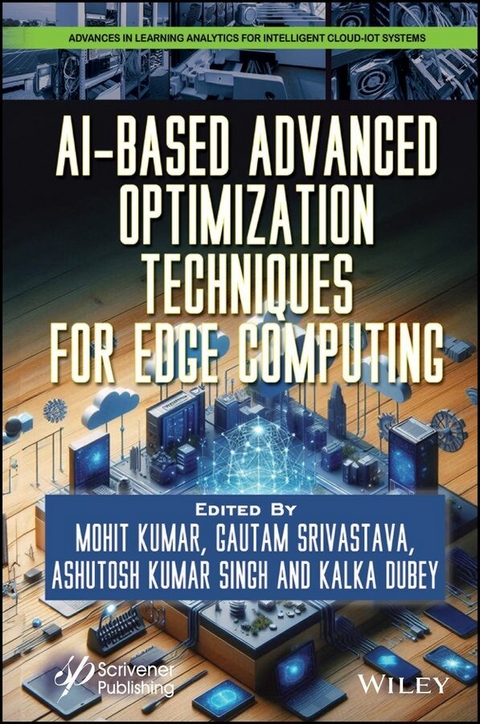
AI-Based Advanced Optimization Techniques for Edge Computing (eBook)
679 Seiten
Wiley-Scrivener (Verlag)
9781394287048 (ISBN)
The book offers cutting-edge insights into AI-driven optimization algorithms and their crucial role in enhancing real-time applications within fog and Edge IoT networks and addresses current challenges and future opportunities in this rapidly evolving field.
This book focuses on artificial intelligence-induced adaptive optimization algorithms in fog and Edge IoT networks. Artificial intelligence, fog, and edge computing, together with IoT, are the next generation of paradigms offering services to people to improve existing services for real-time applications. Over the past few years, there has been rigorous growth in AI-based optimization algorithms and Edge and IoT paradigms. However, despite several applications and advancements, there are still some limitations and challenges to address including security, adaptive, complex, and heterogeneous IoT networks, protocols, intelligent offloading decisions, latency, energy consumption, service allocation, and network lifetime.
This volume aims to encourage industry professionals to initiate a set of architectural strategies to solve open research computation challenges. The authors achieve this by defining and exploring emerging trends in advanced optimization algorithms, AI techniques, and fog and Edge technologies for IoT applications. Solutions are also proposed to reduce the latency of real-time applications and improve other quality of service parameters using adaptive optimization algorithms in fog and Edge paradigms.
The book provides information on the full potential of IoT-based intelligent computing paradigms for the development of suitable conceptual and technological solutions using adaptive optimization techniques when faced with challenges. Additionally, it presents in-depth discussions in emerging interdisciplinary themes and applications reflecting the advancements in optimization algorithms and their usage in computing paradigms.
Audience
Researchers, industrial engineers, and graduate/post-graduate students in software engineering, computer science, electronic and electrical engineering, data analysts, and security professionals working in the fields of intelligent computing paradigms and similar areas.
Mohit Kumar, PhD, is an assistant professor in the Department of Information Technology at Dr. B.R. Ambedkar National Institute of Technology, Jalandhar, India. He has published more than 60 research articles in reputed international journals and conferences and served as a session chair and keynote speaker for many international conferences and webinars in India. His research interests include cloud computing, soft computing, fog and edge computing, optimization algorithms, artificial Intelligence, and Internet of Things.
Gautam Srivastava, PhD, is a professor at Brandon University, Manitoba, Canada with over eight years of academic experience. He has published more than 150 papers in various international journals and conferences and serves as an editor for several international journals. In addition to his written work, he has delivered guest lectures in Taiwan and the Czech Republic. His research interests include data mining, big data, cloud computing, Internet of Things, and cryptography.
Ashutosh Kumar Singh, PhD, is an assistant professor in the Department of Computer Science and Engineering, United College of Engineering and Research Allahabad, India. He has published over 25 papers in reputed international journals and conferences and is a reviewer for various reputed journals, conferences, and books. His research interests include network optimization, software-defined networking, machine learning, Internet of Things, and edge computing.
Kalka Dubey, PhD, is an assistant professor in the Department of Computer Science and Engineering, Rajiv Gandhi Institute of Petroleum Technology, Amethi, India. He has published more than 20 articles in international journals and conferences. His research interests include task scheduling, virtual machine placement and allocation in cloud-based systems, quantification and monitoring of security metrics, soft computing, and enforcing security in cloud environments.
The book offers cutting-edge insights into AI-driven optimization algorithms and their crucial role in enhancing real-time applications within fog and Edge IoT networks and addresses current challenges and future opportunities in this rapidly evolving field. This book focuses on artificial intelligence-induced adaptive optimization algorithms in fog and Edge IoT networks. Artificial intelligence, fog, and edge computing, together with IoT, are the next generation of paradigms offering services to people to improve existing services for real-time applications. Over the past few years, there has been rigorous growth in AI-based optimization algorithms and Edge and IoT paradigms. However, despite several applications and advancements, there are still some limitations and challenges to address including security, adaptive, complex, and heterogeneous IoT networks, protocols, intelligent offloading decisions, latency, energy consumption, service allocation, and network lifetime. This volume aims to encourage industry professionals to initiate a set of architectural strategies to solve open research computation challenges. The authors achieve this by defining and exploring emerging trends in advanced optimization algorithms, AI techniques, and fog and Edge technologies for IoT applications. Solutions are also proposed to reduce the latency of real-time applications and improve other quality of service parameters using adaptive optimization algorithms in fog and Edge paradigms. The book provides information on the full potential of IoT-based intelligent computing paradigms for the development of suitable conceptual and technological solutions using adaptive optimization techniques when faced with challenges. Additionally, it presents in-depth discussions in emerging interdisciplinary themes and applications reflecting the advancements in optimization algorithms and their usage in computing paradigms. Audience Researchers, industrial engineers, and graduate/post-graduate students in software engineering, computer science, electronic and electrical engineering, data analysts, and security professionals working in the fields of intelligent computing paradigms and similar areas.
1
Navigating Next-Generation Network Architecture: Unleashing the Power of SDN, NFV, NS, and AI Convergence
Monika Dubey1*, Snehlata2, Ashutosh Kumar Singh2, Richa Mishra1 and Mohit Kumar3
1Department of Electronics & Communication, University of Allahabad, Prayagraj, U.P., India
2Department of Computer Science and Engineering, United College of Engineering & Research, Prayagraj, U.P., India
3Department of Information Technology, National Institute of Technology Jalandhar, Punjab, India
Abstract
The framework for existing legacy network architecture is massive and complex. It mainly relies on inflexible and expensive equipment, typically constructed from a massive number of switches, routers, firewalls, and hubs. Moreover, this vendor-specific network configuration and complex control protocols are not flexible enough to offer customized quality of services (QoS). Provisioning of next-gen (Next Generation, 5G, and beyond) technologies, software-defined networking (SDN), network function virtualization (NFV), and network slicing (NS) work as catalysts to offer simplified, customized, and clever networking. To provide centralized positioning, SDN decouples the control plane (CP) and data plane (DP) from the traditional router. In the SDN architecture, decision making and network control are now done at a centralized place known as the controller. However, DP is still intact with the routing device. This arrangement privileges the network administrators to control, manage, and alter network behavior dynamically. To contrast the vender-specific networking, NFV allows network functions (NFs) to run on generic hardware. In this direction, NS pioneers QoS-specific use cases as a new business model. NS involves the slicing of a single physical network in the form of multiple slices. It not only supports the customization of QoS services for diverse use cases, but it also improves isolation, independence, multitenancy, dynamic resource allocation, and end-to-end service provisioning. In this chapter, we first delved into NexGen’s promising technologies and explored their intertwined role and impact on the modern networking framework. We accessed various SDN and NFV architectures and discussed network-slicing framework. Secondly, we have shed light on the importance of AI-driven automated network management over traditional network approaches. In this sequence, we conducted a comparative analysis of AI-driven machine learning (ML) and deep learning (DL) approaches in the context of NextGen technologies. In this chapter, we intend to systematically and intricately navigate the multifaceted landscape of NexGen technologies. This chapter will offer researchers, industry stakeholders, and practitioners a timely and deeper understanding of transformative technology and its impact on modern network paradigms.
Keywords: Next-generation technology, SDN, NFV, QoS, NS
1.1 Introduction
The evolution of network technologies has marked pivotal advancements in the telecom sector. It spans from the radiant stage of ARPANET to modern networking. The existing legacy network architecture is based upon un-flexible and costly network equipment comprising switches, hubs, routers, and firewalls [1]. These proprietary hardware-based traditional networks grapple with the demands of modern networking. The surge of extensive data traffic, dynamic network conditions, and the need for real-time decision-makers pose challenges that traditional networks are not capable of addressing efficiently [2]. Traditional methods, such as Static Routing, Ethernet, Transmission Control Protocol (TCP), and Internet Protocol (IP), are built on manual configuration and static protocols. With the surge of diverse applications, customized QoS, high volume, and unpredicted traffic necessitate a paradigm shift. To address these limitations of the traditional approach, Next-Gen (Next Generation, 5G, and beyond) technologies, Software Defined Networking (SDN), Network Function Virtualization (NFV), and NS act as catalysts for redefining the network paradigm. SDN [3] disrupts traditional decentralized architecture by decoupling the Control Plane (CP) and Data Plane (DP) from conventional routers. This centralized control and decision-making entity is known as the controller. This architectural shift empowers the network controller to dynamically manage, control, and modify the network behavior. Concurrently, NFV [4] revolutionizes network functionality by enabling them to run on generic hardware instead of proprietary hardware, offering cost-effectiveness, flexibility, and simplified maintenance. With the advancement of the network landscape, customize QoS-specific servers are the new business model. In this direction, NS [5] has become a revolutionary approach, involving the partitioning of a single physical network into multiple slices. It not only offers customized QoS requirements to modern applications but also enhances isolation, dynamic resource allocation, multi-tenancy, and security [6].
This book chapter also explored the NextGen promising technologies and their intertwined role and impact on modern networking. Traditional networking approaches are static and require human intervention during changes in the network. The increase in network size and the unpredictable nature of network traffic make them more time-consuming and complex. Therefore, AI emerges as a key driver for NextGen networking. It introduced the level of intelligence with its learning and capability of predictive analysis. This chapter also sheds light on how AI-driven approaches complement and enhance the functionalities of SDN, NFV, and NS.
The contributions and highlight of this book chapter are as follows:
- Initially, we present a concise overview of the evolutionary history of network technologies and the key phases that shaped the modern networking landscape.
- To explore the transformative NexGen technologies (SDN, NFV, and NS), we highlight the influence and intertwining role of NexGen technologies.
- This paper systematically highlights the importance of AI over traditional methods. In this sequence, we conducted a comparative analysis of AI-driven Machine Learning (ML) and Deep Learning (DL) approaches in the context of NextGen technologies.
- Finally, we identify challenges associated with NexGen Technologies and with the integration of these modern technologies.
In a nutshell, this chapter will offer researchers and industry stakeholders a timely and deep understanding of transformative NexGen technologies and the impact of their combination on modern technology. It also includes the contribution and comparative analysis of AI-driven algorithms in the context of NexGen technologies.
1.2 Revolutionizing Infrastructure with SDN, NFV, and NS
Due to increasing day-to-day network traffic, networking technologies have undergone a continuous evolution, and based on this, they can be categorized into several phases, such as traditional networking, Wireless Sensor Networking (WSN), client-server networking, and more. Before discussing NexGen technologies and its specifications, it is crucial to examine the evolutionary changes of networking technologies and the key developments that have been influenced by traditional networking. Concise overview is given as follows:
- ARPANET and Early Networking:
- ARPANET: The Advanced Research Projects Agency Network (ARPANET) [7], established in the 1960s, conducted early experiments for linking computer systems over short distances. It laid the foundation for modern networking. However, these networks remained restricted to research institutions.
- Packet Switching: The development of packet switching [8], a key innovation during this era, allowed data to be broken into packets, transmitted independently, and reassembled at the intended destination.
The pioneering work and packet switching laid the fundamental groundwork for the internet.
- Emergence of the Internet:
- Standardization (TCP/IP): During the 1980s, the TCP [9] and IP underwent standardization, forming the backbone of the modern Internet.
- Commercialization: The Internet underwent a pivotal shift from being primarily dedicated to research and academia to a commercial platform, leading to the rise of the World Wide Web (WWW). It establishes the fundamental framework for the contemporary Internet.
- Emergence of Client-Server Architecture and LANs:
- Client-Server Model: In 1980s, the paradigm of computing is shifting from centralized mainframes to distributed systems with the client-server model [10].
- The rise of Local Area Networks (LANs): The internet and other LAN technologies emerged, allowing computers to share resources within confined spaces.
- Wireless Networking and Mobility:
- Wi-Fi Standardization: In the 2000s, the standardization of wireless technologies, particularly Wi-Fi adoption [11], empowered enhanced mobility and flexibility in network access.
- Expansion of Mobile Networks: The surge in mobile device usage during this era empowered enhanced mobility and flexibility in network access [12].
- Cloud Computing and Virtualization:
- Evolution of Cloud Services: The 2010s witnessed a transformative shift with the advent of cloud computing [13], fundamentally changing the way data and applications...
| Erscheint lt. Verlag | 27.3.2025 |
|---|---|
| Sprache | englisch |
| Themenwelt | Mathematik / Informatik ► Informatik ► Theorie / Studium |
| ISBN-13 | 9781394287048 / 9781394287048 |
| Informationen gemäß Produktsicherheitsverordnung (GPSR) | |
| Haben Sie eine Frage zum Produkt? |
 EPUB (Adobe DRM)
Kopierschutz: Adobe-DRM
Adobe-DRM ist ein Kopierschutz, der das eBook vor Mißbrauch schützen soll. Dabei wird das eBook bereits beim Download auf Ihre persönliche Adobe-ID autorisiert. Lesen können Sie das eBook dann nur auf den Geräten, welche ebenfalls auf Ihre Adobe-ID registriert sind.
Details zum Adobe-DRM
Dateiformat: EPUB (Electronic Publication)
EPUB ist ein offener Standard für eBooks und eignet sich besonders zur Darstellung von Belletristik und Sachbüchern. Der Fließtext wird dynamisch an die Display- und Schriftgröße angepasst. Auch für mobile Lesegeräte ist EPUB daher gut geeignet.
Systemvoraussetzungen:
PC/Mac: Mit einem PC oder Mac können Sie dieses eBook lesen. Sie benötigen eine
eReader: Dieses eBook kann mit (fast) allen eBook-Readern gelesen werden. Mit dem amazon-Kindle ist es aber nicht kompatibel.
Smartphone/Tablet: Egal ob Apple oder Android, dieses eBook können Sie lesen. Sie benötigen eine
Geräteliste und zusätzliche Hinweise
Buying eBooks from abroad
For tax law reasons we can sell eBooks just within Germany and Switzerland. Regrettably we cannot fulfill eBook-orders from other countries.
aus dem Bereich