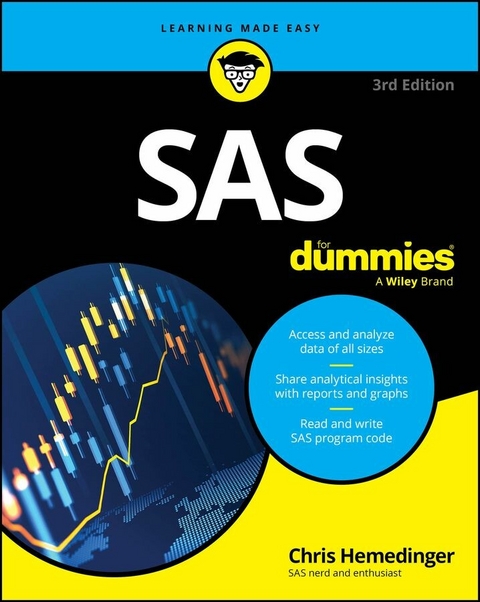
SAS For Dummies (eBook)
565 Seiten
For Dummies (Verlag)
978-1-394-31740-0 (ISBN)
Become data-savvy with the widely used data and AI software
Data and analytics are essential for any business, giving insight into what's working, what can be improved, and what else needs to be done. SAS software helps you make sure you're doing data right, with a host of data management, reporting, and analysis tools. SAS For Dummies teaches you the essentials, helping you navigate this statistical software and turn information into value. In this book, learn how to gather data, create reports, and analyze results. You'll also discover how SAS machine learning and AI can help deliver decisions based on data. Even if you're brand new to data and analytics, this easy-to-follow guide will turn you into an SAS power user.
- Become familiar with the most popular SAS applications, including SAS 9 and SAS Viya
- Connect to data, organize your information, and adopt sound data security practices
- Get a primer on working with data sets, variables, and statistical analysis
- Explore and analyze data through SAS programming and rich application interfaces
- Create and share graphs interactive visualizations to deliver insights
This is the perfect Dummies guide for new SAS users looking to improve their skills-in any industry and for any organization size.
Chris Hemedinger is the author of previous editions of SAS For Dummies. He's also the Director of SAS User Engagement, facilitating the activities of online communities, user groups, tech newsletters, tutorials, and webinars with a focus on SAS software.
Become data-savvy with the widely used data and AI software Data and analytics are essential for any business, giving insight into what's working, what can be improved, and what else needs to be done. SAS software helps you make sure you're doing data right, with a host of data management, reporting, and analysis tools. SAS For Dummies teaches you the essentials, helping you navigate this statistical software and turn information into value. In this book, learn how to gather data, create reports, and analyze results. You'll also discover how SAS machine learning and AI can help deliver decisions based on data. Even if you're brand new to data and analytics, this easy-to-follow guide will turn you into an SAS power user. Become familiar with the most popular SAS applications, including SAS 9 and SAS Viya Connect to data, organize your information, and adopt sound data security practices Get a primer on working with data sets, variables, and statistical analysis Explore and analyze data through SAS programming and rich application interfaces Create and share graphs interactive visualizations to deliver insights This is the perfect Dummies guide for new SAS users looking to improve their skills in any industry and for any organization size.
Chapter 1
Touring the Wonderful World of SAS
IN THIS CHAPTER
Finding something for everyone in SAS
Learning what SAS is
Discovering the many uses for SAS
Programming using SAS, or not
Examining a few real-world examples
One of the questions newcomers ask most frequently about SAS is, “What does the name mean?” After all, those capital letters usually indicate an acronym, right? Today, SAS just refers to the name of a company. If you’ve been around the world of data analysis for a while, however, you may also be familiar with the old meaning of SAS: Statistical Analysis System.
SAS software was developed by a bunch of smart and inquisitive people at North Carolina State University (NCSU) in the late 1960s and early 1970s. Some of these people are still at the company as owners or executives: Jim Goodnight (the current company president) and John Sall. Most of these SAS software pioneers were trained as statisticians or mathematicians and developed the SAS language to help analyze a variety of scientific experiments being conducted at NCSU and other research universities.
Over time, the software became as important as the experiments it was being used to analyze. The company now known as SAS Institute was formed in 1976, by a few people who were brave enough to leave the cozy world of academics for the then-unknown world of software. The first few years were a bit rough, but before long, word of this software and its capabilities began to spread, revenues increased, and the company began to grow. As of this writing, SAS has enjoyed nearly 50 consecutive years of growth and profitability. They must be doing something right.
This chapter is an overview of the power and flexibility of SAS for a range of applications and industries. SAS has expanded from being just a programming language for experts to meeting the needs of a wide variety of users in almost every industry and country in the world.
So, What Is SAS and Who Uses It?
SAS is the iconic software that provides capabilities for data management, analytics, reporting, decisioning, and machine learning and AI.
What SAS looks like to you depends on your skills and interests, your job role, and what SAS products or solutions your organization has provided. As you can learn in Chapter 2, SAS comes in many shapes and sizes. Figure 1-1 shows an example of a SAS program and output in SAS Enterprise Guide, where Figure 1-2 shows a report designed within SAS Visual Analytics. These are just two of the many “faces of SAS” that SAS users may encounter.
FIGURE 1-1: One view of SAS: A program, log, and results shown in SAS Enterprise Guide.
FIGURE 1-2: Also SAS! A designed report in SAS Visual Analytics.
A Tale of Two Platforms: SAS 9.4 and SAS Viya
SAS 9.4 was released in 2013 as the latest major version of what users think of as the “classic” SAS platform. Even though its initial release was over a decade ago, SAS continues to enhance it and issue fixes by delivering maintenance releases, which allows SAS customers to continue using SAS 9.4 with the latest operating systems and security-conscious IT policies.
SAS Viya represents the newest capabilities of SAS, including the latest machine learning algorithms and AI methods. Every month, SAS delivers new SAS Viya releases, with fixes and new features. This continuous-delivery model is a standard practice for cloud-based software and software-as-a-service.
Even though SAS 9.4 and SAS Viya seem very different on the surface, they share a core that makes it easy to move from one to the other. In fact, many customers have both: a continuing SAS 9.4 installation while they accomplish new tasks using SAS Viya. The ability of SAS 9.4 to connect to SAS Viya helps these customers share data and code between the two systems.
Isn’t SAS just for gurus?
You might assume that you need to be a statistician or math guru to use SAS, but happily that’s not the case. In the past several years, SAS has made a significant investment in making the unparalleled analytical and data management capabilities developed over 40-plus years available to almost anyone with a problem to solve in business, science, or government. With products such as SAS Enterprise Guide, SAS Visual Analytics, and SAS for Microsoft 365, SAS has never been more accessible or flexible. These products provide user-friendly interfaces to maximize the heavy-duty capabilities that SAS has long provided to gurus!
Most of this book is dedicated to spelling out simple-to-understand principles that are full of possibilities and limited only by your situation and imagination. SAS offers so much potential that this book just scratches the surface and gets you up to speed on the basics.
SAS for data managers
SAS is famous for its ability to access any type of data, regardless of the source. Of course, you can use SAS to connect with any database system to read and update data. SAS users also often work with file-based data such as flat files, Excel files, and long-forgotten formats such as fixed-length records and more. Finally, SAS includes methods to work with application programming interfaces (APIs) to pull and publish data in our Internet-connected world.
Data managers use all these aspects together with SAS procedures and interfaces to build robust, repeatable processes that can pull data in, transform and enrich it with analytical insights, and publish new data and results to the systems that need it. Conventional wisdom holds that 80 percent of analytics lies in the data prep — and SAS has that covered, and more.
SAS for statisticians
SAS has been a leader in statistics since its inception — it’s literally part of the original meaning of the SAS name (as in Statistical Analysis Software). SAS software is used in universities around the world to teach statistical concepts. (See Chapter 16 for free and easy ways to learn SAS.)
In industry, SAS is used for all types of important statistical applications, including pharmaceutical research, medical studies, quality control, risk management, fraud detection, and many more. SAS software is often cited in published papers found in peer-reviewed scientific journals, where authors must share their methodology along with their findings and conclusions.
Chapter 9 provides an overview of the many statistical methods that SAS supports. Reading this book won’t make you a statistician, but you will learn enough to distinguish a p-value from a pie chart.
SAS for business analysts
Regardless of industry, it’s the job of business analysts to help their organization make data-driven decisions. You’ve already read how SAS offers great coverage for managing data and crunching statistics. A business analyst needs the tools to build upon this work to create compelling data stories and communicate the insights to a less-technical audience. To that end, they need tools for
- Reporting and visualization: Needed to create detailed reports and visualizations to present findings in a clear and understandable way. This helps stakeholders grasp insights quickly and make strategic decisions.
- Problem solving: To identify business problems and use data to find solutions and examine what-if scenarios. This involves a lot of critical thinking and the ability to interpret data in the context of the business environment. Skilled analysts can explore solutions by using SAS code or by using interactive tools like SAS Visual Analytics (discussed in Chapter 14).
- Communication: To share their findings effectively to both technical and nontechnical audiences. This requires strong presentation skills and the ability to translate complex data into insights you can act on. The collaboration features of SAS for Microsoft 365 (see Chapter 13) and SAS Visual Analytics (see Chapter 14) reduce the barriers for sharing information with nontechnical audiences.
SAS for data scientists
What happens when you cross the mathematical rigor of statistics with the process innovation of computer science? You get the newer discipline of data science, which has driven the adoption of machine learning and AI. Data scientists appreciate the tools that SAS offers for their discipline, which includes
- Model building: To develop and train statistical and machine learning models to make predictions or uncover insights. SAS provides robust tools for building and validating these models. Chapter 10 covers the machine learning capabilities of SAS Viya.
- Experimentation: To design and conduct experiments to test hypotheses and validate models. This iterative process helps in refining models and improving their accuracy. Data scientists move easily through the analytics life cycle, as described in Chapter 12.
- Algorithm Development: To create and refine algorithms to solve specific business problems. This requires a deep understanding of both the data and the business context.
- Collaboration: To work closely with other teams and gain value from work done in the open-source community. To that end, they’re familiar with GitHub and programming tools that offer Git integration.
Data...
| Erscheint lt. Verlag | 25.3.2025 |
|---|---|
| Sprache | englisch |
| Themenwelt | Informatik ► Office Programme ► Outlook |
| Schlagworte | Business Intelligence • data analytics software • Data Management • data software • predictive analytics • SAS • sas book beginners • sas business • sas data analysis • sas handbook • sas manual • sas software • sas visualization • Statistical Analysis System |
| ISBN-10 | 1-394-31740-9 / 1394317409 |
| ISBN-13 | 978-1-394-31740-0 / 9781394317400 |
| Informationen gemäß Produktsicherheitsverordnung (GPSR) | |
| Haben Sie eine Frage zum Produkt? |
 EPUB (Adobe DRM)
Kopierschutz: Adobe-DRM
Adobe-DRM ist ein Kopierschutz, der das eBook vor Mißbrauch schützen soll. Dabei wird das eBook bereits beim Download auf Ihre persönliche Adobe-ID autorisiert. Lesen können Sie das eBook dann nur auf den Geräten, welche ebenfalls auf Ihre Adobe-ID registriert sind.
Details zum Adobe-DRM
Dateiformat: EPUB (Electronic Publication)
EPUB ist ein offener Standard für eBooks und eignet sich besonders zur Darstellung von Belletristik und Sachbüchern. Der Fließtext wird dynamisch an die Display- und Schriftgröße angepasst. Auch für mobile Lesegeräte ist EPUB daher gut geeignet.
Systemvoraussetzungen:
PC/Mac: Mit einem PC oder Mac können Sie dieses eBook lesen. Sie benötigen eine
eReader: Dieses eBook kann mit (fast) allen eBook-Readern gelesen werden. Mit dem amazon-Kindle ist es aber nicht kompatibel.
Smartphone/Tablet: Egal ob Apple oder Android, dieses eBook können Sie lesen. Sie benötigen eine
Geräteliste und zusätzliche Hinweise
Buying eBooks from abroad
For tax law reasons we can sell eBooks just within Germany and Switzerland. Regrettably we cannot fulfill eBook-orders from other countries.
aus dem Bereich