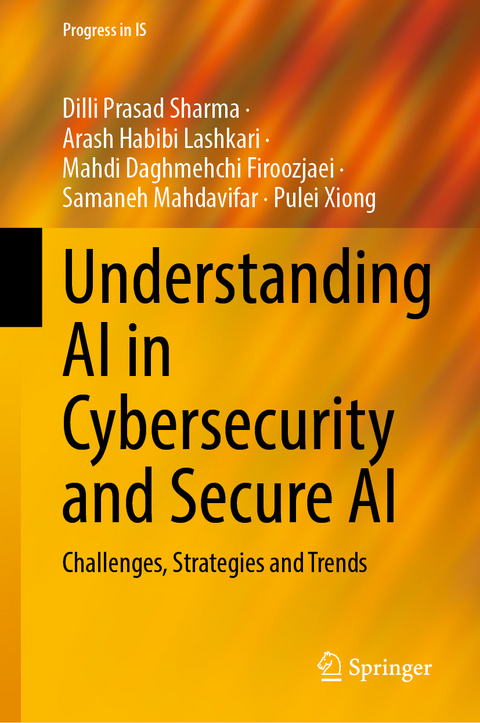
Understanding AI in Cybersecurity and Secure AI
Springer International Publishing (Verlag)
978-3-031-91523-9 (ISBN)
This book presents an overview of the emerging topics in Artificial Intelligence (AI) and cybersecurity and addresses the latest AI models that could be potentially applied to a range of cybersecurity areas. Furthermore, it provides different techniques of how to make the AI algorithms secure from adversarial attacks. The book presents the cyber threat landscape and explains the various spectrums of AI and the applications and limitations of AI in cybersecurity. Moreover, it explores the applications and limitations of secure AI. The authors discuss the three categories of machine learning (ML) models and reviews cutting-edge recent Deep Learning (DL) models. Furthermore, the book provides a general AI framework in security as well as different modules of the framework; similarly, chapter four proposes a general framework for secure AI. It explains different aspects of network security including malware and attacks.
The book also includes a comprehensive study of various scopes of application security; categorised into three groups of smartphone, web application, and desktop application and delves into the concepts of cloud security. The authors discuss state-of-the-art Internet of Things (IoT) security and describe various challenges of AI for cybersecurity, such as data diversity, model customising, explainability, and time complexity and includes some future work. They provide a comprehensive understanding of adversarial machine learning including the up-to-date adversarial attacks and defences. The book finishes off with a discussion of the challenges and future work in secure AI.
Overall, this book covers applications of AI models to various fields of cybersecurity and appeals not only to an scholarly audience but also to professionals wanting to learn more about the new developments in these areas.Dr. Dilli Prasad Sharma is associated with the University of Toronto, Canada, and previously served as a Postdoctoral Fellow at the Canadian Institute for Cybersecurity, University of New Brunswick, Canada. He holds a Ph.D. in Computer Science from the University of Canterbury, New Zealand. Dr. Sharma has over a decade of experience in teaching, research, and development in Computer Science, focusing on Cybersecurity, Artificial Intelligence (AI), Machine Learning (ML), and their applications. He has published his research in top-ranked international conferences and journals, contributing significantly to these fields. His research interests include Cybersecurity, Security Metrics, Privacy-Preserving Technologies, Moving Target Defense, Smart and Safe Cities, IoT Security, Cybersecurity in Healthcare, Adversarial Machine Learning, ML Robustness, AI Security, and Responsible and Trustworthy AI/ML Applications.
Dr. Arash Habibi Lashkari, a Canada Research Chair (CRC) in Cybersecurity, holds a prominent position as an Associate Professor at the School of Information Technology. As the founder and director of the Behaviour-Centric Cybersecurity Center (BCCC) and co-founder of the Cybersecurity Cartoon Award (CSCA), with an extensive background spanning over 28 years in industry and academia, he has taught and conducted research & development at various international universities and organizations, contributing significantly to the field. Dr. Lashkari's expertise has earned him numerous accolades, including 15 international cybersecurity competition awards and three gold awards. He was also recognized among Canada's Top 150 Researchers in 2017. With a remarkable publication record, including 11 books and over 120 academic articles, his work covers diverse cybersecurity topics. He focuses on developing vulnerability detection technology to safeguard network systems against cyberattacks. He also has extensive industrial and development experience in network, software, information, and computer security.
Dr. Mahdi Daghmehchi Firoozjaei is an Assistant Professor in the Department of Computer Science at MacEwan University, Canada. Previously, he served as an Assistant Professor at the University of Windsor and as a Postdoctoral Research Fellow at the Canadian Institute for Cybersecurity (CIC). He holds a Ph.D. in Computer Engineering from Sungkyunkwan University (SKKU), Korea, and has over a decade of industry experience in cybersecurity. His experience includes leading R&D projec
Part I: General.- Chapter 1: Why AI and Security?.- Chapter 2: Understanding AI and ML.- Part II: AI in Security.- Chapter 3: AI in Security.- Chapter 4: AI for Network Security.- Chapter 5: AI for Software Security.- Chapter 6: AI for Cloud Security.- Chapter 7: AI for IoT and OT Security.- Part III: Secure AI.- Chapter 8: AI Security and Privacy.- Chapter 9: Defense Methods for Adversarial Attacks and Privacy Issues in Secure AI.- Chapter 10: General Framework for AI Security and Privacy.- Chapter 11: AI Safety and Fairness.- Chapter 12: AI Security Challenges, Opportunities and Future Work.- Chapter 13: Conclusion.
| Erscheinungsdatum | 28.05.2025 |
|---|---|
| Reihe/Serie | Progress in IS |
| Zusatzinfo | XIV, 250 p. 50 illus., 43 illus. in color. |
| Verlagsort | Cham |
| Sprache | englisch |
| Maße | 155 x 235 mm |
| Themenwelt | Informatik ► Theorie / Studium ► Künstliche Intelligenz / Robotik |
| Mathematik / Informatik ► Mathematik ► Finanz- / Wirtschaftsmathematik | |
| Wirtschaft ► Allgemeines / Lexika | |
| Schlagworte | adversarial attacks • AI • algorithms • Cloud • cybercrime • cyber threats • Deep learning • IOT • machine learning • Network Security • security |
| ISBN-10 | 3-031-91523-2 / 3031915232 |
| ISBN-13 | 978-3-031-91523-9 / 9783031915239 |
| Zustand | Neuware |
| Informationen gemäß Produktsicherheitsverordnung (GPSR) | |
| Haben Sie eine Frage zum Produkt? |
aus dem Bereich