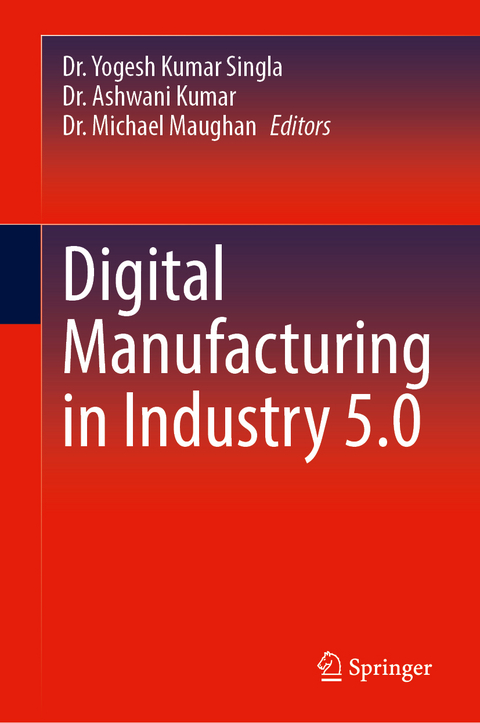
Digital Manufacturing in Industry 5.0
Springer International Publishing (Verlag)
978-3-031-91499-7 (ISBN)
- Noch nicht erschienen - erscheint am 05.01.2026
- Versandkostenfrei
- Auch auf Rechnung
- Artikel merken
This volume focuses on the virtualization of manufacturing through technologies like digital twin, edge computing, big data analytics, and cloud computing. The authors explain the integration of these technologies in ensuring real-time data processing and decision-making routes and how smart sensors play a pivotal role in digital manufacturing, acting as the sensory network that feeds real-time information into the interconnected manufacturing systems. The book further examines augmented reality (AR), another key facet in enhancing human-machine interactions and improving operational efficiency. Describing the broad technological contributions to the creation of responsive, data-driven manufacturing environments that are agile and adaptable to dynamic market demands, the book is ideal for academics/researchers, production engineers, automotive engineers, computer data scientists, IoT & AI engineers, and other professionals in related engineering and cloud computing industries.
- Explores smart factory concepts, integration of cyber-physical systems in manufacturing, and edge computing;
- Explains aspects of sensory network in manufacturing, real-time information flow, and augmented reality applications;
- Illustrates Industry 5.0 and sustainability issues, 3D printing technologies and their applications.
Dr. Yogesh Kumar Singla is an Assistant Professor in the School of Engineering, Math and Technology, Navajo Technical University, USA.
Dr. Ashwani Kumar is a Professor and Head of Department of Mechanical Engineering, Technical Education Department Uttar Pradesh Kanpur India.
Dr. Michael R. Maughan is an Associate Professor in the Department of Mechanical Engineering, University of Idaho, USA.
Part 1: Digital Manufacturing.- Ch 1: Historical Evolution Leading to the Current State of Digital Manufacturing in Industry 5.0.- Ch 2: Shaping the Future: A Global Perspective on Digital Manufacturing in Industry 5.0.- Ch 3: Optimizing Digital Manufacturing Practices: A Global Data-Driven Approach for Industry 5.0 Using SPSS.- Ch 4: Technology Shift from Traditional Subtractive Manufacturing to Additive Manufacturing in Digital Manufacturing Era.- Ch 5: Additive Manufacturing for Industry 5.0: Techniques, Applications, and Future Trends.- Ch 6: Additive Manufacturing and 3D Printing Revolution in Industry 5.0.- Ch 7: The Future of Manufacturing: A Convergence of 3D Printing and Industry 5.0.- Ch 8: Application of 3D printing in the Experimental Aerodynamic Research.- Ch 9: Revolutionizing Metal Manufacturing with AI-Driven 3D Printing and Additive Manufacturing.- Ch 10: Advancements in Additive Manufacturing for the Fabrication of Manual Gear Transmission Box.- Ch 11: Next-Gen Additive Manufacturing: AI-Powered Design, Production, and Control in Industry 5.0.- Ch 12: Machine Learning for Optimized Additive Manufacturing: Challenges, Opportunities and Sustainability.- Ch 13: Recent Advances in the Application of Thermography to Additive Manufacturing: From Process Monitoring to Mechanical Characterisation.- Ch 14: Additive Manufacturing and 3D Printing for Tissue Engineering and Regenerative Medicine.- Ch 15: Optimizing Fiber Volume in Steel Fiber-Reinforced GGBS Geopolymer Concrete for Smart Manufacturing.- Ch 16: Composite Fabrication for Industry 5.0 Applications using Friction Stir Processing.- Ch 17: Numerical Simulation of Pressure and Temperature Characteristics in Fire Tube Boilers Utilizing Alcohol-Based Fuels for Optimized Energy Efficiency in Smart Manufacturing.- Ch 18: Combustion Characteristics and Fracture Toughness of Epoxy Glass Fiber/Phenolic Composites During Oxidation Gas Release.- Part 2: Sustainability Issues in Manufacturing.- Ch 19: Industry 5.0: A New Era of Sustainable and Human-Centered Production.- Ch 20: Industry 5.0 and Sustainability Issues.- Ch 21: Industry 5.0: Addressing Sustainability Challenges through Human-Machine Collaboration.- Ch 22: Advancing Sustainability through Industry 5.0: Trends, Challenges, and Future Directions.- Ch 23: Navigating the Challenges of Industry 5.0.- Ch 24: Sustainability and Performance Evaluation of Concrete Reinforced with Fly Ash and Silica Fume: A Combined LCA and TEA Approach.- Ch 25: Waste to Resource: Smart 3R Approaches for Sustainable and Resilient Construction.- Ch 26: Digital Tool Life Prediction and Monitoring for Sustainable Manufacturing in Industry 5.0.- Ch 27: Challenges and Considerations in Industry 5.0 Adoption.- Ch 28: Challenges and Opportunities in Integrating Natural Fiber-Reinforced Polymer Composites into Industry 5.0 for Enhanced Mechanical and Thermal Properties.- Ch 29: Bananature: Sustainable Carry Bags Crafted from Banana Pseudostems for a
| Erscheint lt. Verlag | 5.1.2026 |
|---|---|
| Zusatzinfo | XXII, 1142 p. 329 illus., 297 illus. in color. |
| Verlagsort | Cham |
| Sprache | englisch |
| Maße | 155 x 235 mm |
| Themenwelt | Informatik ► Software Entwicklung ► User Interfaces (HCI) |
| Mathematik / Informatik ► Mathematik ► Wahrscheinlichkeit / Kombinatorik | |
| Schlagworte | AI • Artifical Intelligence • Big Data • Cloud Computing • digital manufacturing • Digital Twin • edge computing • Human-Machine Interaction • Industry 5.0 • IOT |
| ISBN-10 | 3-031-91499-6 / 3031914996 |
| ISBN-13 | 978-3-031-91499-7 / 9783031914997 |
| Zustand | Neuware |
| Informationen gemäß Produktsicherheitsverordnung (GPSR) | |
| Haben Sie eine Frage zum Produkt? |
aus dem Bereich