


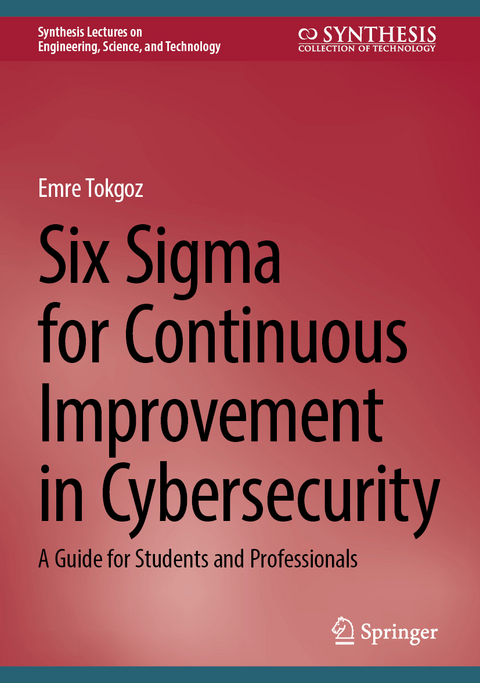
Six Sigma for Continuous Improvement in Cybersecurity
Springer International Publishing (Verlag)
978-3-031-91029-6 (ISBN)
This textbook is designed to teach students and practitioners how to integrate Six Sigma techniques with cybersecurity applications, specifically in training current and future cybersecurity professionals. It utilizes the DMAIC process (Define, Measure, Analyze, Improve, and Control) to strengthen cybersecurity defenses against cyber-attacks while reducing costs and waste. Recognizing that Six Sigma training requires a solid understanding of statistics and technology for effective data analysis, the book covers relevant statistical concepts along with essential Six Sigma, Lean, quality, and technology principles. These are crucial for readers to understand, adopt, and implement continuous improvement strategies in the workplace, ultimately making them a part of their cybersecurity project management culture. This book is suitable for undergraduate courses, depending on the curriculum's specific statistics and technology requirements. It can also serve as a Six Sigma certificate training resource for professionals in the field.
Emre Tokgöz, Ph.D., is an Assistant Professor in the Department of Computer Security, School of Engineering Technology at Farmingdale State College. He authored this book based on his extensive project experience during Six Sigma Black Belt training of university students in conjunction with industry partners, including Pratt & Whitney, Parker Hannifin, Nucor Stainless Steel, Yale New Haven Hospital, Hartford Hospital, Turner Construction, Brook & Whittle Ltd., and ITW Drawform. Dr. Tokgöz completed a Ph.D. in mathematics, another Ph.D. in industrial engineering, an MS in computer science, and an MA in mathematics at the University of Oklahoma. He also completed an MS and BA in mathematics at the University of Ankara, Turkey. His most recent education is a master's degree in engineering management with a concentration in applied biomedical engineering for professionals from Johns Hopkins University. His research, publication, and teaching areas and interests included cybersecurity, network intrusion detection systems, optimization, biomedical engineering, game theory, network analysis, financial engineering, facility allocation, inventory systems, queueing theory analysis, supply chain, renewable energy sources, STEM education, machine and deep learning, engineering management, artificial intelligence, and Riemannian geometry.
Introduction.- Statistics of Six Sigma for Industrial Engineers.- Defining the Six-Sigma Project.- Measure.- Analyze.- Improve.- Control.- Epilogue.
| Erscheinungsdatum | 18.06.2025 |
|---|---|
| Reihe/Serie | Synthesis Lectures on Engineering, Science, and Technology |
| Zusatzinfo | XV, 289 p. 121 illus., 88 illus. in color. |
| Verlagsort | Cham |
| Sprache | englisch |
| Maße | 168 x 240 mm |
| Themenwelt | Mathematik / Informatik ► Informatik ► Datenbanken |
| Technik | |
| Schlagworte | Continuous Improvement in Cybersecurity • Cybersecurity Defenses • Cybersecurity Process Improvement • Cybersecurity Waste Reduction and Improvement • Define, Measure, Analyze, Improve, and Control • DMAIC • Kaizen • Lean Six Sigma in Cybersecurity • Risk Management in Cybersecurity • Six Sigma in Cybersecurity |
| ISBN-10 | 3-031-91029-X / 303191029X |
| ISBN-13 | 978-3-031-91029-6 / 9783031910296 |
| Zustand | Neuware |
| Informationen gemäß Produktsicherheitsverordnung (GPSR) | |
| Haben Sie eine Frage zum Produkt? |
aus dem Bereich


