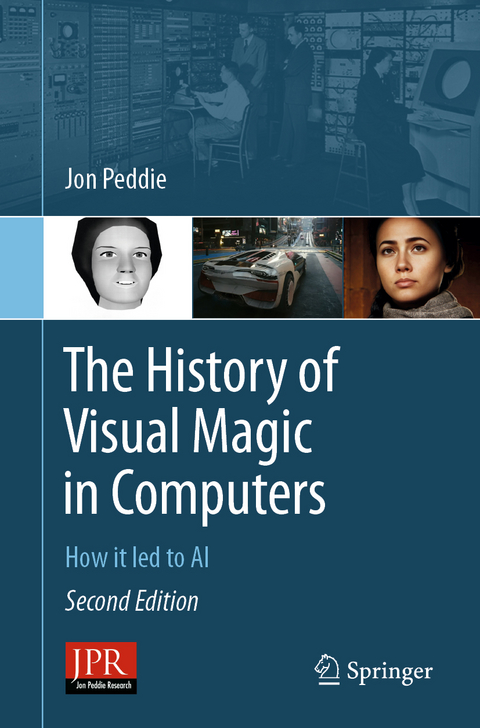
The History of Visual Magic in Computers
Springer London Ltd (Verlag)
978-1-4471-7552-0 (ISBN)
- Noch nicht erschienen - erscheint am 22.01.2026
- Versandkostenfrei
- Auch auf Rechnung
- Artikel merken
Have you ever watched a captivating adventure or science fiction movie, played an intricate and immersive computer game, or seen a TV commercial where objects like cars, gas pumps, or biscuits act like people and wondered, "How do they do that?" If so, then you've witnessed the magic of 3D worlds created by computers. It's a captivating field that blends artistry and technology to bring fictional worlds to life and this 2nd edition adds the unique combination of artistry, technology, and AI that goes into creating 3D worlds real and imaginary.
The roots of 3D graphics in computers lie in practical applications, like representing automotive designs and illustrating the structure of molecules. Over time, these techniques evolved, expanding to visualize simulated data and create artistic representations of imaginary worlds. The goal was, and still is, to create images that feel real, overcoming the visual cues that might make a viewer question the authenticity of what they're seeing.
To achieve realism, developers had to find ways to work around the limitations of early computers. They exploited the characteristics of the human eye and brain, developing clever visual techniques to simulate reality. This involved harnessing the way people perceive depth and movement and using tricks to create a convincing sense of three dimensions. In this fully revised version, The History of Visual Magic in Computers traces how in the 2020s AI-enabled real-time ray tracing became common and an expected capability.
The journey of 3D graphics is a long and collaborative effort. Thousands of individuals, over thousands of years, have made crucial discoveries in mathematics and science, laying the groundwork for these immersive 3D experiences. The story of 3D graphics is a testament to the collective efforts of these individuals, pushing the boundaries of what is possible and today there is a new partner in the process AI.
It traces back to the earliest understanding of three-dimensional space, followed by the development of foundational mathematical concepts to explain and construct 3D worlds. This history spans from the days of mechanical computers to the modern age of tablets and smartphones and ending up with AI enhancements. There have been periods where breakthroughs in computer graphics seemed to happen all at once, leading to exciting developments in algorithms and techniques. As our understanding of how to draw lines and create realistic images improved, 3D controllers for display hardware emerged, paving the way for immersive technologies like stereovision, virtual reality and enhanced image processing using AI.
Dr. Jon Peddie is one of the pioneers of the graphics industry, and formed Jon Peddie Research (JPR) to provide customer intimate consulting and market forecasting services. Peddie lectures at numerous conferences on topics pertaining to graphics technology and the emerging trends in digital media technology. Recently named one of the most influential analysts, he is frequently quoted in trade and business publications, and contributes articles to numerous publications including – as well as appearing on – CNN and TechTV.
Foreword by Rae Earnshaw.- Foreword by Mark Fihn.- Preface.- Introduction: The History of 3D in Computers.- Getting to 3D.- Developing the 3D Software.- Developing the Applications.- Developing the Computer.- Development of 3D Controllers.- Development of Displays: Getting to See 3D.- Stereoscopic 3D in Computers.- The Future.- Index.
| Erscheint lt. Verlag | 22.1.2026 |
|---|---|
| Zusatzinfo | 348 Illustrations, color; 104 Illustrations, black and white |
| Verlagsort | England |
| Sprache | englisch |
| Maße | 155 x 235 mm |
| Themenwelt | Mathematik / Informatik ► Informatik ► Software Entwicklung |
| Schlagworte | 3D Art • 3D Controllers • 3d software • Computer Aided Design • Computer Graphics • Game Making • Stereoscopic 3D |
| ISBN-10 | 1-4471-7552-2 / 1447175522 |
| ISBN-13 | 978-1-4471-7552-0 / 9781447175520 |
| Zustand | Neuware |
| Informationen gemäß Produktsicherheitsverordnung (GPSR) | |
| Haben Sie eine Frage zum Produkt? |
aus dem Bereich