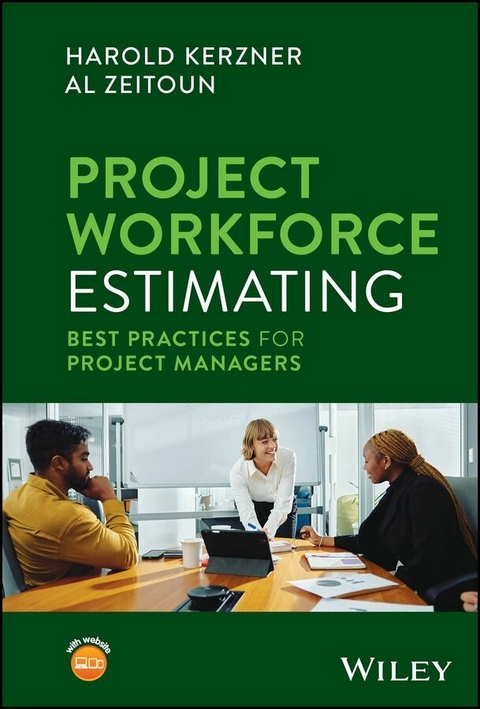
Project Workforce Estimating (eBook)
281 Seiten
Wiley (Verlag)
978-1-394-31938-1 (ISBN)
Place the right people in the right roles at the right time with this essential guide
Project estimating, or project workforce planning, involves a systematic process of identifying and managing the key human resources required for efficient and effective completion of a project. This process necessarily balances a huge range of factors, from forecasting labor costs to managing team composition to incorporating relevant legislation and projecting the impact of artificial intelligence and market conditions. Effective workforce planning contributes to overall project success by ensuring that the right people are in the right roles at the right time.
Project Workforce Estimating: Best Practices for Project Managers offers a comprehensive overview of workforce planning, from foundational principles to advanced techniques. It offers a range of techniques and strategies that can be incorporated into planning for virtually any kind of project, along with detailed guidance to ensure accurate projections. Closely aligned with industry standards, it is a must-own for project managers looking to systematize a critical stage of project management.
Project Workforce Estimating: Best Practices for Project Managers readers will also find:
- Information aligned with standards such as the PMBOK® Guide and Earned Value Management Systems
- A detailed exploration of global workforce estimation, project life cycle costing, and more
- A range of techniques and strategies suitable for any possible industry
Project Workforce Estimating: Best Practices for Project Managers is ideal for project managers, business analysts and consultants, executives and senior managers, and HR professionals.
Harold Kerzner, PhD, is Senior Executive Director for Project Management at the International Institute for Learning, Inc. (IIL), a global learning solutions company offering professional training and consulting services worldwide. Dr. Kerzner's profound effect on the project management industry inspired IIL to establish, in coordination with PMI, the Kerzner International Project Manager of the Year Award, which is presented to a distinguished PMP® or global equivalent each year.
Al Zeitoun, PhD, PgMP, is a PMI Fellow and has over 30 years of global experience in program/project management and strategic change, leading operational excellence for large corporations. He brings decades of global experience with multi-billion-dollar industry-leading organizations. He has implemented digital transformation as a key to accelerating revenue growth and driving market dominance, while redefining internal cultures to embrace and champion new Ways of Working and innovation mindset across all levels of the organization. Dr. Zeitoun has taught, trained, and coached professionals worldwide.
Place the right people in the right roles at the right time with this essential guide Project estimating, or project workforce planning, involves a systematic process of identifying and managing the key human resources required for efficient and effective completion of a project. This process necessarily balances a huge range of factors, from forecasting labor costs to managing team composition to incorporating relevant legislation and projecting the impact of artificial intelligence and market conditions. Effective workforce planning contributes to overall project success by ensuring that the right people are in the right roles at the right time. Project Workforce Estimating: Best Practices for Project Managers offers a comprehensive overview of workforce planning, from foundational principles to advanced techniques. It offers a range of techniques and strategies that can be incorporated into planning for virtually any kind of project, along with detailed guidance to ensure accurate projections. Closely aligned with industry standards, it is a must-own for project managers looking to systematize a critical stage of project management. Project Workforce Estimating: Best Practices for Project Managers readers will also find: Information aligned with standards such as the PMBOK Guide and Earned Value Management SystemsA detailed exploration of global workforce estimation, project life cycle costing, and moreA range of techniques and strategies suitable for any possible industry Project Workforce Estimating: Best Practices for Project Managers is ideal for project managers, business analysts and consultants, executives and senior managers, and HR professionals.
1
The Future of Project Workforce Planning
LEARNING OBJECTIVES
- Understand the challenges with a limited workforce
- Understand where the workforce comes from
- Understand how legislation impacts the workforce
- Understand the need for workforce professional development and future shifts
Keywords Artificial intelligence (AI); Contracted workers; Corporate workforce needs; Labor rates; Resources limitations; Workforce gap analysis; Workforce legislation; Workforce planning models
Navigating the World of Limited Resources
Today we live in a world of limited resources. Companies are running lean and mean due to uncertain economic conditions, unavailable qualified labor, and rapidly changing customer demands. Yet companies never seem to run out of projects to work on, but they do have a shortage of resources to support all of the desired projects.
Newly appointed project managers often willingly accept project management positions with the mistaken belief that they will have all of the necessary resources for their projects. Executives and sponsors also reiterate these words, namely that you will get all of the workforce support needed when selecting and appointing the new project manager. But then, after a go‐ahead, reality sets in and the project manager discovers that he/she is living in a world of limited resources.
To make matters worse, newly appointed project managers do not seem to have any idea as to the complexities with project resources staffing and estimating. Wanting an army of resources may seem like a good idea at first, but the allocated budget may not even allow you to have the minimum workforce you think you need. In an ideal situation, you would determine the workforce needed first, and then price out the workforce to determine the budget for the project. While this sometimes happens, it is more likely that the budget is established first by senior management when approving the project, often without any involvement by the project manager, and then the project manager must staff the project based upon the available funding. The result is often a project team with a shortage of resources or team members with inadequate skill sets.
For simplicity's sake, companies can be classified as project‐driven and non‐project‐driven. Project‐driven companies usually survive on the various projects they manage for external clients through a competitive bidding process. In these companies, the size and type of resources can fluctuate based upon the types and quantities of projects they are asked to manage.
In non‐project‐driven companies, there are usually standard production lines, and projects exist to support the creation of new products or modifications to existing products as well as ongoing business needs. Workforce management is somewhat easier in this type of company.
Both types of companies must deal with the risks of limited resources and need to adopt a workforce planning model. There are two reasonable solutions expected from workforce planning based upon limited resources:
- Make sure that we assign the right people with the right skills to the right tasks
- Try to increase productivity, efficiency, and effectiveness
With limited resources, it is essential that we have the right people assigned to the right tasks. Project managers may not know the capabilities of the assigned workers and may have to rely upon the expertise of the functional managers who provide the staff. Increasing the productivity of the assigned workers does not mean producing more deliverables or increasing production. Instead, it implies getting workers to perform their assigned tasks more efficiently or more effectively. The proper investment in training and education can make this happen.
For companies that survive on competitive bidding, limited resources are almost always a way of life. Companies tend to bid on more jobs than their resources can support because they know that they will not be awarded all of the contracts they are bidding on. If they were to win more projects through competitive bidding than they can handle, there would still be a reluctance to hire more people for fear that there would be no place to put the people after the projects are completed. Companies that hire when they win a contract and then lay off the workers when the contract is finished may find it difficult to attract talented workers who want some degree of employment stability and security. This can be devastating to the company's reputation and create havoc with workforce planning.
Principles of Project Workforce Management
Workforce management begins with workforce planning. Workforce planning, also known as human resource planning or manpower planning, is the process of determining the human resources that an organization needs to meet its strategic goals. The three critical elements in the process are the forecasting of future labor demand, analyzing present labor availability, and effectively managing resource supply versus demand. The outcome, if done effectively, should be a plan that ensures that the right people with the right skills are assigned to the projects such that there is a high expectancy of achieving the organization's strategic goals. Effective manpower planning also minimizes the risks of overstaffing, having to pay for excess staff that may not be needed, and loss of productivity.
A simple model for future workforce planning is shown in Exhibit 1.1.
Exhibit 1.1 Future Workforce Planning Model
Most of the principles in Exhibit 1.1 apply to workforce planning in any type of company.
The focus of this book is future workforce planning for projects.
Workforce planning begins with an understanding of the organization's business goals now and possibly in the future. Forecasting future manpower needs requires answering the following questions:
- What ongoing or new types of projects will be worked on in the future?
- How many people will be required to meet the needs of present and future projects?
- What skill sets will the employees need?
Gap analysis, as identified in Exhibit 1.1, is more than identifying a potential shortage of resources. It also includes answering the following questions:
- Will the organization be required to work on new types of projects?
- Will new skills be required?
- Will training be a necessity for existing or newly hired personnel to develop the skills needed?
- How long might it take for employees to develop the new skills?
Gap analysis is more than making sure you have the right number of resources. It also provides guidance for making sure you have the best possible employees assigned to the best possible activities.
Developing either organizational or project manpower strategies includes the following1:
- Organizational restructuring: this may include organizational redesign to fit a potentially new business model, regrouping activities, and improving efficiency.
- Training and development: this may include providing the current staff with training and development opportunities to encompass their new roles and responsibilities as well as training newly hired workers in the new skills needed.
- Recruitment activities: this may include the recruiting of new hires who already have the skills or are willing to learn new skills.
- Outsourcing activities: this may include teaming with other individuals or organizations that possess the needed skills for the tasks.
People come and go for a variety of reasons. Long‐term workforce planning for projects must consider the risks of replacing workers if needed and how they will be trained. People usually find working on projects challenging and rewarding. This is especially a critical attraction point for the next‐generation workforce that enjoys exploring new outcomes. Proper investment in human resources helps retain talented workers and reduces employee turnover.
Human resource planning must also include ways to retain talented employees and keep them motivated. Some techniques include:
- Engaging employees effectively when they are assigned to a new project
- Making sure they are assigned to challenging work
- Providing a recognition program for excellent performance
- Providing training that is aligned with their career goals
If we look at the principles of human resources management and project objectives together, we can define project staffing as the process that ensures that the organization has the correct number of people with the correct skills doing the right activities at the right time to achieve the project's objectives. But human resources management on a project is more than simply getting people assigned to the project team. It also involves:
- Compensation: Even though project managers may not have any responsibility for wage and salary administration, they might still provide rewards for the team members, whether they are tangible or intangible, and monetary or nonmonetary. They may also be asked to provide informal feedback to the functional managers as to how the workers are performing.
- Safety and health: These are things that the project manager must do to protect the employees from on‐the‐job injuries and work‐related illnesses. This also...
| Erscheint lt. Verlag | 11.3.2025 |
|---|---|
| Sprache | englisch |
| Themenwelt | Informatik ► Office Programme ► Project |
| Technik ► Elektrotechnik / Energietechnik | |
| Wirtschaft ► Betriebswirtschaft / Management ► Projektmanagement | |
| Schlagworte | Contingency Planning in Projects • Earned Value Management • Labor Rate Structures • professional development • Project Life Cycle Costing • Project Team Engagement • Project Workforce Planning • Workforce Expenditure Tracking • Workforce Leveling |
| ISBN-10 | 1-394-31938-X / 139431938X |
| ISBN-13 | 978-1-394-31938-1 / 9781394319381 |
| Informationen gemäß Produktsicherheitsverordnung (GPSR) | |
| Haben Sie eine Frage zum Produkt? |
 EPUB (Adobe DRM)
Kopierschutz: Adobe-DRM
Adobe-DRM ist ein Kopierschutz, der das eBook vor Mißbrauch schützen soll. Dabei wird das eBook bereits beim Download auf Ihre persönliche Adobe-ID autorisiert. Lesen können Sie das eBook dann nur auf den Geräten, welche ebenfalls auf Ihre Adobe-ID registriert sind.
Details zum Adobe-DRM
Dateiformat: EPUB (Electronic Publication)
EPUB ist ein offener Standard für eBooks und eignet sich besonders zur Darstellung von Belletristik und Sachbüchern. Der Fließtext wird dynamisch an die Display- und Schriftgröße angepasst. Auch für mobile Lesegeräte ist EPUB daher gut geeignet.
Systemvoraussetzungen:
PC/Mac: Mit einem PC oder Mac können Sie dieses eBook lesen. Sie benötigen eine
eReader: Dieses eBook kann mit (fast) allen eBook-Readern gelesen werden. Mit dem amazon-Kindle ist es aber nicht kompatibel.
Smartphone/Tablet: Egal ob Apple oder Android, dieses eBook können Sie lesen. Sie benötigen eine
Geräteliste und zusätzliche Hinweise
Buying eBooks from abroad
For tax law reasons we can sell eBooks just within Germany and Switzerland. Regrettably we cannot fulfill eBook-orders from other countries.
aus dem Bereich