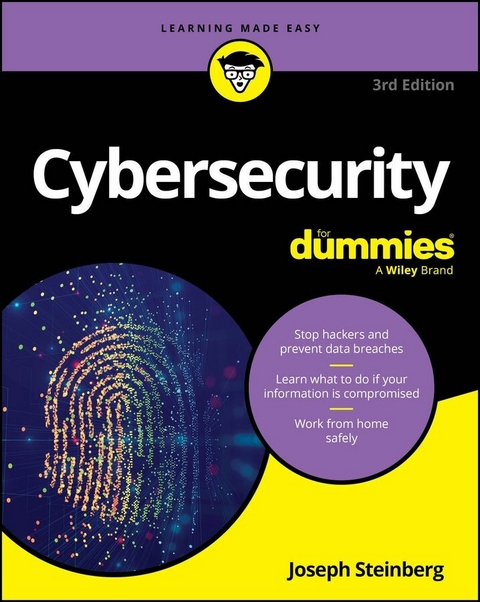
Cybersecurity For Dummies (eBook)
587 Seiten
For Dummies (Verlag)
978-1-394-31873-5 (ISBN)
Get the know-how you need to safeguard your data against cyber attacks
Cybercriminals are constantly updating their strategies and techniques in search of new ways to breach data security-shouldn't you learn how to keep yourself and your loved ones safe? Fully updated with information on AI, hybrid work environments, and more, Cybersecurity For Dummies is the best-selling guide you need to learn how to protect your personal and business information from the latest cyber threats. This book helps you build stronger defenses, with detailed instructions on how to protect your computer, your online data, and your mobile devices. Learn how to set up the right security measures and prevent breaches-as well as what to do if your information or systems are compromised.
- Learn about the different types of cyberattacks and how to defend against them
- Beef up your data security for hybrid work environments and cloud storage
- Keep your family members safe against deepfake and other social engineering attacks
- Make sure you have a plan to respond quickly and limit damage in the event of a breach
Ideal for businesses and individuals who want to be cyber-secure. Cybersecurity For Dummies is also a great primer for anyone interested in pursuing a career in cybersecurity.
Joseph Steinberg holds many security certifications, including CISSP, ISSAP, ISSMP, and CSSLP. He serves as a cybersecurity expert witness, an advisor to businesses and governments, and a lecturer on cybersecurity at Columbia University. He has been named one of the top three cybersecurity influencers worldwide.
Chapter 1
What Exactly Is Cybersecurity?
IN THIS CHAPTER
Understanding the difference between cybersecurity and information security
Showing why cybersecurity is a constantly moving target
Understanding the goals of cybersecurity
Looking at the risks mitigated by cybersecurity
To keep yourself and your loved ones cybersecure, you must first understand what cybersecure means. Along with that, you need to understand what your cybersecurity goals should be, and against what exactly you’re securing yourself and your loved ones.
Although the answers to these questions may initially seem simple and straightforward, they aren’t. As you see in this chapter, the answers to these questions can vary dramatically between people, company divisions, organizations, and even within the same entity at different times.
Cybersecurity Means Different Things to Different Folks
Although the word cybersecurity may sound like a simple enough word to define, in actuality, from a practical standpoint, it means quite different things to different people in different situations, leading to extremely varied policies, procedures, and practices. Individuals who want to protect their social media accounts from hacker takeovers, for example, are unlikely to assume the approaches and technologies used by Pentagon workers to secure classified networks or CIA agents to protect the communications of spies.
Typically, for example:
- For individuals, cybersecurity means that their personal data is reliably accessible to them but not to anyone other than themselves and the others they have authorized, and that their computing devices work properly and are free from malware.
- For small business owners, cybersecurity may include ensuring that credit card data is properly protected, that security cameras work properly and cannot be accessed by criminals, and that standards for data security are properly implemented at point-of-sale registers.
- For firms conducting online business, cybersecurity may include protecting servers that untrusted outsiders regularly interact with.
- For shared service providers, cybersecurity may entail protecting numerous data centers housing numerous servers that, in turn, host many virtual servers belonging to many different organizations.
- For the government, cybersecurity may include establishing different classifications of data, each with its own set of related laws, policies, procedures, and technologies.
The bottom line is that although the word cybersecurity is easy to define, the practical expectations that enter people’s minds when they hear the word vary quite a bit.
Technically speaking, cybersecurity is the subset of information security that addresses information and information systems that store and process data in electronic form, whereas information security encompasses the security of all forms of data (for example, securing a paper file and a filing cabinet).
That said, today, many people colloquially interchange these terms, often referring to aspects of information security that are technically not part of cybersecurity as being part of the latter. Such usage also results from the blending of the two terms. Technically speaking, for example, if someone writes down a password on a piece of paper and leaves the paper on a desk where other people can see the password instead of placing the paper in a safe deposit box or safe, that person has violated a principle of information security, not of cybersecurity, even though those actions may result in serious cybersecurity repercussions. Today, of course, paper documents can easily be scanned and thereby become electronic records — so the lines between cybersecurity and information security have become quite blurry.
Cybersecurity Is a Constantly Moving Target
Although the ultimate goal of cybersecurity may not change much over time, the policies, procedures, and technologies used to achieve it change dramatically as the years march on. Many approaches and technologies that were more than adequate to protect consumers’ digital data in 1980, for example, are effectively worthless today, either because they’re no longer practical to employ or because technological advances have rendered them obsolete or impotent.
Although assembling a complete list of every advancement that the world has seen in recent decades and how such changes impact cybersecurity in effectively impossible, we can examine several key development areas and their impacts on the ever-evolving nature of cybersecurity: technological changes, and social, political, and economic model shifts.
Technological changes
Technological changes tremendously impact cybersecurity. New risks come along with the new capabilities and conveniences that new offerings deliver. As the pact of technological advancement continues to increase, therefore, so does the pace of new cybersecurity risks. Although the number of such risks created over the past few decades as the result of new offerings is astounding, the areas described in the following sections have yielded a disproportionate impact on cybersecurity.
Digital data
In the last few decades, we have witnessed dramatic changes in the technologies that exist, as well as in the people who use such technologies, how they do so, and for what purposes. All these factors impact cybersecurity.
Consider, for example, that when many of the people alive today were children, controlling access to data in a business environment simply meant that the data owner placed a physical file containing the information into a locked cabinet and gave the key only to people the owner recognized as authorized personnel and only when those people requested the key during business hours. For additional security, the data owner may have stored the cabinet in an office that was locked after business hours in a building that itself was also locked and alarmed.
Today, with the digital storage of information, however, simple filing and protection schemes have been replaced with complex technologies that must automatically authenticate users who seek the data from potentially any location at potentially any time, determine whether the users are authorized to access a particular element or set of data, and securely deliver the proper data — all while preventing any attacks against the system servicing data requests, any attacks against the data in transit, and any of the security controls protecting the both of them.
Furthermore, the transition from written communication to email and chat has moved tremendous amounts of sensitive information to Internet-connected servers. Likewise, society’s move from film to digital photography and videography has increased the stakes for cybersecurity. Nearly every photograph and video taken today is stored electronically rather than on film and negatives — a situation that has enabled criminals situated anywhere to steal people’s images and leak them, hold them for ransom with ransomware, or use them to create turmoil in people’s personal lives by creating fake profiles on dating sites, for example. The fact that movies and television shows are now stored and transmitted electronically has likewise allowed pirates to copy them and offer them to the masses — sometimes via malware-infested websites.
The Internet
The most significant technological advancement when it comes to cybersecurity impact has been the arrival of the Internet era, and, more specifically, the transformation of the Internet from a small network connecting researchers at a few universities to an enormous worldwide communication system utilized by a tremendous number of people, businesses, and organizations. In recent years, the Internet has also become the conduit for communication both by billions of smart devices and by people remotely connecting to industrial control systems. Just a few decades ago, it was unfathomable that hackers from across the globe could disrupt a business, manipulate an election, create a fuel shortage, pollute drinking water, or steal a billion dollars. Today, no knowledgeable person would dismiss any such possibilities.
Prior to the Internet era, it was extremely difficult for the average hacker to financially profit by hacking. The arrival of online banking and commerce in the 1990s, however, meant that hackers could directly steal money or goods and services — which meant that not only could hackers quickly and easily monetize their efforts, but unethical people had strong incentives to enter the world of cybercrime.
Cryptocurrency
Compounding those incentives severalfold has been the arrival and proliferation of cryptocurrency over the past decade. Cryptocurrency has dramatically magnified the potential return-on-investment for criminals involved in cybercrime, simultaneously increasing the crooks’ ability to earn money through cybercrime and to hide while doing so. Criminals historically faced a challenge when receiving payments since the account from which they ultimately withdrew the money could often be tied to them. Cryptocurrency effectively eliminated such risks, and also allowed for the fast transfer of money across national borders without the need to use easily-traceable bank wires.
In addition, not only has the dramatic rise in the value of cryptocurrencies...
| Erscheint lt. Verlag | 11.3.2025 |
|---|---|
| Sprache | englisch |
| Themenwelt | Mathematik / Informatik ► Informatik ► Netzwerke |
| Schlagworte | books on cybersecurity • Cyber Attack • cyber certification • cybersecurity • cyber security 101 • cybersecurity beginners • cybersecurity career • cyber security device • cyber security tools • cyber threat • Data Security • zero trust cybersecurity |
| ISBN-10 | 1-394-31873-1 / 1394318731 |
| ISBN-13 | 978-1-394-31873-5 / 9781394318735 |
| Informationen gemäß Produktsicherheitsverordnung (GPSR) | |
| Haben Sie eine Frage zum Produkt? |
 EPUB (Adobe DRM)
Kopierschutz: Adobe-DRM
Adobe-DRM ist ein Kopierschutz, der das eBook vor Mißbrauch schützen soll. Dabei wird das eBook bereits beim Download auf Ihre persönliche Adobe-ID autorisiert. Lesen können Sie das eBook dann nur auf den Geräten, welche ebenfalls auf Ihre Adobe-ID registriert sind.
Details zum Adobe-DRM
Dateiformat: EPUB (Electronic Publication)
EPUB ist ein offener Standard für eBooks und eignet sich besonders zur Darstellung von Belletristik und Sachbüchern. Der Fließtext wird dynamisch an die Display- und Schriftgröße angepasst. Auch für mobile Lesegeräte ist EPUB daher gut geeignet.
Systemvoraussetzungen:
PC/Mac: Mit einem PC oder Mac können Sie dieses eBook lesen. Sie benötigen eine
eReader: Dieses eBook kann mit (fast) allen eBook-Readern gelesen werden. Mit dem amazon-Kindle ist es aber nicht kompatibel.
Smartphone/Tablet: Egal ob Apple oder Android, dieses eBook können Sie lesen. Sie benötigen eine
Geräteliste und zusätzliche Hinweise
Buying eBooks from abroad
For tax law reasons we can sell eBooks just within Germany and Switzerland. Regrettably we cannot fulfill eBook-orders from other countries.
aus dem Bereich