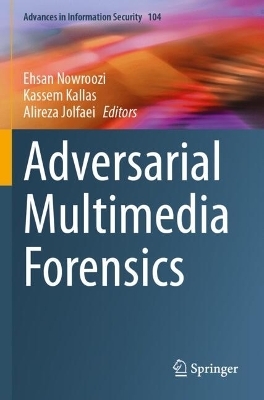
Adversarial Multimedia Forensics
Springer International Publishing (Verlag)
9783031498053 (ISBN)
This book explores various aspects of digital forensics, security and machine learning, while offering valuable insights into the ever-evolving landscape of multimedia forensics and data security. This book's content can be summarized in two main areas. The first area of this book primarily addresses techniques and methodologies related to digital image forensics. It discusses advanced techniques for image manipulation detection, including the use of deep learning architectures to generate and manipulate synthetic satellite images. This book also explores methods for face recognition under adverse conditions and the importance of forensics in criminal investigations. Additionally, the book highlights anti-forensic measures applied to photos and videos, focusing on their effectiveness and trade-offs.
The second area of this book focuses on the broader landscape of security, including the detection of synthetic human voices, secure deep neural networks (DNNs) and federated learning in the context of machine learning security. It investigates novel methods for detecting synthetic human voices using neural vocoder artifacts, and it explores the vulnerabilities and security challenges of federated learning in the face of adversarial attacks. Furthermore, this book delves into the realms of linguistic steganography and steganalysis, discussing the evolving techniques that utilize deep learning and natural language processing to enhance payload and detection accuracy.
Overall, this book provides a comprehensive overview of the ever-evolving field of digital forensics and security, making it an invaluable resource for researchers and students interested in image forensics, machine learning security and information protection. It equips readers with the latest knowledge and tools to address the complex challenges posed by the digital landscape. Professionals working in this related field will also find this book to be a valuable resource.
Ehsan Nowroozi is a Senior Lecturer (Associate Professor) at Ravensbourne University London, Department of Business and Computing, London, UK. He received his doctorate from Siena University in 2020. He is a highly skilled researcher in the field of artificial intelligence for cybersecurity that addresses areas such as adversarial machine learning (Adv-ML), adversarial multimedia forensics (Adv-MF), network security, and digital forensics (DF). To makes AI systems more secure and resilient, Ehsan's work emphasizes determining and defending against adversarial threats. His research has had a significant impact on the development of AI-cyber and the ability to defend against cyber threats. He had four postdocs in different high-prestige universities, including a Research Fellow at the Centre for Secure Information Technologies (CSIT) at Queen's University Belfast in the United Kingdom, a Research Fellow at the Security and Privacy Research Group (SPRITZ) at the University of Padua in Italy, a Research Fellow at the Visual Information Processing and Protection (VIPP) at the University of Siena in Italy, a Research Fellow at the Sabanci University in Turkey. He was also an assistant professor at Bahcesehir University, Istanbul, Turkey. He has worked on a variety of projects funded by renowned institutions, such as DARPA, the Air Force Research Laboratory (AFRL) of the U.S. government, the Italian Ministry of University and Research (MUR), and THALES United Kingdom. He serves as a reviewer for prominent journals, such as IEEE TNSM, IEEE TIFS, and IEEE TNNLS. In addition, he has been a senior member of the Institute of Electrical and Electronics Engineers (IEEE) since 2022 and an ACM Professional member since 2023.
Dr.Kassem Kallas is a seasoned Research Scientist with expertise in the fields of Machine Learning (ML) and Artificial Intelligence (AI). He has a wealth of experience in applying these concepts to real-world problems. Dr. Kallas earned his Ph.D. in Information Engineering and Sciences from the University of Siena, Italy.He has worked on a variety of projects, including ones funded by renowned institutions such as DARPA, Air Force Research Laboratory (AFRL) of the U.S. government, and the Italian Ministry of University and Research (MUR) to research adversarial deep learning and adversarial signal processing. He worked on applying deep learning to wireless communication systems at the National Institute of Standards and Technology (NIST), USA.In addition to his academic and professional accomplishments, Dr. Kallas has gained valuable experience in the business and industrial sectors. He worked as an R&D scientist at ViDiTrust srl and AI consultant at Centrica-ImagineMore. Dr. Kallas is currently a research scientist at the French National Institute for Research in Digital Science and Technology (INRIA), where he continues to make significant contributions to the field. He has also been recognised for his achievements with the Best Paper Award at the Ninth International Conference on Advances in Multimedia (MMEDIA) in 2017 and top 3% paper award at ICASSP 2023. He is a Senior Member of IEEE and is part of the IEEE Young Professionals, IEEE Signal Processing Society, the European Association for Signal Processing (EURASIP), and Asia-Pacific Signal and Information Processing Association (APSIPA). In addition, he has been a reviewer at the IEEE WCNC'2016, IRACON-WS 2017, Inscrypt 2019 and iSES 2019 conferences and the IEEE Transactions on Information Forensics and Security (TIFS), IEEE Transactions on Signal Processing, EURASIP Journal on Information Security and National Institute of Standards and Technology (NIST) journal of research.He has been a technical committee - PC member at the 51st International Carnahan Conference on Security Technology ICCST 2017, and a Session Chair for NGN and Network Management at IARIA Ninth International Conferences on A
Chapter. 1. Model Poisoning Attack against Federated Learning with Adaptive Aggregation.- Chapter. 2. Image Forgery Detection using Comprint: A Comprehensive Study.- Chapter. 3. Good or evil: Generative adversarial networks in digital forensics.- Chapter. 4. Refined GAN-Based Attack Against Image Splicing Detection and Localization Algorithms.- Chapter. 5. Generative Adversarial networks for Artificial Satellite Image Creation and Manipulation.- Chapter. 6. Domain Specific Information based learning for Facial Image Forensics.- Chapter. 7. Linguistic Steganography and Linguistic Steganalysis.- Chapter. 8. Random Deep Feature Selection's Efficiency in Securing Image Manipulation Detectors Opposed by Adversarial Attacks.- Chapter. 9. Optimized Distribution for Robust Watermarking of Deep neural Networks through Fixed Embedding Weights.- Chapter. 10. Anti Forensic Measures and Their Impact on Forensic Investigations.- Chapter. 11. Using Vocoder Artifacts for Audio Deepfakes Detection.
| Erscheinungsdatum | 19.03.2025 |
|---|---|
| Reihe/Serie | Advances in Information Security |
| Zusatzinfo | XVIII, 284 p. 92 illus., 83 illus. in color. |
| Verlagsort | Cham |
| Sprache | englisch |
| Maße | 155 x 235 mm |
| Themenwelt | Mathematik / Informatik ► Informatik |
| Schlagworte | adversarial attacks • Adversarial Attacks of Image and Video • Adversarial Defense • Adversarial Machine Learning • Audio Forensics • DeepFake Detection • Deep Learning in Forensics • Deep Learning Security • digital forensics • fake media • forgery detection • generative adversarial networks • image forensics • image manipulation • multimedia forensics • multimedia security • steganalysis • Synthetic Media • Video Forensics • Watermarking |
| ISBN-13 | 9783031498053 / 9783031498053 |
| Zustand | Neuware |
| Informationen gemäß Produktsicherheitsverordnung (GPSR) | |
| Haben Sie eine Frage zum Produkt? |
aus dem Bereich