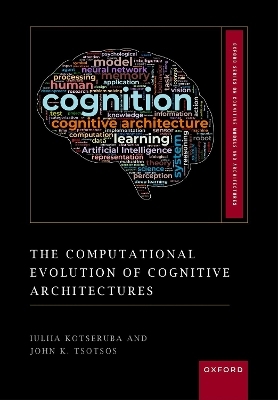
The Computational Evolution of Cognitive Architectures
Oxford University Press (Verlag)
978-0-19-284483-5 (ISBN)
What is the human mind, and how does it work? These questions have occupied humanity since antiquity but have only recently received rigorous scientific investigation. Cognitive architectures are complex software programs whose goal is to approach human-like behavior on a wide variety of tasks. This is accomplished by employing human-like, or at least human-plausible, mechanisms within an integrated framework that is claimed representative of human cognitive, perceptual, and movement capabilities. By examining how close their behavior is to human, they help us understand how the human mind and brain work. They contribute to our understanding as computational models that can be tested and whose details in turn provide insights on new aspects of the human brain and mind. This field of cognitive architectures emerged at the intersection of artificial intelligence and cognitive science and in less than fifty years has spawned hundreds of projects.
In The Computational Evolution of Cognitive Architectures, the authors trace the evolution of cognitive architectures, their abilities, and future prospects, from their early logic-based beginnings to their recent melding of classic methodologies with deep learning concepts. Analyzing over 3000 publications on more than eighty cognitive architectures and hundreds more surveys, research papers, and opinion pieces spanning philosophy, cognitive science, computer science, and robotics, the authors aggregate their findings into broad themes, such as common components of the architectures, their organization, interaction, and relation to human cognitive abilities. They discuss both theoretical elements of cognitive architectures and their performance before finally considering the future of cognitive architectures and their challenges.
Iuliia Kotseruba is a Postdoctoral Visitor at York University, Canada, where she received her PhD and MSc in Computer Science focusing on cognitive systems and transportation safety. Prior to that she obtained her BSc in AI from University of Toronto and BA in Philosophy from National University of Kyiv-Mohyla Academy. She works on intelligent systems inspired by human vision, attention, and cognition. She has spent the past decade building and surveying cognitive architectures and has been a keynote speaker and a contributor to major AI conferences. She has authored over thirty scientific papers on various topics from visual saliency to intelligent transportation. John Tsotsos is Distinguished Research Professor of Vision Science, York University, Canada. He received his PhD in Computer Science from the University of Toronto in 1980, joined their faculty, and founded the University of Toronto's Computer Vision Group, leading it for 20 years. He moved to York University in 2000 as Director, Centre for Vision Research. His honours include CIFAR Fellow, Canada Research Chair in Computational Vision, IEEE Life Fellow, Fellow Canadian Academy of Engineering, and Fellow of the Royal Society of Canada. He received the 2015 Sir John William Dawson Medal for sustained excellence in multidisciplinary research and the 2020 CS-Can
Foreword
What is this book about?
I. COGNITIVE ARCHITECTURES: AN OVERVIEW
1: What are Cognitive Architectures?
2: Cognitive Architectures, AI, and Cognitive Science
3: Taxonomies of Cognitive Architectures
II. HOW ARE COGNITIVE ARCHITECTURES BUILT?
4: Sensation and Perception
5: Memory
6: Learning
7: Reasoning and Decision-Making
8: Putting It All Together
III. WHAT CAN COGNITIVE ARCHITECTURES DO?
9: Practical Applications of Cognitive Architectures
10: Evaluating Cognitive Architectures
IV. WHAT IS NEXT?
11: Cognitive Architectures in the Deep Learning Era
12: Challenges of the Past and Opportunities Ahead
References
| Erscheinungsdatum | 18.06.2025 |
|---|---|
| Reihe/Serie | Oxford Series on Cognitive Models and Architectures |
| Verlagsort | Oxford |
| Sprache | englisch |
| Maße | 180 x 250 mm |
| Gewicht | 699 g |
| Themenwelt | Geisteswissenschaften ► Psychologie ► Allgemeine Psychologie |
| Geisteswissenschaften ► Psychologie ► Pädagogische Psychologie | |
| Geisteswissenschaften ► Psychologie ► Verhaltenstherapie | |
| Informatik ► Theorie / Studium ► Künstliche Intelligenz / Robotik | |
| ISBN-10 | 0-19-284483-0 / 0192844830 |
| ISBN-13 | 978-0-19-284483-5 / 9780192844835 |
| Zustand | Neuware |
| Informationen gemäß Produktsicherheitsverordnung (GPSR) | |
| Haben Sie eine Frage zum Produkt? |
aus dem Bereich