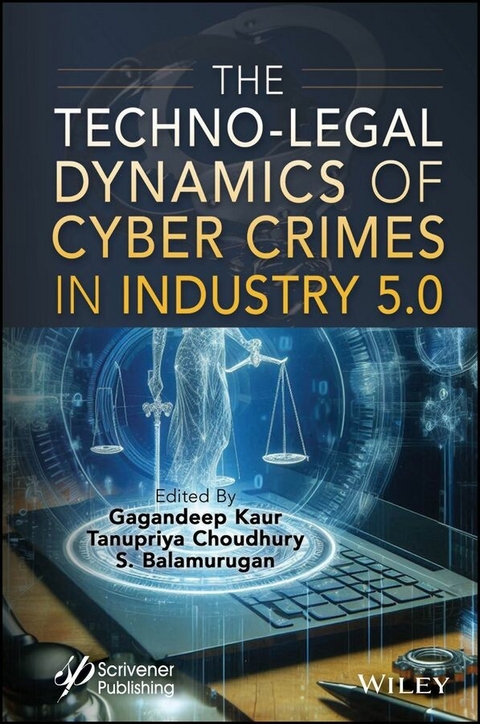
The Techno-Legal Dynamics of Cyber Crimes in Industry 5.0 (eBook)
584 Seiten
Wiley-Scrivener (Verlag)
978-1-394-24215-3 (ISBN)
This book explores the core principles, technological advancements, and legal challenges of Industry 5.0's digital transformation.
Industry 5.0 has enhanced the operational efficiency of the entire manufacturing process by incorporating multiple emerging technologies; however, high-tech cybercrimes have prompted legal scholars worldwide to rethink the fundamental principles of technology and law.
The Techno-Legal Dynamics of Cyber Crimes in Industry 5.0 shows how advanced technologies, such as artificial intelligence, the Internet of Things, and robotics, are integrated within manufacturing environments. It explores the intricate relationship between legal systems and technological advancements and addresses the rise of cybercrime following Industry 5.0's digital transformation. Focusing on the interaction between technology and law, the book investigates current cyberlaw issues and solutions. It draws insights from diverse experts, including scholars, legal professionals, and industry leaders, emphasizing effective regulations to minimize cyber threat risks for Industry 5.0.
By adopting an international viewpoint, this book sheds light on various dimensions of nascent cybercrimes and legislative efforts worldwide aimed at governing them effectively.
Audience
This book should be read by legal scholars, lawyers, judges, legal and information technology researchers, cybersecurity experts, computer and software engineers, and students of law and technology. Regulators, policymakers, international trade specialists, and business executives should read it as well.
Gagandeep Kaur, PhD, is an assistant professor of law at the School of Law, University of Petroleum & Energy Studies, Dehradun, India. She specializes in cyber law, information technology law, cybercrimes, and digital copyright and has over 14 years of teaching and research experience at prestigious universities. She has authored five law books, published more than 100 articles in peer-reviewed journals, and received numerous awards.
Tanupriya Choudhury, PhD, is a professor and associate dean of research at Graphic Era (Deemed to be University), Dehradun, India. He has authored more than 150 research papers and filed 25 patents. He serves as the Honorary Secretary of the Indian Engineering Teachers' Association, a Senior Advisor in the INDO-UK Confederation of Science, Technology, and Research Ltd., London, UK, and the International Association of Professional and Fellow Engineers, Delaware, USA.
S. Balamurugan, PhD, is the Director of Research and Development at Intelligent Research Consultancy Services (iRCS), Coimbatore, Tamil Nadu, India. He also holds the position of Director at the Albert Einstein Engineering and Research Labs (AEER Labs) and Vice Chairman of the Renewable Energy Society of India (RESI). He has published over 50 books, more than 200 international journal articles and conference papers, and has 35 patents.
This book explores the core principles, technological advancements, and legal challenges of Industry 5.0 s digital transformation. Industry 5.0 has enhanced the operational efficiency of the entire manufacturing process by incorporating multiple emerging technologies; however, high-tech cybercrimes have prompted legal scholars worldwide to rethink the fundamental principles of technology and law. The Techno-Legal Dynamics of Cyber Crimes in Industry 5.0 shows how advanced technologies, such as artificial intelligence, the Internet of Things, and robotics, are integrated within manufacturing environments. It explores the intricate relationship between legal systems and technological advancements and addresses the rise of cybercrime following Industry 5.0 s digital transformation. Focusing on the interaction between technology and law, the book investigates current cyberlaw issues and solutions. It draws insights from diverse experts, including scholars, legal professionals, and industry leaders, emphasizing effective regulations to minimize cyber threat risks for Industry 5.0. By adopting an international viewpoint, this book sheds light on various dimensions of nascent cybercrimes and legislative efforts worldwide aimed at governing them effectively. Audience This book should be read by legal scholars, lawyers, judges, legal and information technology researchers, cybersecurity experts, computer and software engineers, and students of law and technology. Regulators, policymakers, international trade specialists, and business executives should read it as well.
1
AI & IP: Ownership Rights in Industry 5.0
Pulkit Mogra
Faculty of Law, Univesity of Ottawa, Ottawa, Canada
Abstract
Creativity and expression are no longer a forte of a human being. Advanced algorithms, also known as AI, are capable of creating content of their own such as painting and composing music. In the era of Industry 5.0, Google’s AI company, DeepMind, has created software that can produce novel music sounds and unique images. If such things had been created by humans, they would have been subject to protection under copyright laws but since machine lacks the characteristics of humans, the question arises about who owns the copyrights for the content.
US circuit court has recently held in the case of Naruto et al. vs David Slater that animals, other than humans, cannot sue for copyright protection. Furthermore, WIPO member countries enacted a law that states non-humans are not subjected to protection under IP laws. Furthermore, it depends a lot upon the interpretation of courts for originality requirements under authorship and if it requires creative inputs from humans. In India, to get protection under copyright, one must prove creativity in addition to variation from previous works.
Another issue that this paper reflects on would be the determination of several possibilities for assigning authorship where an object has been designed by AI. This paper will analyse the claims of the stakeholders such as programmers, users, and AI software itself to determine who has the greatest claim towards ownership of products and further possibilities for assigning authorship where an object has been designed by AI, thus analysing the question of “who is the author” of the works created by AI.
This piece contributes to the literature on conundrums arising in the Industry 5.0 era, which on hand is striving hard to develop technologies in assistance of AI but is also facing issues on who owns the assets and liabilities arising out from the labour of AI. With the press release of the Japanese government that plans to create a legal framework, especially for the works created by AI to protect copyrights on novels, music, and other works, it becomes a relevant question if laws, including international treaties, should redefine the term “authorship” and include non-legal entities as well under the umbrella or should develop a new legal framework for AI.
Keywords: Artificial intelligence, intellectual property law, copyrights
1.1 Introduction
Artificial intelligence (AI) system–driven robots and other systems with AI technology possess the capabilities of creating independent original works, i.e., without the intervention of human beings. The modern AI system consists of ten characteristics, i.e., (i) autonomous, (ii) free choice, (iii) innovative, (iv) independent, (v) unpredictable, (vi) intelligent and rational, (vii) efficient, (viii) capable of evolving and learning, (ix) accurate, and (x) goal-oriented, all such features together make a system intelligent [1]. That raises many legal questions: Are these works copyrightable as original artwork? Who owns the copyrights, along with the bundle of ownership rights such as royalties, licences, right to get remedies in case of infringements, and so forth? Let us imagine that an AI-driven computer system generates an image of a spaceship based upon a few inputs by the user, such as “company logo” and typing terms such as “Space,” “Ship,” or “Pyramid.” Further to that, an image is being generated; now, does a user have a right to sell the image without the programmer’s consent? Some possible answers to this question can be that the right may be assigned to the programmer, user, both user and programmer, AI system itself, both user and AI system, both programmer and AI system, or nobody.
Although most of the principles have been in favour of awarding the rights to users, they have evolved since the 1800s when technology was merely a tool for the users such as typewriters and cameras [2]. However, with time, computer programmes became more and more intelligent and sophisticated and, hence, started to display their own set of creativity without much intervention from users. Therefore, weighing the programmes in the same set of tests is no longer relevant, and hence AI-based computer programmes are required to be tested from the new lenses with the broadened category of ownership rights. It seems challenging to transpose it in combination with the norms of existing legal systems connected to the Droit d’Auteur tradition, where the creation must result from an effort of human intellect.
This paper deals with finding out the best possible solution amongst the variety of existing suggested frameworks, which would allow the rights and liabilities to be distributed amongst programmers, owners, and users of AI, and at the same time also promote the innovational incentive for the society.
The first part of the paper briefly explains the definition of an AI system, classifying it under “Strong” and “Weak” AI systems. Furthermore, it explains how the competency of an AI is determined through a test suggested by Prof. Alan Turing in 1950 in his paper “Computing Machinery and Intelligence” [3]. This part also highlights the creativity of AI systems and what it means when we use the term “creative” in the AI context. Traditionally, creativity has been seen as a component of human intellect and copyright law in the EU, UK, and many other jurisdictions that state the importance of creativity explicitly in granting up copyrights.
The second part deals with the contemporary issue of “Who owns the rights in the works created by AI systems”? This part lays down and analyses the US and EU’s legal position on the subject matter along with the Macque and Fiest Publications case and the stance of the Berne Convention upon copyrightability. Furthermore, this part examines the stance of various stakeholders that may claim ownership of AI-developed products or services, such as the programmer, AI itself, the user, or the public domain, and also lays down a test where an AI can be qualified as an independent AI and thus concluding with the recent developments.
Lastly, the third part of the paper suggests a possible solution by examining the principles of employer-employee relationships and licencing. Also, this part mentions the advantages of the “Work Made for Hire” along with the “Licencing model” and how this model creates a win-win situation for every stakeholder. This brings an important discussion for stakeholders of Industry 5.0, a term coined by the European Commission Report on “Industry 5.0, Towards a sustainable, human-centric and resilient European industry”, which states the importance of technologies such as AI that contribute towards unprecedented opportunities [4]. Whilst AI or robotics allows for workplace innovation and capitalisation on human-machine interaction, it becomes a pertinent question to discuss who may own the rights and liabilities arising out of this interaction. This model contributes towards easing the issue and provides a plausible solution to the questions raised in the paper, thus concluding with remarks on the model and also highlighting the innovative trends from countries such as Japan that have sought a pioneering approach to deal with this contemporary issue.
1.2 Evolution of Artificial Intelligence System
The term “Artificial Intelligence”, a neologism term, was first coined during the Dartmouth Conference where John McCarthy in 1956 at MIT defined AI as the science of developing machines along with the intelligent computer programme [5] (Sejnowski, 2018). However, AI with time has evolved into multi-folds, and so has the definition. In today’s era, there exists no universal definition of AI; linguistically, if we analyse the terms, it leads us to the following conclusion:
- Artificial, in a literary sense, means something unreal that has been created by humans through various scientific techniques [6].
- Intelligence infers the ability to live organisms to undertake a decision-making process when presented with sets of data or situations, through planning, reasoning, analysing, and understanding [7].
Combining these two terms, the simple explanation of AI is a machine that is capable of simulating human behaviour, as also introduced by Norvig and Russell, for a scale to measure the ability of non-human intelligence, in terms of its ability to replicate human skills and mental smartness such as recognising of patterns, learning through experiences, and reasoning [8].
In general terms, AI can be classified on the grounds of their type of approach towards technical implementation or their application as per the situation. The prominent type of AI can be classified under these categories, keeping in consideration their intended and displayed intelligence:
- General AI: Also known as artificial general intelligence, an AI that can be referred to in a manner that it can function, think, and act similar to how a human brain might act and it would be difficult to distinguish between the acts of both [9].
- Narrow AI: Unlike general AI, narrow AI is not associated with duplicating human intelligence activities but works towards being associated with the attempts to create programmes that act as a supplement to a given task....
| Erscheint lt. Verlag | 6.3.2025 |
|---|---|
| Reihe/Serie | Industry 5.0 Transformation Applications |
| Sprache | englisch |
| Themenwelt | Mathematik / Informatik ► Informatik ► Netzwerke |
| Schlagworte | algorithms • Artificial Intelligence • cybercrime • Cyber Security Threat • cyber terrorism • Industry 5.0 • International Law • international laws • internet crime • internet of things • IPR • machine learning • Online Dating • Regulation • Social Media • Virus Attacks |
| ISBN-10 | 1-394-24215-8 / 1394242158 |
| ISBN-13 | 978-1-394-24215-3 / 9781394242153 |
| Informationen gemäß Produktsicherheitsverordnung (GPSR) | |
| Haben Sie eine Frage zum Produkt? |
 EPUB (Adobe DRM)
Kopierschutz: Adobe-DRM
Adobe-DRM ist ein Kopierschutz, der das eBook vor Mißbrauch schützen soll. Dabei wird das eBook bereits beim Download auf Ihre persönliche Adobe-ID autorisiert. Lesen können Sie das eBook dann nur auf den Geräten, welche ebenfalls auf Ihre Adobe-ID registriert sind.
Details zum Adobe-DRM
Dateiformat: EPUB (Electronic Publication)
EPUB ist ein offener Standard für eBooks und eignet sich besonders zur Darstellung von Belletristik und Sachbüchern. Der Fließtext wird dynamisch an die Display- und Schriftgröße angepasst. Auch für mobile Lesegeräte ist EPUB daher gut geeignet.
Systemvoraussetzungen:
PC/Mac: Mit einem PC oder Mac können Sie dieses eBook lesen. Sie benötigen eine
eReader: Dieses eBook kann mit (fast) allen eBook-Readern gelesen werden. Mit dem amazon-Kindle ist es aber nicht kompatibel.
Smartphone/Tablet: Egal ob Apple oder Android, dieses eBook können Sie lesen. Sie benötigen eine
Geräteliste und zusätzliche Hinweise
Buying eBooks from abroad
For tax law reasons we can sell eBooks just within Germany and Switzerland. Regrettably we cannot fulfill eBook-orders from other countries.
aus dem Bereich