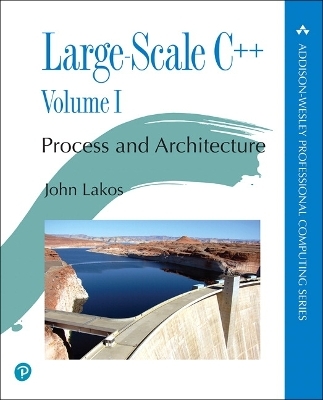
Large-Scale C++
Addison-Wesley Educational Publishers Inc (Verlag)
978-0-201-71706-8 (ISBN)
Up to date and with a solid engineering focus, Large-Scale C++, Volume I: Process and Architecture, demonstrates fundamental design concepts with concrete examples. Professional developers of all experience levels will gain insights that transform their approach to design and development by understanding how to
Raise productivity by leveraging differences between infrastructure and application development
Achieve exponential productivity gains through feedback and hierarchical reuse
Embrace the component’s role as the fundamental unit of both logical and physical design
Analyze how fundamental properties of compiling and linking affect component design
Discover effective partitioning of logical content in appropriately sized physical aggregates
Internalize the important differences among sufficient, complete, minimal, and primitive software
Deliver solutions that simultaneously optimize encapsulation, stability, and performance
Exploit the nine established levelization techniques to avoid cyclic physical dependencies
Use lateral designs judiciously to avoid the “heaviness” of conventional layered architectures
Employ appropriate architectural insulation techniques for eliminating compile-time coupling
Master the multidimensional process of designing large systems using component-based methods
This is the first of John Lakos’s three authoritative volumes on developing large-scale systems using C++. This book, written for fellow software practitioners, uses familiar C++ constructs to solve real-world problems while identifying (and motivating) modern C++ alternatives. Together with the forthcoming Volume II: Design and Implementation and Volume III: Verification and Testing, Large-Scale C++ offers comprehensive guidance for all aspects of large-scale C++ software development. If you are an architect or project leader, this book will empower you to solve critically important problems right now — and serve as your go-to reference for years to come.
Register your book for convenient access to downloads, updates, and/or corrections as they become available. See inside book for details.
John Lakos, manager at Bloomberg, runs their BDE group, which develops fine-grained reusable C++ software using his component-based methodology and process. He also mentors engineers and team leads throughout Bloomberg’s software infrastructure department. As a voting member of the C++ Standards Committee, he has helped shape new generations of C++. He is the author of Large-Scale C++ Software Design (Addison-Wesley, 1996).
Preface xvii
Acknowledgments xxv
Chapter 0: Motivation 1
0.1 The Goal: Faster, Better, Cheaper! 3
0.2 Application vs. Library Software 5
0.3 Collaborative vs. Reusable Software 14
0.4 Hierarchically Reusable Software 20
0.5 Malleable vs. Stable Software 29
0.6 The Key Role of Physical Design 44
0.7 Physically Uniform Software: The Component 46
0.8 Quantifying Hierarchical Reuse: An Analogy 57
0.9 Software Capital 86
0.10 Growing the Investment 98
0.11 The Need for Vigilance 110
0.12 Summary 114
Chapter 1: Compilers, Linkers, and Components 123
1.1 Knowledge Is Power: The Devil Is in the Details 125
1.2 Compiling and Linking C++ 129
1.3 Declarations, Definitions, and Linkage 153
1.4 Header Files 190
1.5 Include Directives and Include Guards 201
1.6 From .h /.cpp Pairs to Components 209
1.7 Notation and Terminology 216
1.8 The Depends-On Relation 237
1.9 Implied Dependency 243
1.10 Level Numbers 251
1.11 Extracting Actual Dependencies 256
1.12 Summary 259
Chapter 2: Packaging and Design Rules 269
2.1 The Big Picture 270
2.2 Physical Aggregation 275
2.3 Logical/Physical Coherence 294
2.4 Logical and Physical Name Cohesion 297
2.5 Component Source-Code Organization 333
2.6 Component Design Rules 342
2.7 Component-Private Classes and Subordinate Components 370
2.8 The Package 384
2.9 The Package Group 402
2.10 Naming Packages and Package Groups 422
2.11 Subpackages 427
2.12 Legacy, Open-Source, and Third-Party Software 431
2.13 Applications 433
2.14 The Hierarchical Testability Requirement 437
2.15 From Development to Deployment 459
2.16 Metadata 469
2.17 Summary 481
Chapter 3: Physical Design and Factoring 495
3.1 Thinking Physically 497
3.2 Avoiding Poor Physical Modularity 517
3.3 Grouping Things Physically That Belong Together Logically 555
3.4 Avoiding Cyclic Link-Time Dependencies 592
3.5 Levelization Techniques 602
3.6 Avoiding Excessive Link-Time Dependencies 704
3.7 Lateral vs. Layered Architectures 722
3.8 Avoiding Inappropriate Link-Time Dependencies 739
3.9 Ensuring Physical Interoperability 753
3.10 Avoiding Unnecessary Compile-Time Dependencies 773
3.11 Architectural Insulation Techniques 790
3.12 Designing with Components 835
3.13 Summary 908
Conclusion 923
Appendix: Quick Reference 925
Bibliography 933
Index 941
| Erscheint lt. Verlag | 5.2.2020 |
|---|---|
| Reihe/Serie | Addison-Wesley Professional Computing Series |
| Mitarbeit |
Herausgeber (Serie): John Fuller |
| Verlagsort | New Jersey |
| Sprache | englisch |
| Themenwelt | Mathematik / Informatik ► Informatik ► Programmiersprachen / -werkzeuge |
| ISBN-10 | 0-201-71706-9 / 0201717069 |
| ISBN-13 | 978-0-201-71706-8 / 9780201717068 |
| Zustand | Neuware |
| Informationen gemäß Produktsicherheitsverordnung (GPSR) | |
| Haben Sie eine Frage zum Produkt? |
aus dem Bereich