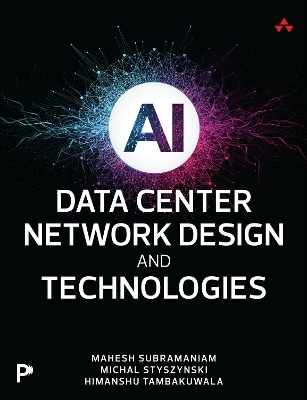
AI Data Center Network Design and Technologies
Addison Wesley (Verlag)
978-0-13-543628-8 (ISBN)
- Noch nicht erschienen (ca. April 2026)
- Versandkostenfrei
- Auch auf Rechnung
- Artikel merken
AI Data Center Network Design and Technologies is the first comprehensive, vendor-agnostic guide to the design principles, architectures, and technologies that power AI training and inference clusters. Written by leading experts in AI Data center design, this book helps engineers, architects, and technology leaders understand how to design and scale networks purpose-built for the AI era.
INSIDE, YOU’LL LEARN HOW TO
Architect scalable, high-radix network fabrics to support xPU (GPE, TPU)-based AI clusters
Integrate lossless Ethernet/IP fabrics for high-throughput, low-latency data movement
Align network design with AI/ML workload characteristics and server architectures
Address challenges in cooling, power, and interconnect design for AI-scale computing
Evaluate emerging technologies from the Ultra Ethernet Consortium (UEC) and their affect on future AI data centers
Apply best practices for deployment, validation, and performance measurement in AI/ML environments
With broad coverage of both foundational concepts and emerging innovations, this book bridges the gap between network engineering and AI infrastructure design. It empowers readers to understand not only how AI data centers work—but why they must evolve.
Mahesh Subramaniam is a proven leader in AI data centers and next-generation networking technologies. He played a key role in defining the advanced software roadmap for AI fabrics, which are now deployed in production networks across various AI data centers worldwide. As the Senior Director of Product Management for AI Data Centers at HPE Juniper Networks, he leads cutting-edge innovations in AI infrastructure and cloud-scale solutions, optimized for both scale-up and scale-out architectures. Mahesh is also an inventor with several technology patents and a recognized speaker at global forums, including the UEC Summit, OCP, and Tokyo MPLS forum. His work has earned him accolades, including the CEO Excellence Award, the Record High Business Award, and the Star Award for the Cloud DC Reference Architecture. With a remarkable history in the networking industry, Mahesh has a strong track record of leading products and managing technical and business strategies across cross-functional teams. Michal Styszynski is a Product Management Director in the Data Center Networks Business Unit (DC BU) at HPE Juniper Networking. Michal has been with Juniper Networks for more than 13 years. Before his current role, he was a Technical Marketing Engineer (TME) in the DC BU and a Technical Solution Consultant at Juniper. In these roles, he handled data center projects for large-scale enterprises and federal networks and worked closely with Tier 2 cloud and telco-cloud service providers. Before joining Juniper, he spent around 10 years working at Orange, FT R&D, and TPSA Polpak engineering. Michal graduated from the Electronics & Telecommunications department at Wroclaw University of Science & Technology with a master’s degree in engineering. He also holds an MBA from Paris Sorbonne Business School and is a JNCIE-DC#523, as well as PEC, PLC, and PMC certified from the Product School in San Francisco. Himanshu Tambakuwala is a highly accomplished networking expert and certified technical architect whose experience spans the entire product lifecycle[md]from hands-on engineering to product strategy. He is a JNCIE holder in Data Center and Service Provider technologies and an inventor with four granted technology patents and two additional patents currently filed. As a Product Manager at Juniper Networks, Himanshu was instrumental in defining the feature roadmap for network fabrics that power cutting-edge AI/ML data centers.
Part 1: AI/ML Data Center Design Workloads and Requirements
Chapter 1 Wonders in the Workload
Chapter 2 “The Common-Man View” of AI Data Center Fabrics
Part 2: AI/ML Data Center Design Concepts
Chapter 3 Network Design Considerations
Chapter 4 Optics and Cables Management
Chapter 5 Thermal and Power Efficiency Considerations
Part 3: AI/ML Data Center Technology Requirements
Chapter 6 Efficient Load Balancing
Chapter 7 RoCEv2 Transport and Congestion Management
Chapter 8 IP Routing for AI/ML Fabrics
Chapter 9 Storage Network Design and Technologies
Part 4: KPIs and Performance Monitoring
Chapter 10 AI Network Performance KPIs
Chapter 11 Monitoring and Telemetry
Part 5: UEC – Ultra Ethernet Consortium
Chapter 12 Ultra Ethernet Consortium (UEC)
CONCLUSION
Chapter 13 Scale-Up Systems
Chapter 14 Conclusion
Appendix A: Questions and Answers
Appendix B: Acronyms
| Erscheint lt. Verlag | 6.4.2026 |
|---|---|
| Verlagsort | Boston |
| Sprache | englisch |
| Themenwelt | Mathematik / Informatik ► Informatik ► Netzwerke |
| Informatik ► Theorie / Studium ► Künstliche Intelligenz / Robotik | |
| ISBN-10 | 0-13-543628-1 / 0135436281 |
| ISBN-13 | 978-0-13-543628-8 / 9780135436288 |
| Zustand | Neuware |
| Informationen gemäß Produktsicherheitsverordnung (GPSR) | |
| Haben Sie eine Frage zum Produkt? |
aus dem Bereich