From Here to Infinity (eBook)
788 Seiten
Springer-Verlag
978-3-031-72585-2 (ISBN)
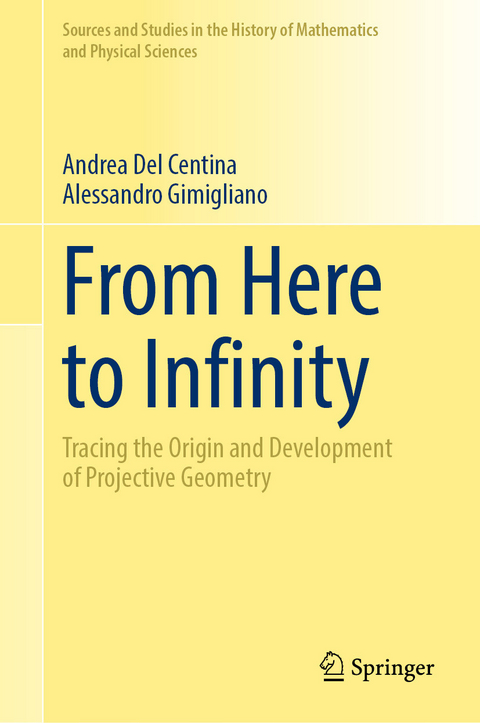
This monograph traces the development of projective geometry from its Greek origins to the early 20th century. It covers Renaissance perspective studies and insights from the late sixteenth to seventeenth centuries, examining the contributions of Desargues and Pascal.
Most of the book is devoted to the evolution of the subject in the 19th century, from Carnot to von Staudt. In particular, the book offers an unusually thorough appreciation of Brianchon's work, a detailed study of Poncelet's innovations, and a remarkable account of the contributions of Möbius and Plücker. It also addresses the difficult question of the historical relationship between synthetic and analytic points of view in geometry, analyzing the work of prominent synthetic geometers Steiner, Chasles, and von Staudt in detail. The book concludes around 1930, after the synthetic point of view was axiomatized and the analytic point of view became intertwined with algebraic geometry.
Balancing historical analysis with technical precision and providing deep insights into the evolution of the mathematics, this richly illustrated book serves as a central reference on the history of projective geometry.
| Erscheint lt. Verlag | 3.3.2025 |
|---|---|
| Reihe/Serie | Sources and Studies in the History of Mathematics and Physical Sciences |
| Zusatzinfo | XLII, 788 p. 448 illus. |
| Sprache | englisch |
| Themenwelt | Mathematik / Informatik ► Mathematik ► Allgemeines / Lexika |
| Schlagworte | Chasles • conic sections • Desargues • history of geometry • PASCAL • Perspective • Points at Infinity • Poncelet • Projective Geometry • Von Staudt |
| ISBN-10 | 3-031-72585-9 / 3031725859 |
| ISBN-13 | 978-3-031-72585-2 / 9783031725852 |
| Informationen gemäß Produktsicherheitsverordnung (GPSR) | |
| Haben Sie eine Frage zum Produkt? |
 PDF (Wasserzeichen)
DRM: Digitales Wasserzeichen
Dieses eBook enthält ein digitales Wasserzeichen und ist damit für Sie personalisiert. Bei einer missbräuchlichen Weitergabe des eBooks an Dritte ist eine Rückverfolgung an die Quelle möglich.
Dateiformat: PDF (Portable Document Format)
Mit einem festen Seitenlayout eignet sich die PDF besonders für Fachbücher mit Spalten, Tabellen und Abbildungen. Eine PDF kann auf fast allen Geräten angezeigt werden, ist aber für kleine Displays (Smartphone, eReader) nur eingeschränkt geeignet.
Systemvoraussetzungen:
PC/Mac: Mit einem PC oder Mac können Sie dieses eBook lesen. Sie benötigen dafür einen PDF-Viewer - z.B. den Adobe Reader oder Adobe Digital Editions.
eReader: Dieses eBook kann mit (fast) allen eBook-Readern gelesen werden. Mit dem amazon-Kindle ist es aber nicht kompatibel.
Smartphone/Tablet: Egal ob Apple oder Android, dieses eBook können Sie lesen. Sie benötigen dafür einen PDF-Viewer - z.B. die kostenlose Adobe Digital Editions-App.
Buying eBooks from abroad
For tax law reasons we can sell eBooks just within Germany and Switzerland. Regrettably we cannot fulfill eBook-orders from other countries.
aus dem Bereich