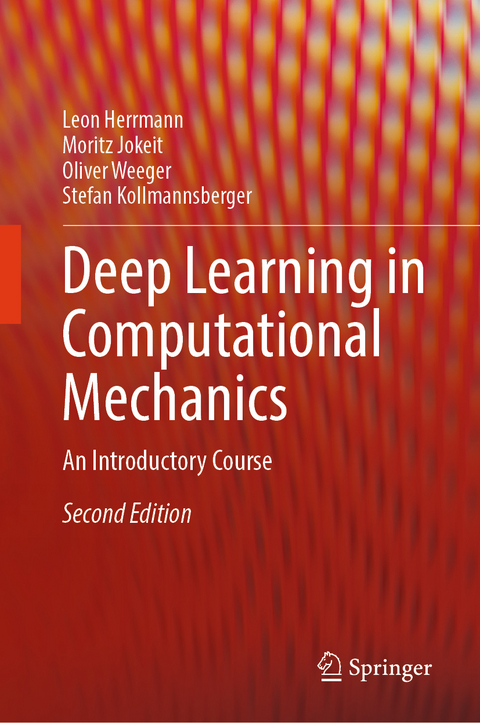
Deep Learning in Computational Mechanics
Springer International Publishing (Verlag)
978-3-031-89528-9 (ISBN)
This book provides a first course without requiring prerequisite knowledge. Fundamental concepts of machine learning are introduced before explaining neural networks. With this knowledge, prominent topics in deep learning for simulation are explored. These include surrogate modeling, physics-informed neural networks, generative artificial intelligence, Hamiltonian/Lagrangian neural networks, input convex neural networks, and more general machine learning techniques.
The idea of the book is to provide basic concepts as simple as possible but in a mathematically sound manner. Starting point are one-dimensional examples including elasticity, plasticity, heat evolution, or wave propagation. The concepts are then expanded to state-of-the-art applications in material modeling, generative artificial intelligence, topology optimization, defect detection, and inverse problems.
Leon Herrmann has a uniquely diverse background; born in South Africa and
growing up in seven different countries. He earned a bachelor's degree in
Mechanical Engineering from the Technical University of Denmark (DTU) and a
master's degree in Computational Mechanics from the Technical University of
Munich (TUM), where he also obtained his doctorate for his work in
computational mechanics with neural networks. His primary research focus has
been on finite element methods, fracture in composite materials, and combining
traditional numerical simulations with modern machine learning techniques.
As a product of the Mauerfall , Moritz Jokeit grew up in the non-existing town of
Bielefeld and the alpine foothills near Rosenheim. Following his bachelor s
degree in Civil Engineering, he studied Computational Mechanics at the
Technical University of Munich (TUM) and the Polytechnic University of Catalonia
(UPC). His passion for deep learning and computational mechanics was
transformed into a master thesis that laid the groundwork for this lecture book.
After his graduation he continued his research at the Chair of Computational
Modeling and Simulation. He is now a doctoral candidate at the Institute for
Biomechanics at the ETH Zürich focusing on the mechanics of the spine.
Oliver Weeger is a Full Professor for Cyber-Physical Simulation with the
Department of Mechanical Engineering at the Technical University of Darmstadt
in Germany. He graduated in Techno-Mathematics from TU Munich in 2011 and
obtained his Ph.D. in Mathematics from TU Kaiserslautern in 2015. Before joining
TU Darmstadt in 2019, he had been working at the Singapore University of
Technology and Design as a Postdoctoral Researcher and Assistant Professor.
His passion for research and education evolves around advanced computational
methods, modeling, and optimization approaches for nonlinear, multiscale, and
multiphysics problems in engineering. In particular, this includes the fusion of
machine learning, classical modeling, and simulation to obtain flexible and yet
accurate, reliable and robust predictive models for computational mechanics.
Stefan Kollmannsberger graduated in Civil Engineering in 1998 and worked for
several years as heavy underground construction engineer before returning to
university to devote himself to computational mechanics. He graduated with a
PhD at the Technical University of Munich in 2009, where he enjoyed leading the
research group Simulation in Applied Mechanics until 2023. Since then, he is
full professor at the Bauhaus University in the culturally opulent city of Weimar
and heads the Chair of Data Science in Construction. He is dedicated to both
teaching and science and uses the content of this lecture book as a basis for an
introductory course in the field of artificial intelligence in computational
mechanics.
Computational Mechanics Meets Artificial Intelligence.- Neural Networks.- Machine Learning in Computational Mechanics.- Methodological Overview of Deep Learning in Computational Mechanics.- Index.
| Erscheinungsdatum | 26.11.2025 |
|---|---|
| Zusatzinfo | XXVI, 475 p. 192 illus., 128 illus. in color. With online files/update. |
| Verlagsort | Cham |
| Sprache | englisch |
| Maße | 155 x 235 mm |
| Themenwelt | Informatik ► Theorie / Studium ► Künstliche Intelligenz / Robotik |
| Technik ► Maschinenbau | |
| Schlagworte | Artificial Intelligence • Computational Intelligence • Computational Mechanics • machine learning • Neural networks |
| ISBN-10 | 3-031-89528-2 / 3031895282 |
| ISBN-13 | 978-3-031-89528-9 / 9783031895289 |
| Zustand | Neuware |
| Informationen gemäß Produktsicherheitsverordnung (GPSR) | |
| Haben Sie eine Frage zum Produkt? |
aus dem Bereich