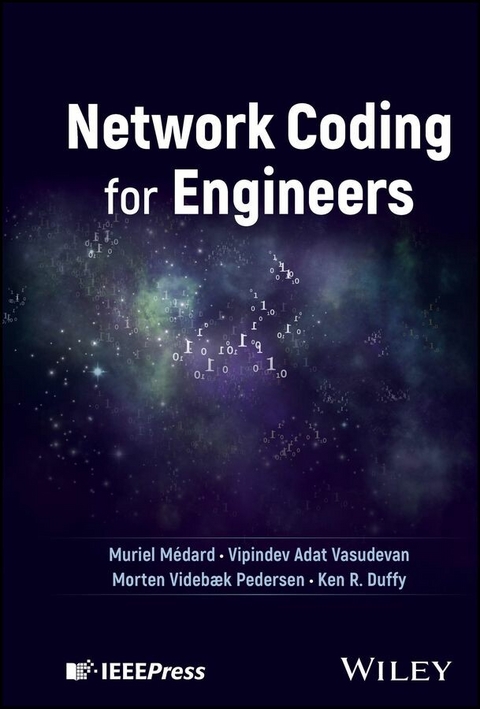
Network Coding for Engineers (eBook)
275 Seiten
Wiley-IEEE Press (Verlag)
978-1-394-21728-1 (ISBN)
Understand the fundamentals of network coding from an engineering perspective with this accessible guide
Network Coding is a method of increasing network throughput and efficiency by encoding and decoding transmitted data packets instead of simply forwarding them. It was mainly a body of information theory until the rise of random linear networking coding (RLNC), a method ideally suited to wireless networks and other cooperative environments. The ease of introducing network coding to legacy systems and the resulting gains in efficiency have made this a widely applied technology with the potential to revolutionize networked communications.
Network Coding for Engineers introduces the fundamentals of this exciting subject from an engineering perspective. Beginning with the basics, including step-by-step details for implementing network coding and current applications, it also highlights potential uses of network coding in the communications technologies of the future. The result is an innovative and accessible introduction to a subject quickly becoming indispensable.
Network Coding for Engineers readers will also find:
- A structure that facilitates gradual deepening of knowledge, ideal for students and new readers
- Follows a semester-long course curriculum structure, making it suitable for direct adaptation for academic purposes
- Detailed discussion of future applications in technology areas including post-quantum cryptography, 6G, and more
- Design principles for different network models, such as multi-path and mesh networks
Network Coding for Engineers is ideal for electrical engineering and computer science students, particularly those studying advanced networking and communications and related subjects.
Muriel Médard, PhD, is NEC Professor of Software Science and Engineering in the Electrical Engineering and Computer Science (EECS) Department and Head of the Network Coding and Reliable Communications Group in the Research Laboratory of Electronics at the Massachusetts Institute of Technology (MIT), USA. She is a member of the US National Academy of Engineering and a Fellow of the US National Academy of Inventors and the Institute of Electrical and Electronics Engineers, among other organizations, and is a past president of the IEEE Information Theory Society.
Vipindev Adat Vasudevan, PhD, is a Postdoctoral Associate in the Network Coding and Reliable Communications Group in the Research Laboratory of Electronics, Massachusetts Institute of Technology (MIT), USA. He has previously worked as an MSCA Fellow in the Wireless Telecommunications Laboratory of the University of Patras, Greece, and has researched extensively into network coding, network security, 5G, and related subjects.
Morten Videbæk Pedersen, PhD, is co-founder and Chief Technology Officer of Steinwurf APS, a company specializing in industrial-grade high-performance content distribution systems, where he focuses on low-complexity network coding algorithms and cooperative networking programs. He is a member of the Mobile Devices Research Group, Aalborg, Denmark, and a past recipient of the Forum Nokia Developer Champion Award.
Ken R. Duffy, PhD, is a Professor of Electrical and Computer Engineering, and a Professor of Mathematics, at Northeastern University (NU), USA. He leads the Engineering Probability Information and Communications Laboratory and is core faculty at NU's Institute for the Wireless Internet of Things. He was previously the Director of the Hamilton Institute at the National University of Ireland, Maynooth, and a co-director of the Science Foundation Ireland Centre for Research Training in Foundations of Data Science.
Understand the fundamentals of network coding from an engineering perspective with this accessible guide Network Coding is a method of increasing network throughput and efficiency by encoding and decoding transmitted data packets instead of simply forwarding them. It was mainly a body of information theory until the rise of random linear networking coding (RLNC), a method ideally suited to wireless networks and other cooperative environments. The ease of introducing network coding to legacy systems and the resulting gains in efficiency have made this a widely applied technology with the potential to revolutionize networked communications. Network Coding for Engineers introduces the fundamentals of this exciting subject from an engineering perspective. Beginning with the basics, including step-by-step details for implementing network coding and current applications, it also highlights potential uses of network coding in the communications technologies of the future. The result is an innovative and accessible introduction to a subject quickly becoming indispensable. Network Coding for Engineers readers will also find: A structure that facilitates gradual deepening of knowledge, ideal for students and new readersFollows a semester-long course curriculum structure, making it suitable for direct adaptation for academic purposesDetailed discussion of future applications in technology areas including post-quantum cryptography, 6G, and moreDesign principles for different network models, such as multi-path and mesh networks Network Coding for Engineers is ideal for electrical engineering and computer science students, particularly those studying advanced networking and communications and related subjects.
| Erscheint lt. Verlag | 28.2.2025 |
|---|---|
| Sprache | englisch |
| Themenwelt | Mathematik / Informatik ► Informatik ► Netzwerke |
| Schlagworte | Communication Protocols • Decoding • encoded packets • Finite Fields • information packets • Linear operations • low latency • Multicasting • network efficiency • network infrastructure • network throughput • random linear network coding • small-cell environments |
| ISBN-10 | 1-394-21728-5 / 1394217285 |
| ISBN-13 | 978-1-394-21728-1 / 9781394217281 |
| Informationen gemäß Produktsicherheitsverordnung (GPSR) | |
| Haben Sie eine Frage zum Produkt? |
 PDF (Adobe DRM)
Kopierschutz: Adobe-DRM
Adobe-DRM ist ein Kopierschutz, der das eBook vor Mißbrauch schützen soll. Dabei wird das eBook bereits beim Download auf Ihre persönliche Adobe-ID autorisiert. Lesen können Sie das eBook dann nur auf den Geräten, welche ebenfalls auf Ihre Adobe-ID registriert sind.
Details zum Adobe-DRM
Dateiformat: PDF (Portable Document Format)
Mit einem festen Seitenlayout eignet sich die PDF besonders für Fachbücher mit Spalten, Tabellen und Abbildungen. Eine PDF kann auf fast allen Geräten angezeigt werden, ist aber für kleine Displays (Smartphone, eReader) nur eingeschränkt geeignet.
Systemvoraussetzungen:
PC/Mac: Mit einem PC oder Mac können Sie dieses eBook lesen. Sie benötigen eine
eReader: Dieses eBook kann mit (fast) allen eBook-Readern gelesen werden. Mit dem amazon-Kindle ist es aber nicht kompatibel.
Smartphone/Tablet: Egal ob Apple oder Android, dieses eBook können Sie lesen. Sie benötigen eine
Geräteliste und zusätzliche Hinweise
Buying eBooks from abroad
For tax law reasons we can sell eBooks just within Germany and Switzerland. Regrettably we cannot fulfill eBook-orders from other countries.
aus dem Bereich