


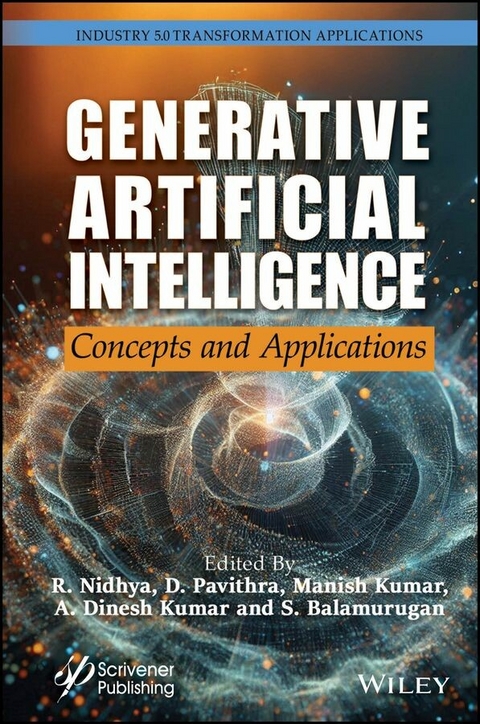
Generative Artificial Intelligence (eBook)
434 Seiten
Wiley-Scrivener (Verlag)
978-1-394-20981-1 (ISBN)
This book is a comprehensive overview of AI fundamentals and applications to drive creativity, innovation, and industry transformation.
Generative AI stands at the forefront of artificial intelligence innovation, redefining the capabilities of machines to create, imagine, and innovate. GAI explores the domain of creative production with new and original content across various forms, including images, text, music, and more. In essence, generative AI stands as evidence of the boundless potential of artificial intelligence, transforming industries, sparking creativity, and challenging conventional paradigms. It represents not just a technological advancement but a catalyst for reimagining how machines and humans collaborate, innovate, and shape the future.
The book examines real-world examples of how generative AI is being used in a variety of industries. The first section explores the fundamental concepts and ethical considerations of generative AI. In addition, the section also introduces machine learning algorithms and natural language processing. The second section introduces novel neural network designs and convolutional neural networks, providing dependable and precise methods. The third section explores the latest learning-based methodologies to help researchers and farmers choose optimal algorithms for specific crop and hardware needs. Furthermore, this section evaluates significant advancements in revolutionizing online content analysis, offering real-time insights into content creation for more interactive processes.
Audience
The book will be read by researchers, engineers, and students working in artificial intelligence, computer science, and electronics and communication engineering as well as industry application areas.
R. Nidhya, PhD, is an assistant professor in the Department of Computer Science & Engineering, Madanapalle Institute of Technology & Science, affiliated with Jawaharlal Nehru Technical University, Anantapuram, India. She has published many research papers in international journals and her research interests include wireless body area networks, network security, and data mining.
D. Pavithra, PhD, is an assistant professor at Dr. NGP Institute of Technology, Coimbatore, Tamil Nadu, India. Her current research interests include autism, machine learning, and deep learning.
Manish Kumar, PhD, is an assistant professor at The School of Computer Science & Engineering, VIT, Chennai, India. His research interests include soft computing applications for bioinformatics problems and computational intelligence.
A. Dinesh Kumar, PhD, is an associate professor at KL (Deemed to be University), Vijayawada, Andhra Pradesh, India. His current research interests include wireless body area networks, wireless sensor networks, network security, and artificial intelligence.
S. Balamurugan, PhD, is the Director of Research and Development, Intelligent Research Consultancy Services (iRCS), Coimbatore, Tamil Nadu, India. He is also Director of the Albert Einstein Engineering and Research Labs (AEER Labs), as well as Vice-Chairman of the Renewable Energy Society of India (RESI), India. He has published 50+ books, 200+ international journals/conferences, and 35 patents.
This book is a comprehensive overview of AI fundamentals and applications to drive creativity, innovation, and industry transformation. Generative AI stands at the forefront of artificial intelligence innovation, redefining the capabilities of machines to create, imagine, and innovate. GAI explores the domain of creative production with new and original content across various forms, including images, text, music, and more. In essence, generative AI stands as evidence of the boundless potential of artificial intelligence, transforming industries, sparking creativity, and challenging conventional paradigms. It represents not just a technological advancement but a catalyst for reimagining how machines and humans collaborate, innovate, and shape the future. The book examines real-world examples of how generative AI is being used in a variety of industries. The first section explores the fundamental concepts and ethical considerations of generative AI. In addition, the section also introduces machine learning algorithms and natural language processing. The second section introduces novel neural network designs and convolutional neural networks, providing dependable and precise methods. The third section explores the latest learning-based methodologies to help researchers and farmers choose optimal algorithms for specific crop and hardware needs. Furthermore, this section evaluates significant advancements in revolutionizing online content analysis, offering real-time insights into content creation for more interactive processes. Audience The book will be read by researchers, engineers, and students working in artificial intelligence, computer science, and electronics and communication engineering as well as industry application areas.
1
Exploring the Creative Frontiers: Generative AI Unveiled
Generated Using ChatGPT*
Abstract
Generative artificial intelligence (AI) stands at the forefront of technological innovation, captivating minds and pushing the boundaries of creativity. This paper delves into the realm of generative AI, exploring its foundational concepts, applications across diverse domains, ethical considerations, and the future implications it holds. The study navigates through the evolution of generative AI, highlighting its capabilities in generating content, fostering artistic expression, aiding in problem-solving, and revolutionizing various industries. Additionally, it examines the ethical implications associated with generative AI’s advancements, shedding light on concerns regarding bias, authenticity, and societal impact. The paper concludes by envisioning future prospects and challenges that lie ahead in the fascinating landscape of generative AI.
1.1 Introduction
1.1.1 Definition and Significance of Generative AI
Generative artificial intelligence (AI) refers to a subset of AI that focuses on creating, generating, or producing new content, information, or data that mimics human-like creativity and innovation. Unlike traditional AI, which typically focuses on analyzing existing data to make predictions or decisions, generative AI is designed to generate new content autonomously.
The significance of generative AI lies in its ability to simulate humanlike creativity, enabling machines to produce content that ranges from text, images, and music to videos and more. This technology has far-reaching implications across various domains:
Creative Expression: Generative AI allows for the creation of original artworks, music compositions, and literary pieces. This facilitates new forms of artistic expression and exploration.
Content Generation: It helps in automating the generation of content for various purposes, such as writing news articles, producing marketing materials, or creating realistic images and videos.
Problem-solving and Innovation: Generative AI aids in exploring new solutions to complex problems by generating diverse hypotheses and scenarios, contributing to innovation in research and development.
Personalization and Customization: It enables personalized content creation, catering to individual preferences and needs, thereby enhancing user experiences in various applications.
Data Augmentation and Simulation: In scientific research and data analysis, generative models assist in generating synthetic data, facilitating better analysis and understanding of complex systems.
Enhanced Realism in Virtual Environments: In gaming and virtual reality (VR), generative AI enhances the realism of virtual worlds, creating more immersive experiences for users.
Generative AI’s significance also lies in its potential to transform industries by automating content creation, aiding in decision-making processes, and driving innovation. However, its development raises ethical concerns related to authenticity, bias, privacy, and ownership of generated content. Understanding and addressing these ethical challenges are crucial for responsible deployment and usage of generative AI in various fields.
1.1.2 Historical Overview and Development
The history of generative AI is an evolutionary journey marked by significant milestones in the field of AI and machine learning. Here is a brief historical overview:
Early Concepts (1950s – 1960s): The roots of generative AI can be traced back to the early days of AI research. Pioneers like Alan Turing laid the theoretical groundwork for machine intelligence and the concept of machines exhibiting creative behavior.
Rule-based Systems (1970s – 1980s): Early AI systems relied on rulebased approaches, where experts codified explicit rules for the computer to follow. While these systems were not inherently generative, they formed the basis for later developments.
Probabilistic Models (1990s – 2000s): Bayesian networks and probabilistic graphical models emerged, allowing machines to model uncertainty and generate probabilistic outputs. This era saw advancements in probabilistic modeling for tasks like speech recognition and natural language processing.
Rise of Neural Networks (2010s): With the resurgence of neural networks and deep learning, generative AI witnessed a significant leap. Variational Autoencoders (VAEs) and generative adversarial networks (GANs) became prominent; VAEs focused on learning latent representations of data for generative purposes, while GANs introduced a novel adversarial training framework for generating realistic data.
Recent Advancements (2010s – 2020s): The latter half of the 2010s and early 2020s marked rapid progress in generative AI. OpenAI’s generative pre-trained transformer (GPT) models, starting from GPT-1 and evolving into larger versions like GPT-2 and GPT-3, showcased the power of large-scale language generation.
Diversification of Generative Models: The development of various architectures and techniques, such as transformer models, attention mechanisms, reinforcement learning, and fine-tuning strategies, expanded the capabilities of generative AI beyond language to images, music, and multimodal generation.
Ethical and Social Implications: Alongside technological advancements, discussions about the ethical implications of generative AI, including issues of bias, manipulation, and misinformation, gained prominence. Researchers and policymakers began addressing these concerns to ensure responsible use of generative technologies.
The historical progression of generative AI highlights the iterative nature of technological development, driven by advancements in algorithms, computational power, and data availability. This evolution laid the foundation for contemporary generative AI models and their diverse applications across industries, setting the stage for further innovation and ethical considerations in the field.
1.2 Foundational Concepts
1.2.1 Neural Networks and Generative Models
Neural networks serve as the backbone for many generative models within the realm of generative AI. These models leverage neural network architectures to facilitate the generation of new content or data. Here is an overview of how neural networks are used in generative models:
Feedforward Neural Networks (FNNs):
- FNNs consist of interconnected layers of nodes, passing information in a unidirectional flow from input to output.
- While not inherently generative, FNNs can be used in generative settings, especially in early rule-based approaches where explicit instructions guide the generation process.
Recurrent Neural Networks (RNNs):
- RNNs are designed to process sequential data by utilizing loops within the network, allowing information to persist over time.
- RNNs are employed in language generation tasks where context and sequence are crucial, but they face challenges in modeling long-range dependencies due to vanishing/exploding gradient problems.
Variational Autoencoders (VAEs) with Neural Networks:
- VAEs employ neural networks as encoders and decoders. These networks learn to encode input data into a latent space representation and decode it back to generate output data.
- The encoder and decoder networks in VAEs are typically composed of feedforward or convolutional neural networks.
Generative Adversarial Networks (GANs) with Neural Networks:
- GANs consist of two neural networks—the generator and the discriminator—working in tandem.
- The generator uses neural networks to transform random noise into data that resembles real data, while the discriminator uses neural networks to distinguish between real and generated data.
Transformer Models:
- Transformer models, like the ones used in GPT series, employ attention mechanisms and self-attention layers to process and generate sequences.
- These models leverage neural networks to generate text, allowing for longer-range dependencies and capturing intricate patterns in the data.
Neural networks serve as the computational backbone for various generative models, allowing for the creation of sophisticated architectures capable of generating diverse and high-quality content across different modalities—such as text, images, audio, and more. The advancements in neural network architectures and training methodologies continue to drive innovation in generative AI, enabling the development of more powerful and versatile generative models.
1.2.2 Variational Autoencoders (VAEs) and Generative Adversarial Networks (GANs)
Variational autoencoders (VAEs) and generative adversarial networks (GANs) represent two powerful paradigms in generative AI, each with unique approaches to generating new content. Here’s an exploration of their key characteristics and differences:
- Variational Autoencoders (VAEs):
- Objective: VAEs aim to learn a latent representation of data by mapping it to a lower-dimensional space and reconstructing it back to the original form.
- Architecture: VAEs consist of an encoder and a decoder. The encoder maps input data to a latent space, producing mean and variance parameters that describe a probabilistic distribution. The decoder generates data from samples drawn from...
| Erscheint lt. Verlag | 27.2.2025 |
|---|---|
| Reihe/Serie | Industry 5.0 Transformation Applications |
| Sprache | englisch |
| Themenwelt | Mathematik / Informatik ► Informatik ► Theorie / Studium |
| Schlagworte | Algorithmic Approach for Industrialization • Artificial Intelligence • Brain Tumor Detection • Computational Intelligence • Content Intelligence • Conversational Intelligence • Decision Support Systems • Diseases Prediction • Generative Adversarial Network • generative AI • Image Processing • Natural Language Processing • Neuro Computing Algorithms • Soft Computing • supervised learning |
| ISBN-10 | 1-394-20981-9 / 1394209819 |
| ISBN-13 | 978-1-394-20981-1 / 9781394209811 |
| Informationen gemäß Produktsicherheitsverordnung (GPSR) | |
| Haben Sie eine Frage zum Produkt? |
 EPUB (Adobe DRM)
Kopierschutz: Adobe-DRM
Adobe-DRM ist ein Kopierschutz, der das eBook vor Mißbrauch schützen soll. Dabei wird das eBook bereits beim Download auf Ihre persönliche Adobe-ID autorisiert. Lesen können Sie das eBook dann nur auf den Geräten, welche ebenfalls auf Ihre Adobe-ID registriert sind.
Details zum Adobe-DRM
Dateiformat: EPUB (Electronic Publication)
EPUB ist ein offener Standard für eBooks und eignet sich besonders zur Darstellung von Belletristik und Sachbüchern. Der Fließtext wird dynamisch an die Display- und Schriftgröße angepasst. Auch für mobile Lesegeräte ist EPUB daher gut geeignet.
Systemvoraussetzungen:
PC/Mac: Mit einem PC oder Mac können Sie dieses eBook lesen. Sie benötigen eine
eReader: Dieses eBook kann mit (fast) allen eBook-Readern gelesen werden. Mit dem amazon-Kindle ist es aber nicht kompatibel.
Smartphone/Tablet: Egal ob Apple oder Android, dieses eBook können Sie lesen. Sie benötigen eine
Geräteliste und zusätzliche Hinweise
Buying eBooks from abroad
For tax law reasons we can sell eBooks just within Germany and Switzerland. Regrettably we cannot fulfill eBook-orders from other countries.
aus dem Bereich


