Macs For Seniors For Dummies (eBook)
398 Seiten
For Dummies (Verlag)
978-1-394-31354-9 (ISBN)

It's never too late to become a Mac expert!
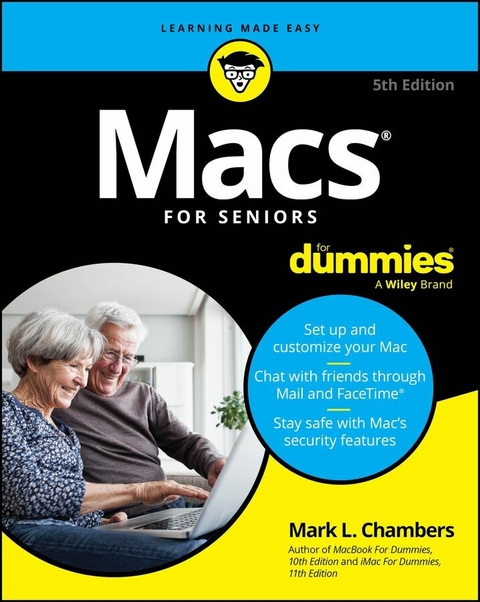
Every year, hundreds of thousands of seniors choose to use Mac products-like the MacBook Air and iMac-to connect with their loved ones, access the web, and make their lives easier. And even if you've never used a Mac before, we're here to show you how you can make the most of it-one easy step at a time!
The newly updated fifth edition of Macs For Seniors For Dummies is filled with large, easy-to-read text, sharp figures and illustrations, and accessible instructions to help you give the Gen-Z or millennial in your life a run for their money. You'll learn how to customize your Mac so it works exactly the way you want it to, connect to the Internet, work with documents and spreadsheets, play music, watch video, and even read the latest news headlines.
This book walks you through how to secure your Mac so your privacy and data is protected and gets you comfortable with the operating system so you won't have to worry about 'breaking' something again. You'll also find:
- Instructions for handy applications so you can make to-do lists and text documents
- Step-by-step instructions to keep your Mac updated for security and convenience
- Strategies to help you choose a Mac to buy (if you haven't bought one already)
Macs are truly the computers for everyone! Whether you're looking to get started with Macs for the first time or you're a long-time Mac user searching for updates, Macs For Seniors For Dummies is where you'll find the easy-to-follow info you need. Grab a copy today!
Mark L. Chambers has over 40 years of experience as a tech author and computer consultant. His recent titles include MacBook For Dummies, Macs For Seniors For Dummies, and iMac For Dummies. Mark is currently a full-time author and tech editor-and an unabashed Mac fan.
Chapter 1
Buying a Mac
IN THIS CHAPTER
Know What Your Mac Can Do
Understand Hardware and Software
Choose a Desktop or Laptop
Assess Computing Power Needs
Choose a Price Range
Select a Monitor
Compare Processors, Memory, and Internal Drives
Decide Which Software You Want
Buy Online or at the Apple Store
Shopping for a Mac can leave you dazzled by a long list of features, acronyms, and assorted hoo-hah. This chapter is here to help explain what to look for and why while you shop, especially if this is your first Mac.
The best part? I wrote it in common English, with the smallest amount of technobabble possible. (That’s my job!) In this chapter, you discover the tasks that your Mac can perform and the differences between hardware and software. You also find out about the various Mac models and what features and specifications to covet when shopping for a Mac.
Know What Your Mac Can Do
I would bet that you already know why you want a computer. You have an idea what you want to do with a Mac, but you may not know all the things you can do with a computer.
To help get you excited about owning a Mac, here’s a (very) short list of only a few of the most popular uses for a computer these days. See whether any of these uses reflects what you want to do or you see any tasks that you want to learn more about:
- The internet: You knew I would start with the web (home of pages like
Google.comandApple.com) and electronic mail (or email). Now you can also add online games, instant messaging (like the texts you send from your smartphone), social media (like Facebook and Instagram), shopping, banking, streaming audio (like Spotify), internet radio and video streaming (like Netflix) to the mix. The internet literally expands in front of your eyes, and your Mac can be your doorway to the online world. - Digital media: If your interest is digital media, such as photography, video, or music (making it or listening to it), you’re in luck — your Mac comes with everything you need to get started.
- Data collection: If genealogy is your passion — or collecting baseball cards or cataloging stamps — your Mac can help you enter, organize, and present your treasured information.
- Productivity stuff: Oh, yes! You can compose documents, create spreadsheets, and build professional-looking presentations on your Mac with ease using the productivity applications that come with your Mac (which I cover in Part 3). You also can use productivity applications that you purchase separately, such as the popular Microsoft Office suite and free applications like Google Docs (both of which are available on the internet).
Remember, this list offers only a few high points. The more time you invest learning about your Mac and the software that’s available, the more you’ll get from it.
Understand Hardware and Software
First-time computer owners often become confused about what constitutes hardware and what should rightly be called software. It’s time to clear things up!
In the computing world, hardware is any piece of circuitry or any component of your computer with a physical structure. Your Mac’s monitor (the computer screen) is a piece of hardware, for example, as are your mouse or trackpad (the pointing device you use to direct your Mac’s actions) and your keyboard. So are the components you normally can’t see or touch (the ones buried inside the case), such as your Mac’s internal drive. And even your computer’s case is technically a piece of hardware, even though it’s not electrical.
You can also expand your Mac with all sorts of new hardware. Figure 1-1 illustrates a common piece of hardware you can connect to your Mac: an internet router that connects a fiber, DSL, or cable internet connection with a home network.
The other side of the computing coin is the software you use. Software refers to programs (also called applications) that you interact with onscreen. Examples include a word processing application that displays your typing and a chess program that enables you to move pieces onscreen. Figure 1-2 shows Apple’s Photos image editor, a photo editing app (or program) that helps you see and organize digital photos.
Essentially, computer hardware and software work together so that you can do various tasks on your computer.
When you hear folks discussing a software upgrade, patch, or update, they’re talking about (you guessed it) another piece of software! However, the upgrade-patch-update program isn’t designed to be run more than once; rather, its job is to apply the latest features, fixes, and data files to a piece of software that’s already running on your Mac, to update it to a new version. (Virtually all software developers refer to successive editions of their software, such as Version 1.5 or Version 3; the higher the version, generally the more features the software includes.) In Chapter 18, you find out how to maintain your Mac with updates.
Choose a Desktop or Laptop
First, some quick definitions: A desktop Mac is designed to sit on your desk and uses a separate monitor, keyboard, and mouse. Examples are the iMac, Mac Studio, Mac mini, and Mac Pro.
The iMac is a special case: iMacs are “all-in-one” computers, with the monitor and computer both housed in the same case to save space. However, the keyboard and mouse still reside separately from the “picture frame” case on these computers.
On the other hand, a laptop Mac is portable. You can carry the whole package with you because laptops have a built-in keyboard, a trackpad (the square pointing device located on the base of the laptop, near the keyboard, that takes the place of a mouse), and an integrated monitor. MacBooks are laptop computers. Laptops are as powerful as most of the Mac desktop line, and MacBook Air and Pro models offer desktop-type features, such as high-resolution graphics, speakers and microphones, and Wi-Fi (or wireless networking).
Figure 1-3 shows the different types of Mac computers you have to choose from.
So should you buy a desktop or a laptop Mac? If portability is a requirement — maybe your job or your lifestyle demands travel — you want to opt for a laptop, such as a MacBook Air or MacBook Pro.
If you’re sitting on the fence and portability is a lesser requirement, I generally recommend getting a Mac desktop system, for these two important reasons:
- MacBooks are more expensive than desktop Macs of similar capability. My friend, you pay dearly for that portability. If you don’t need it, jump to the desktop side of the fence. It’s that simple.
- Laptops usually cost much more to repair. All Mac computers (both desktops and laptops) require the attention of a certified Apple repair technician if an internal component breaks. However, part of the MacBook portability stems from the computer industry practice of shoehorning all hardware onto one circuit board to save space. So if one piece malfunctions, you have to take apart (and perhaps replace) the whole thing, which isn’t an easy (or inexpensive) task.
Bottom line, if portability isn’t important, opt for a desktop — an iMac, Mac Studio, Mac mini, or Mac Pro — depending on the processing power you need (as described in the following section) and the desk space you have available.
Know How Much Computing Power Is Too Much
Take a moment to consider which tasks your Mac will be used for — not only now but also a year or three down the road. If you plan to try your hand at any of the following tasks (either now, or in the future), feel free to label yourself a power user:
- High-resolution photography, audio and music production, or video editing: If you want to edit high-resolution digital photography (images from a 48-megapixel camera, for example), record or edit professional audio, or do any type of video editing (including using the iMovie application), you need a Mac with horsepower. Think of serious professional photographers, musicians, or videographers.
- Running resource-hogging software: The perfect example is Adobe Photoshop, a program you use to work with high-resolution images that demands the highest level of horsepower your Mac can deliver, along with requirements for more system memory (or RAM). Today’s cutting-edge 3D games also require a powerful Mac to run well.
If the preceding points apply to you, you need a powerful Mac Studio desktop, Mac Pro desktop, or MacBook Pro laptop.
If you know the specific programs you’ll be running, check the requirements for that software on the manufacturer’s website or the program’s packaging (typically, on the side of the box). That way, you can gain a better idea up front whether you need to invest in a more expensive, more powerful Mac Studio or MacBook...
| Erscheint lt. Verlag | 26.2.2025 |
|---|---|
| Sprache | englisch |
| Themenwelt | Informatik ► Weitere Themen ► Hardware |
| Schlagworte | are macs easy? • are macs easy to use? • can I use a mac? • how do I use a mac? • mac or pc? • mac or windows? • Macs for beginners • macs for senior citizens • should I buy a mac? • should I get a mac? • should I get a mac or pc? • which mac should I buy? |
| ISBN-10 | 1-394-31354-3 / 1394313543 |
| ISBN-13 | 978-1-394-31354-9 / 9781394313549 |
| Informationen gemäß Produktsicherheitsverordnung (GPSR) | |
| Haben Sie eine Frage zum Produkt? |
 EPUB (Adobe DRM)
Kopierschutz: Adobe-DRM
Adobe-DRM ist ein Kopierschutz, der das eBook vor Mißbrauch schützen soll. Dabei wird das eBook bereits beim Download auf Ihre persönliche Adobe-ID autorisiert. Lesen können Sie das eBook dann nur auf den Geräten, welche ebenfalls auf Ihre Adobe-ID registriert sind.
Details zum Adobe-DRM
Dateiformat: EPUB (Electronic Publication)
EPUB ist ein offener Standard für eBooks und eignet sich besonders zur Darstellung von Belletristik und Sachbüchern. Der Fließtext wird dynamisch an die Display- und Schriftgröße angepasst. Auch für mobile Lesegeräte ist EPUB daher gut geeignet.
Systemvoraussetzungen:
PC/Mac: Mit einem PC oder Mac können Sie dieses eBook lesen. Sie benötigen eine
eReader: Dieses eBook kann mit (fast) allen eBook-Readern gelesen werden. Mit dem amazon-Kindle ist es aber nicht kompatibel.
Smartphone/Tablet: Egal ob Apple oder Android, dieses eBook können Sie lesen. Sie benötigen eine
Geräteliste und zusätzliche Hinweise
Buying eBooks from abroad
For tax law reasons we can sell eBooks just within Germany and Switzerland. Regrettably we cannot fulfill eBook-orders from other countries.
aus dem Bereich