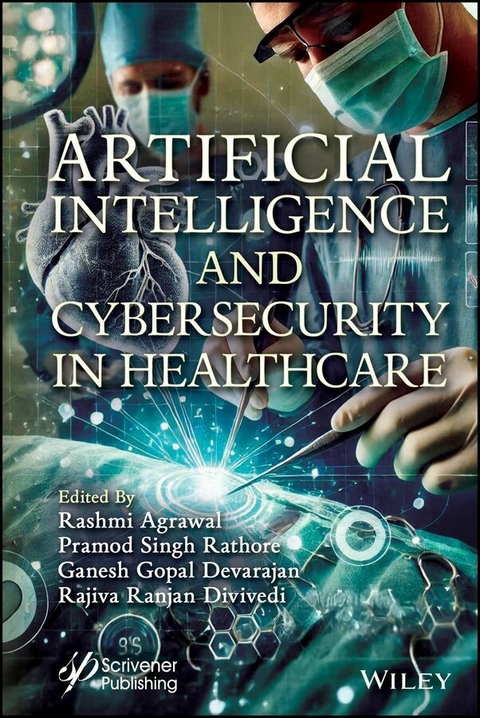
Artificial Intelligence and Cybersecurity in Healthcare (eBook)
719 Seiten
Wiley-Scrivener (Verlag)
978-1-394-22980-2 (ISBN)
Artificial Intelligence and Cybersecurity in Healthcare provides a crucial exploration of AI and cybersecurity within healthcare Cyber Physical Systems (CPS), offering insights into the complex technological landscape shaping modern patient care and data protection.
As technology advances, healthcare has transformed, particularly through the implementation of CPS that integrate the digital and physical worlds, enhancing system efficiency and effectiveness. This increased reliance on technology raises significant security concerns. The book addresses the integration of AI and cybersecurity in healthcare CPS, detailing technological advancements, applications, and the challenges they present.
AI applications in healthcare CPS include remote patient monitoring, AI chatbots for patient assistance, and biometric authentication for data security. AI not only improves patient care and clinical decision-making by analyzing extensive data and optimizing treatment plans, but also enhances CPS security by detecting and responding to cyber threats. Nonetheless, AI systems are susceptible to attacks, emphasizing the need for robust cybersecurity.
Significant issues include the privacy and security of sensitive healthcare data, potential identity theft, and medical fraud from data breaches, alongside ethical concerns such as algorithmic bias. As the healthcare industry becomes increasingly digital and data-driven, integrating AI and cybersecurity measures into CPS is essential. This requires collaboration among healthcare providers, tech vendors, regulatory bodies, and cybersecurity experts to develop best practices and standards.
This book aims to provide a comprehensive understanding of AI, cybersecurity, and healthcare CPS. It explores technologies like augmented reality, blockchain, and the Internet of Things, addressing associated challenges like cybersecurity threats and ethical dilemmas.
Rashmi Agrawal, PhD, is a professor and the Head of the Department of Computer Applications, Manav Rachna International Institute of Research and Studies, Faridabad, India with 20 years of experience in teaching and research. She is a lifetime member of the Computer Society of India, a senior member of the Institute of Electrical and Electronics Engineers, and a chapter chair and professional member of the Association for Computing Machinery. Alongside her affiliations, she is a series editor, has authored and co-authored over 80 research papers in peer-reviewed national and international journals and conferences, and has four patents to her credit as well as a copyright. Additionally, she has contributed as a keynote speaker at IEEE international conferences, an expert lecturer at professional development events, and a session chair for various international conferences.
Pramod Singh Rathore, PhD, is an assistant professor in the computer science and engineering department at the Aryabhatta Engineering College and Research Centre, Ajmer, Rajasthan, India and is also visiting faculty at the Government University, MDS Ajmer. He has over eight years of teaching experience and more than 45 publications in peer-reviewed journals, books, and conferences. He has also co-authored and edited numerous books with a variety of global publishers, such as the imprint, Wiley-Scrivener.
Ganesh Gopal Devarajan, PhD, is a professor in the Department of Computer Science and Engineering, SRM Institute of Science and Technology, India with more than 17 years of research and teaching experience in computer science and engineering. He has edited many special issues in reputed journals and is a member of the Institute of Electrical and Electronics Engineers, Association for Computing Machinery, and Computer Society of India. His research interests include Internet of Things (IoT), wireless communication, vehicular communication, and big data.
Rajiva Ranjan Divivedi is an assistant professor in the Computer Science and Engineering Department at SRM Institute of Science and Technology, Delhi, India with over six years of teaching and research experience. He holds a Master's Degree in Computer Science and Engineering and has qualified under both the National Testing Agency's National Eligibility Test and the Graduate Aptitude Test in Engineering. His research interests include machine learning, data analytics, and Internet of Things.
Artificial Intelligence and Cybersecurity in Healthcare provides a crucial exploration of AI and cybersecurity within healthcare Cyber Physical Systems (CPS), offering insights into the complex technological landscape shaping modern patient care and data protection. As technology advances, healthcare has transformed, particularly through the implementation of CPS that integrate the digital and physical worlds, enhancing system efficiency and effectiveness. This increased reliance on technology raises significant security concerns. The book addresses the integration of AI and cybersecurity in healthcare CPS, detailing technological advancements, applications, and the challenges they present. AI applications in healthcare CPS include remote patient monitoring, AI chatbots for patient assistance, and biometric authentication for data security. AI not only improves patient care and clinical decision-making by analyzing extensive data and optimizing treatment plans, but also enhances CPS security by detecting and responding to cyber threats. Nonetheless, AI systems are susceptible to attacks, emphasizing the need for robust cybersecurity. Significant issues include the privacy and security of sensitive healthcare data, potential identity theft, and medical fraud from data breaches, alongside ethical concerns such as algorithmic bias. As the healthcare industry becomes increasingly digital and data-driven, integrating AI and cybersecurity measures into CPS is essential. This requires collaboration among healthcare providers, tech vendors, regulatory bodies, and cybersecurity experts to develop best practices and standards. This book aims to provide a comprehensive understanding of AI, cybersecurity, and healthcare CPS. It explores technologies like augmented reality, blockchain, and the Internet of Things, addressing associated challenges like cybersecurity threats and ethical dilemmas.
Preface
In the era of digital transformation, healthcare stands at the confluence of immense possibilities and complex challenges. The promise of better patient care, more accurate diagnostics, and personalized treatment is being realized daily. Yet, as with all revolutions, there are new challenges to face. Artificial Intelligence and Cybersecurity in Healthcare delves into the intricate dance between the vast potentials of artificial intelligence (AI) and the imperatives of cyber security in the healthcare industry.
The intersection of AI and cyber-physical systems in healthcare, from smart hospital rooms to wearable diagnostics, is reshaping the way we think about medical intervention and patient care. Such advancements are not just incremental; they have the potential to redefine the very paradigms of healthcare delivery. However, the introduction of these technologies also means that healthcare systems are more vulnerable to cyber threats, with potentially life-threatening consequences.
This book is a clarion call to researchers, practitioners, and enthusiasts alike. It outlines not only the myriad opportunities presented by AI in healthcare but also the urgent need for robust and proactive cybersecurity measures. Each chapter unravels a different dimension of this multidisciplinary field, drawing on real-world case studies, cutting-edge research, and expert opinions.
As you turn the pages, you’ll be invited to envision a future where AI-driven healthcare cyber-physical systems are both groundbreaking and secure. A future where technology augments human capabilities, rather than replacing or endangering them. This book serves as both a comprehensive guide and a challenge: to harness the power of AI for healthcare, while ensuring the utmost safety and security for patients.
In our pursuit of better health and well-being, it is essential to understand the balance of innovation and security. Artificial Intelligence and Cybersecurity in Healthcare is your roadmap to this brave new world.
Organization of the Book
This book is organized into twenty chapters. In Chapter 1, this Chapter discusses about the the study is based on machine learning and statistical models, were applied to develop a speech recognition system. As a result of the system, it can convert speech to text that can then be benefited for a variety of purposes, including voice commands, transcription services, and speech-to-text functions. Hidden Markov Models (HMMs) and Deep Neural Networks (DNNs) are combined in the proposed system to enhance existing acoustic modelling techniques. Additionally, the report compares various existing approaches, identifies their flaws, and suggests ways to improve them. The proposed system is implemented and assessed using a publicly accessible dataset, and the findings are discussed.
In Chapter 2, Smart healthcare systems utilise wireless networks and information technology to facilitate the interchange and analysis of patient data. If the security and control measures of the smart healthcare system are insufficient, it becomes vulnerable to compromise by attackers. This vulnerability presents an opportunity for attackers to inflict harm upon patients, potentially leading to fatal consequences, all while remaining undetected. The intrinsic attributes of intelligent healthcare systems, such as their capacity for expansion, intricate nature, and diverse range of devices, pose significant challenges in promptly identifying and safeguarding against such cyber threats. This chapter endeavours to offer a methodical and all-encompassing examination of the security and privacy concerns linked to Smart Home Systems (SHS), as well as the security solutions put forth by the research community to safeguard SHS. Ultimately, the chapter culminates by presenting many prospective avenues for future research within the realm of safeguarding Internet of Medical Things (IoMT)-based intelligent healthcare systems.
In Chapter 3, this chapter explores the use of fog computing in healthcare along with enhancement of security and privacy in distributed systems. We provide an overview of the key concepts and architectures of fog computing and discuss the unique security and privacy challenges that arise in healthcare. We then review existing solutions and techniques for enhancing security and privacy in fog computing-based healthcare systems, including data encryption, access control, and privacy-preserving data analysis. Finally, we highlight some of the open research challenges and opportunities in this area, and provide recommendations for future research directions.
In Chapter 4, in this research chapter, users offers the capability of remote monitoring and management of physical systems, which may save time and money. But technology also brings along other difficulties, such interoperability, security, and privacy. Healthcare cyber-physical data has the ability to transform the healthcare sector, but for it to do so safely and effectively, it has to be carefully planned, managed, and secured. A significant quantity of data produced by healthcare cyber physical systems may be utilized to enhance patient care and guide healthcare policies. However, in order to safeguard this private information and keep patients’ confidence, healthcare organizations must likewise place a high priority on cyber-security.
In Chapter 5, the book chapter affords brief and general information regarding AR & VR technology over health domain, consisting of the blessings as well as capacity packages which additionally discuss regarding safety problems which were merged while taking the concept of AR & VR over health domain which brings the ability solutions to mitigate those challenges. Universal, advantages of AR & VR over health sector affords giant possibilities in developing patient effects, improving scientific training and study as well as allowing remote collaboration along telemedicine. But, addressing the safety demanding situations related to bringing those domains were crucial for making certain secure along best use over health domain meaningful, all models were extended by adding 3 layers at the end to improve their performance. The performance of the VGG19 model was found to be better and was able to classify almost all images belonging to 21 classes with an accuracy of 100% in training and 95.07% in testing data, followed by VGG16 with 93% and ResNet with 91% accuracy in testing data.
In Chapter 6, AI algorithms can analyze large volumes of patient data to create personalized treatment plans that consider individual medical history, genetics, and lifestyle factors. AI can also improve the accuracy and speed of diagnoses, as well as accelerate drug discovery. Remote monitoring and care can be facilitated by IoT devices, with AI analysis allowing for early detection of health issues. While AI holds tremendous potential for healthcare, data privacy, and security remain critical concerns, as does the need for transparency and accountability in the design and deployment of AI algorithms. This paper examines the benefits and challenges of AI in healthcare and demonstrates how it can improve patient outcomes and healthcare deliverys.
In Chapter 7, Computerized mechanism gives the true entity, such as structure, that helps us understand how well our systems are functioning and enables us to make better decisions regarding necessary improvements This ensures that there is always sufficient oxygen available for emergency transfusions. Nonetheless, there are several challenges to address before implementing digital twins in healthcare. Firstly, it is crucial to find a twin that closely matches the age, health, and other characteristics of the system being monitored. Additionally, the genetic profiles of the twins must be comparable to ensure the accuracy of the data. Lastly, both parties involved need to agree on the shared use of the twin’s information. Failure to address these considerations could lead to disregard of the dual usage of the twin technique by either party or clients.
In Chapter 8, we provide an analytical structure for examining these sociotechnical imaginaries, emphasising three key aspects: (a) healthcare and AI imaginaries; (b) their performativity; and (c) the socio-governmental background in which they are expressed. We determine three strategies for envisioning the foreseeable future of AI and medical treatments, namely strategies of 1) authorization, 2) advertisement, and 3) a sense of security. and Supported by an indispensable multimodal examination of the discourse of the regulatory initiative “Valuable AI,” these strategies add to the debate over policy regarding how to organise health care information in the age of artificial intelligence and how to encourage patients to make available their health information. Current methods of exchanging data limit the amount of personal information that may be shared. However, since healthcare AI systems depend on data to expand their capabilities, this kind of data deficiency makes it more difficult to create potential uses and reduces the amount of data required to support them. Three metrics in supply chains—resilience, long-term viability, and cyber-security—define how reliably they function without interruption.
In Chapter 9, Cloud computing is becoming increasingly popular in the healthcare sector, notably in the months following the COVID-19 outbreak. According to www.businesswire.com, the global computer industry in the healthcare sector will be worth $25.54 billion in 2024 and $89 billion in 2027...
| Erscheint lt. Verlag | 21.2.2025 |
|---|---|
| Sprache | englisch |
| Themenwelt | Mathematik / Informatik ► Informatik ► Theorie / Studium |
| ISBN-10 | 1-394-22980-1 / 1394229801 |
| ISBN-13 | 978-1-394-22980-2 / 9781394229802 |
| Informationen gemäß Produktsicherheitsverordnung (GPSR) | |
| Haben Sie eine Frage zum Produkt? |
 EPUB (Adobe DRM)
Kopierschutz: Adobe-DRM
Adobe-DRM ist ein Kopierschutz, der das eBook vor Mißbrauch schützen soll. Dabei wird das eBook bereits beim Download auf Ihre persönliche Adobe-ID autorisiert. Lesen können Sie das eBook dann nur auf den Geräten, welche ebenfalls auf Ihre Adobe-ID registriert sind.
Details zum Adobe-DRM
Dateiformat: EPUB (Electronic Publication)
EPUB ist ein offener Standard für eBooks und eignet sich besonders zur Darstellung von Belletristik und Sachbüchern. Der Fließtext wird dynamisch an die Display- und Schriftgröße angepasst. Auch für mobile Lesegeräte ist EPUB daher gut geeignet.
Systemvoraussetzungen:
PC/Mac: Mit einem PC oder Mac können Sie dieses eBook lesen. Sie benötigen eine
eReader: Dieses eBook kann mit (fast) allen eBook-Readern gelesen werden. Mit dem amazon-Kindle ist es aber nicht kompatibel.
Smartphone/Tablet: Egal ob Apple oder Android, dieses eBook können Sie lesen. Sie benötigen eine
Geräteliste und zusätzliche Hinweise
Buying eBooks from abroad
For tax law reasons we can sell eBooks just within Germany and Switzerland. Regrettably we cannot fulfill eBook-orders from other countries.
aus dem Bereich