Quantum Image Processing in Practice (eBook)
318 Seiten
Wiley (Verlag)
978-1-394-26517-6 (ISBN)
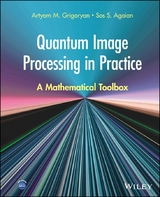
Comprehensive resource addressing the need for a quantum image processing machine learning model that can outperform classical neural networks
Quantum Image Processing in Practice explores the transformative potential of quantum color image processing across various domains, including biomedicine, entertainment, economics, and industry. The rapid growth of image data, especially in facial recognition and autonomous vehicles, demands more efficient processing techniques. Quantum computing promises to accelerate digital image processing (DIP) to meet this demand.
This book covers the role of quantum image processing (QIP) in quantum information processing, including mathematical foundations, quantum operations, image processing using quantum filters, quantum image representation, and quantum neural networks. It aims to inspire practical applications and foster innovation in this promising field.
Topics include:
- Qubits and Quantum Logic Gates: Introduces qubits, the fundamental data unit in quantum computing, and their manipulation using quantum logic gates like Pauli matrices, rotations, the CNOT gate, and Hadamard matrices. The concept of entanglement, where qubits become interconnected, is also explored, highlighting its importance for applications like quantum teleportation and cryptography.
- Two and Multiple Qubit Systems: Demonstrates the importance of using two qubits to process color images, enabling image enhancement, noise reduction, edge detection, and feature extraction. Covers the tensor product, Kronecker sum, SWAP gate, and local and controlled gates. Extends to multi-qubit superpositions, exploring local and control gates for three qubits, such as the Toffoli and Fredkin gates, and describes the measurement of superpositions using projection operators.
- Transforms and Quantum Image Representations: Covers the Hadamard, Fourier, and Heap transforms and their circuits in quantum computation, highlighting their applications in signal and image processing. Introduces the quantum signal-induced heap transform for image enhancement, classification, compression, and filtration. Explores quantum representations and operations for images using the RGB, XYZ, CMY, HSI, and HSV color models, providing numerous examples.
- Fourier Transform Qubit Representation: Introduces a new model of quantum image representation, the Fourier transform qubit representation. Describes the algorithm and circuit for calculating the 2-D quantum Fourier transform, enabling advancements in quantum imaging techniques.
- New Operations and Hypercomplex Algebra: Presents new operations on qubits and quantum representations, including multiplication, division, and inverse operations. Explores hypercomplex algebra, specifically quaternion algebra, for its potential in color image processing.
- Quantum Neural Networks (QNNs): Discusses QNNs and their circuit implementation as advancements in machine learning driven by quantum mechanics. Summarizes various applications of QNNs and current trends and future developments in this rapidly evolving field.
The book also addresses challenges and opportunities in QIP research, aiming to inspire practical applications and innovation. It is a valuable resource for researchers, students, and professionals interested in the intersection of quantum computing and color image processing applications, as well as those in visual communications, multimedia systems, computer vision, entertainment, and biomedical applications.
Artyom M. Grigoryan is an Associate Professor with the Department of Electrical Engineering at the University of Texas at San Antonio. He is a Senior Member of IEEE and the Editor of the International Journal of Applied Control and Electrical and Electronics Engineering.
Sos S. Agaian is a Distinguished Professor of Computer Science at the Graduate Center/CSI at CUNY. He is an Associate Editor for IEEE journals, a Fellow of IS&T, SPIE, AAAS, IEEE, and AAIA, a Member of Academia Europaea, and a Foreign Member of the Armenian National Academy.
Comprehensive resource addressing the need for a quantum image processing machine learning model that can outperform classical neural networks Quantum Image Processing in Practice explores the transformative potential of quantum color image processing across various domains, including biomedicine, entertainment, economics, and industry. The rapid growth of image data, especially in facial recognition and autonomous vehicles, demands more efficient processing techniques. Quantum computing promises to accelerate digital image processing (DIP) to meet this demand. This book covers the role of quantum image processing (QIP) in quantum information processing, including mathematical foundations, quantum operations, image processing using quantum filters, quantum image representation, and quantum neural networks. It aims to inspire practical applications and foster innovation in this promising field. Topics include: Qubits and Quantum Logic Gates: Introduces qubits, the fundamental data unit in quantum computing, and their manipulation using quantum logic gates like Pauli matrices, rotations, the CNOT gate, and Hadamard matrices. The concept of entanglement, where qubits become interconnected, is also explored, highlighting its importance for applications like quantum teleportation and cryptography. Two and Multiple Qubit Systems: Demonstrates the importance of using two qubits to process color images, enabling image enhancement, noise reduction, edge detection, and feature extraction. Covers the tensor product, Kronecker sum, SWAP gate, and local and controlled gates. Extends to multi-qubit superpositions, exploring local and control gates for three qubits, such as the Toffoli and Fredkin gates, and describes the measurement of superpositions using projection operators. Transforms and Quantum Image Representations: Covers the Hadamard, Fourier, and Heap transforms and their circuits in quantum computation, highlighting their applications in signal and image processing. Introduces the quantum signal-induced heap transform for image enhancement, classification, compression, and filtration. Explores quantum representations and operations for images using the RGB, XYZ, CMY, HSI, and HSV color models, providing numerous examples. Fourier Transform Qubit Representation: Introduces a new model of quantum image representation, the Fourier transform qubit representation. Describes the algorithm and circuit for calculating the 2-D quantum Fourier transform, enabling advancements in quantum imaging techniques. New Operations and Hypercomplex Algebra: Presents new operations on qubits and quantum representations, including multiplication, division, and inverse operations. Explores hypercomplex algebra, specifically quaternion algebra, for its potential in color image processing. Quantum Neural Networks (QNNs): Discusses QNNs and their circuit implementation as advancements in machine learning driven by quantum mechanics. Summarizes various applications of QNNs and current trends and future developments in this rapidly evolving field. The book also addresses challenges and opportunities in QIP research, aiming to inspire practical applications and innovation. It is a valuable resource for researchers, students, and professionals interested in the intersection of quantum computing and color image processing applications, as well as those in visual communications, multimedia systems, computer vision, entertainment, and biomedical applications.
| Erscheint lt. Verlag | 19.2.2025 |
|---|---|
| Sprache | englisch |
| Themenwelt | Mathematik / Informatik ► Informatik ► Grafik / Design |
| Technik ► Elektrotechnik / Energietechnik | |
| Schlagworte | color image data • color image processing • Fourier transforms qubit representation • multiplicative arithmetic qubits • optimal filtration multi-signals • quantum color pixels • quantum superpositions • quaternion-quantum processing |
| ISBN-10 | 1-394-26517-4 / 1394265174 |
| ISBN-13 | 978-1-394-26517-6 / 9781394265176 |
| Informationen gemäß Produktsicherheitsverordnung (GPSR) | |
| Haben Sie eine Frage zum Produkt? |
 PDF (Adobe DRM)
Kopierschutz: Adobe-DRM
Adobe-DRM ist ein Kopierschutz, der das eBook vor Mißbrauch schützen soll. Dabei wird das eBook bereits beim Download auf Ihre persönliche Adobe-ID autorisiert. Lesen können Sie das eBook dann nur auf den Geräten, welche ebenfalls auf Ihre Adobe-ID registriert sind.
Details zum Adobe-DRM
Dateiformat: PDF (Portable Document Format)
Mit einem festen Seitenlayout eignet sich die PDF besonders für Fachbücher mit Spalten, Tabellen und Abbildungen. Eine PDF kann auf fast allen Geräten angezeigt werden, ist aber für kleine Displays (Smartphone, eReader) nur eingeschränkt geeignet.
Systemvoraussetzungen:
PC/Mac: Mit einem PC oder Mac können Sie dieses eBook lesen. Sie benötigen eine
eReader: Dieses eBook kann mit (fast) allen eBook-Readern gelesen werden. Mit dem amazon-Kindle ist es aber nicht kompatibel.
Smartphone/Tablet: Egal ob Apple oder Android, dieses eBook können Sie lesen. Sie benötigen eine
Geräteliste und zusätzliche Hinweise
Buying eBooks from abroad
For tax law reasons we can sell eBooks just within Germany and Switzerland. Regrettably we cannot fulfill eBook-orders from other countries.
aus dem Bereich