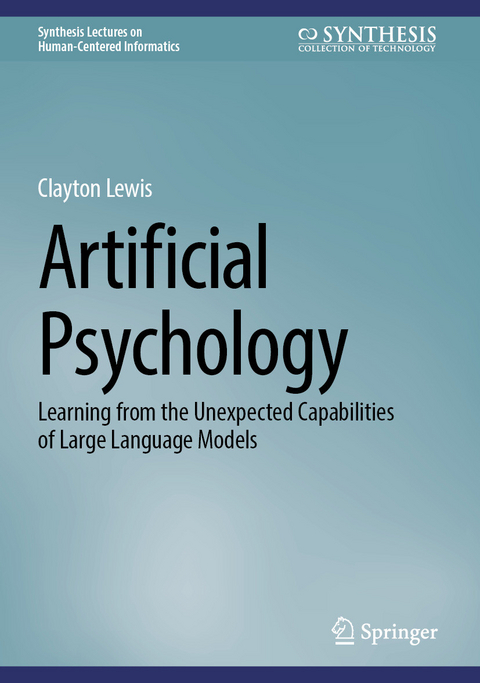
Artificial Psychology (eBook)
XIV, 262 Seiten
Springer Nature Switzerland (Verlag)
978-3-031-76646-6 (ISBN)
The success of predictive large language models (PLLMs) like GPT3 and ChatGPT has created both enthusiasts and skeptics of their widespread practical applications, but this book argues that the larger significance of such models is contained in what they suggest about human cognition. To explore this potential, the book develops a thought experiment called the Prediction Room, a reference to John Searle's influential Chinese Room argument, in which a human agent processes language by following a set of opaque written rules without possessing an inherent understanding of the language. The book proposes a new Room model-the Prediction Room with its resident Prediction Agent-generalizing the working of large language models. Working through a wide range of topics in cognitive science, the book challenges the conclusion of Searle's thought experiment, that discredited contemporary artificial intelligences (AI), through the suggestion that the Prediction Room offers a means of exploring how new ideas in AI can provide productive alternatives to traditional understandings of human cognition. In considering the implications of this, the book reviews an array of topics and issues in cognitive science to uncover new ideas and reinforce older ideas about the mental mechanisms involved in both sides. The discussion of these topics in the book serves two purposes. First, it aims to stimulate new thinking about familiar topics like language acquisition or the nature and acquisition of concepts. Second, by contrasting human psychology with the form of artificial psychology these models exhibit, it uncovers how new directions in the development of these systems can be better explored.
| Erscheint lt. Verlag | 19.2.2025 |
|---|---|
| Reihe/Serie | Synthesis Lectures on Human-Centered Informatics |
| Zusatzinfo | XIV, 262 p. 20 illus., 10 illus. in color. |
| Sprache | englisch |
| Themenwelt | Informatik ► Theorie / Studium ► Künstliche Intelligenz / Robotik |
| Mathematik / Informatik ► Mathematik ► Statistik | |
| Schlagworte | ChatGPT • cognitive computing • GPT3 • hci theory • LLMS • Neural networks • Predictive Large Language Models |
| ISBN-10 | 3-031-76646-6 / 3031766466 |
| ISBN-13 | 978-3-031-76646-6 / 9783031766466 |
| Informationen gemäß Produktsicherheitsverordnung (GPSR) | |
| Haben Sie eine Frage zum Produkt? |
 PDF (Wasserzeichen)
DRM: Digitales Wasserzeichen
Dieses eBook enthält ein digitales Wasserzeichen und ist damit für Sie personalisiert. Bei einer missbräuchlichen Weitergabe des eBooks an Dritte ist eine Rückverfolgung an die Quelle möglich.
Dateiformat: PDF (Portable Document Format)
Mit einem festen Seitenlayout eignet sich die PDF besonders für Fachbücher mit Spalten, Tabellen und Abbildungen. Eine PDF kann auf fast allen Geräten angezeigt werden, ist aber für kleine Displays (Smartphone, eReader) nur eingeschränkt geeignet.
Systemvoraussetzungen:
PC/Mac: Mit einem PC oder Mac können Sie dieses eBook lesen. Sie benötigen dafür einen PDF-Viewer - z.B. den Adobe Reader oder Adobe Digital Editions.
eReader: Dieses eBook kann mit (fast) allen eBook-Readern gelesen werden. Mit dem amazon-Kindle ist es aber nicht kompatibel.
Smartphone/Tablet: Egal ob Apple oder Android, dieses eBook können Sie lesen. Sie benötigen dafür einen PDF-Viewer - z.B. die kostenlose Adobe Digital Editions-App.
Buying eBooks from abroad
For tax law reasons we can sell eBooks just within Germany and Switzerland. Regrettably we cannot fulfill eBook-orders from other countries.
aus dem Bereich