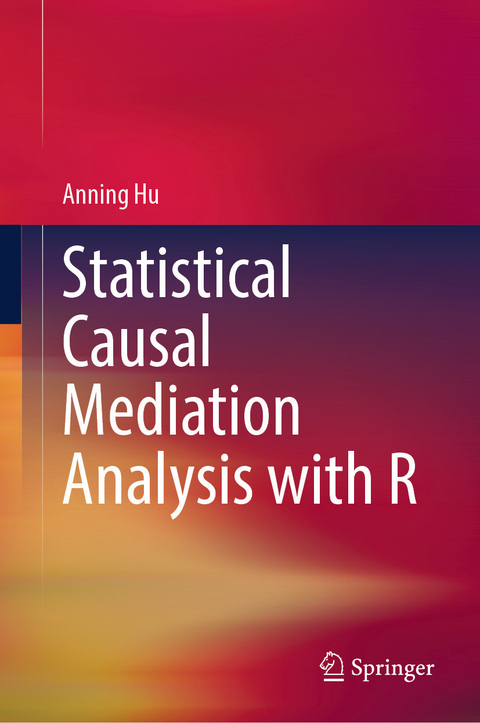
Statistical Causal Mediation Analysis with R (eBook)
101 Seiten
Springer Nature Singapore (Verlag)
978-981-97-6398-6 (ISBN)
This book comprehensively covers various causal mediation analysis (CMA) methods developed across multiple fields, organizing them into a reader-friendly progression of methodological advancements. Interest in the mechanisms that form causal relationships is widespread across various fields, including sociology, demography, economics, political science, psychology, epidemiology, public health, and educational studies, to name a few. Compared to the well-established research focusing on bivariate causality, CMA-the study of mediation mechanisms within the framework of causal inference-requires more complex identification assumptions, estimation methods, and nuanced interpretations of the results. Therefore, to conduct CMA with rigor, one must acquaint themselves with a distinct and systematic body of knowledge that is clearly separate from traditional linear regression modeling or structural equation modelling (SEM). Against this backdrop, the objectives of the proposed book are twofold. Firstly, it aims to offer readers an approachable and engaging explanation of the statistical theories underpinning the diverse methods of CMA. Specifically, we highlight the crucial mediation identification assumptions-a critical aspect frequently neglected by practitioners and educators. Secondly, the book intends to guide readers through detailed, step-by-step examples of applying CMA methods in practical research contexts. Through this approach, readers are anticipated to gain practical skills necessary for addressing their own research or teaching challenges. This book begins with traditional methods that rely on differences or products of coefficients in linear regression modeling, moves on to CMA involving a single mediator, and advances to more sophisticated approaches that manage parallel or sequentially ordered mediators. Additionally, sensitivity analysis is introduced as an important supplementary analytical step. Thus, the content spans from conventional CMA tools to the forefront methodologies that have emerged in recent decades. The book is designed to be self-sufficient, characterized by a balanced and well-integrated presentation of both theory and application.
This book comprehensively covers various causal mediation analysis (CMA) methods developed across multiple fields, organizing them into a reader-friendly progression of methodological advancements. Interest in the mechanisms that form causal relationships is widespread across various fields, including sociology, demography, economics, political science, psychology, epidemiology, public health, and educational studies, to name a few. Compared to the well-established research focusing on bivariate causality, CMA-the study of mediation mechanisms within the framework of causal inference-requires more complex identification assumptions, estimation methods, and nuanced interpretations of the results. Therefore, to conduct CMA with rigor, one must acquaint themselves with a distinct and systematic body of knowledge that is clearly separate from traditional linear regression modeling or structural equation modelling (SEM). Against this backdrop, the objectives of the proposed book are twofold. Firstly, it aims to offer readers an approachable and engaging explanation of the statistical theories underpinning the diverse methods of CMA. Specifically, we highlight the crucial mediation identification assumptions-a critical aspect frequently neglected by practitioners and educators. Secondly, the book intends to guide readers through detailed, step-by-step examples of applying CMA methods in practical research contexts. Through this approach, readers are anticipated to gain practical skills necessary for addressing their own research or teaching challenges. This book begins with traditional methods that rely on differences or products of coefficients in linear regression modeling, moves on to CMA involving a single mediator, and advances to more sophisticated approaches that manage parallel or sequentially ordered mediators. Additionally, sensitivity analysis is introduced as an important supplementary analytical step. Thus, the content spans from conventional CMA tools to the forefront methodologies that have emerged in recent decades. The book is designed to be self-sufficient, characterized by a balanced and well-integrated presentation of both theory and application.
| Erscheint lt. Verlag | 17.2.2025 |
|---|---|
| Zusatzinfo | VII, 101 p. 41 illus., 30 illus. in color. |
| Sprache | englisch |
| Themenwelt | Mathematik / Informatik ► Mathematik ► Computerprogramme / Computeralgebra |
| Sozialwissenschaften ► Soziologie ► Empirische Sozialforschung | |
| Schlagworte | causal mediation analysis • Estimand • Identification • Interventional Indirect Effect • Natural Indirect Effect • R |
| ISBN-10 | 981-97-6398-3 / 9819763983 |
| ISBN-13 | 978-981-97-6398-6 / 9789819763986 |
| Informationen gemäß Produktsicherheitsverordnung (GPSR) | |
| Haben Sie eine Frage zum Produkt? |
 PDF (Wasserzeichen)
DRM: Digitales Wasserzeichen
Dieses eBook enthält ein digitales Wasserzeichen und ist damit für Sie personalisiert. Bei einer missbräuchlichen Weitergabe des eBooks an Dritte ist eine Rückverfolgung an die Quelle möglich.
Dateiformat: PDF (Portable Document Format)
Mit einem festen Seitenlayout eignet sich die PDF besonders für Fachbücher mit Spalten, Tabellen und Abbildungen. Eine PDF kann auf fast allen Geräten angezeigt werden, ist aber für kleine Displays (Smartphone, eReader) nur eingeschränkt geeignet.
Systemvoraussetzungen:
PC/Mac: Mit einem PC oder Mac können Sie dieses eBook lesen. Sie benötigen dafür einen PDF-Viewer - z.B. den Adobe Reader oder Adobe Digital Editions.
eReader: Dieses eBook kann mit (fast) allen eBook-Readern gelesen werden. Mit dem amazon-Kindle ist es aber nicht kompatibel.
Smartphone/Tablet: Egal ob Apple oder Android, dieses eBook können Sie lesen. Sie benötigen dafür einen PDF-Viewer - z.B. die kostenlose Adobe Digital Editions-App.
Buying eBooks from abroad
For tax law reasons we can sell eBooks just within Germany and Switzerland. Regrettably we cannot fulfill eBook-orders from other countries.
aus dem Bereich