


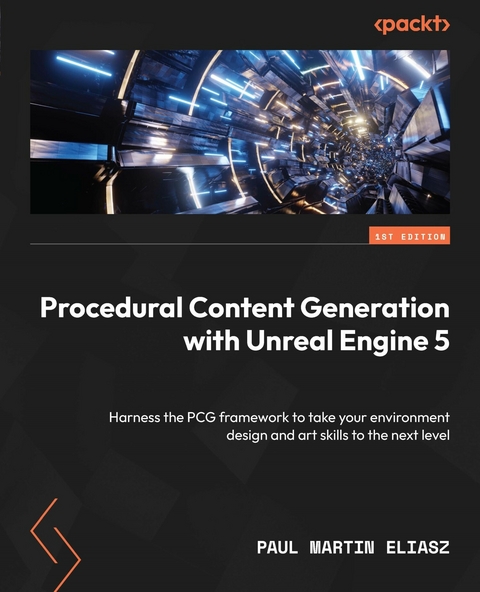
Procedural Content Generation with Unreal Engine 5 (eBook)
488 Seiten
Packt Publishing (Verlag)
978-1-83763-705-8 (ISBN)

In the ever-evolving world of games and virtual production, mastering procedural content generator (PCG) opens the door to endless creative possibilities. This book takes you deeper into the realm of procedurally generated environments and assets by showing you how to use the PCG framework integrated into Unreal Engine 5.4 and helping you build the skills to surpass traditional methods and create cutting-edge projects with unparalleled efficiency.
This book guides you through the complete level design and tools production pipeline using open-source software. Whether you're an aspiring technical artist or level designer in real-time visualization and game production, you'll benefit from following the step-by-step, beginner-friendly approach to crafting custom levels, from jungles to cities, and incorporating 3D assets from libraries such as Quixel or Sketchfab. Next, you'll get to grips with data preparation, construct a PCG graph to populate assets in your environment, and apply these methods to optimize your projects. You'll understand how this process enhances your PCG tools, elevating their capacity to improve the quality of your levels.
By the end of this book, you'll be able to seamlessly integrate different elements in Unreal Engine 5, empowering you to create your own PCG tools and transform your game development experience.
No detailed description available for "e;Procedural Content Generation with Unreal Engine 5"e;.
1
Introducing Procedural Content Generation
Welcome to this thrilling journey into the realm of procedural content generation within Unreal Engine 5!
I can sense your excitement as you prepare to explore the realm of 3D content and its procedural generation capabilities in game projects and real-time visualizations for VFX and film sets. Before we dive into practical applications, we should gain a deeper understanding of procedural generation and its various use cases.
In this chapter, I’ll cover the fundamental concepts of procedural content generation, followed by an exploration of the disparities between traditional procedural generation methods and the enhanced capabilities introduced with the Procedural Content Generation (PCG) plugin tool in Unreal Engine 5.
This exploration will help you identify the most suitable approach for your needs.
I’ll then guide you through the practical implementation of the PCG tool in your project, demonstrating how it can be tailored to your specific tasks. Following this, you’ll have the opportunity to explore using PCG and learn how to align it within your project in Unreal Engine 5.
Note
A quick heads-up for users of the latest Unreal Engine 5, particularly version 5.4: be aware that certain nodes have been deprecated and substituted with the new PCG nodes. Due to these changes, we’ll be utilizing the 5.4 version of Unreal Engine 5 for our discussions. Further clarification on this topic will be provided in the upcoming chapters.
In this chapter, we’re going to cover the following main topics:
- What is PCG?
- Where and how to use PCG tools
- Understanding the PCG framework
- Building your first PCG tool
By the end of this chapter, you will have a solid understanding of PCG and how to use it. You will learn the basics of PCG, how it is used, and how it compares to traditional methods of procedural content generation. This topic will be very useful to cover the most information.
Technical requirements
You will need a good computer that can run a PCG framework plugin and to install the following hardware and software to complete this chapter:
- Use the latest operating system, either Windows 10 or Windows 11
Please note that this book is intended exclusively for Windows users and does not offer support for macOS.
- A GPU (an NVIDIA RTX or AMD Radeon RX with 8+ GB VRAM) and at least 16 GB RAM. For more information, visit the official Epic Games website: https://dev.epicgames.com/documentation/en-us/unreal-engine/hardware-and-software-specifications-for-unreal-engine?application_version=5.4.
- You will need to install the latest version of Unreal Engine 5.4 because this book is based on that version. For detailed instructions on how to install Unreal Engine 5.4, please visit https://dev.epicgames.com/documentation/en-us/unreal-engine/installing-unreal-engine. The reason for this requirement is that the latest PCG framework includes new nodes, and some nodes present in version 5.2 have been removed.
The code files for the chapter are placed at https://github.com/PacktPublishing/Procedural-Content-Generation-with-Unreal-Engine-5
The code in action video for the chapter can be found at https://packt.link/GClp8
What is PCG?
In computing, procedural generation is a technique where data is automatically generated through the application of an algorithm as opposed to being manually crafted. This method typically involves a combination of human-designed assets and algorithms that use computer-generated random numbers and computational capabilities.
Over the past two decades, game content, encompassing terrain, characters, items, and every element in game production, has typically been crafted using two primary approaches.
The first involves manual content creation, where artists produce 3D assets and strategically place them within the game environment. Here is an example of some trees created using the standard foliage tool in Unreal Engine:
Figure 1.1 – Unreal foliage tool example
The following image is an example of PCG enabling the creation of environments within the level:
Figure 1.2 – An example of an Unreal environment built with the PCG framework
Here is the PCG graph that illustrates the PCG node structure used to generate the forest shown in Figure 1.2:
Figure 1.3 – A PCG graph node setup that creates a complete forest environment
The second approach is PCG, where algorithms autonomously generate content either prior to the initiation of a level or dynamically throughout the runtime of the game. This is highly beneficial when working on gameplay involving open-world levels with massive environments. It significantly improves the ability to stream levels if the environment contains a large volume of high-quality foliage instances. The benefits of this method include reduced file sizes, a broader spectrum of content, and the ability to establish more efficient structures for building levels and environments.
Figure 1.4 – An example of an Unreal environment built with the PCG framework
In the next section, we will explore the different types of procedural generation in the context of the PCG tool in Unreal Engine 5.
Where and how to use PCG tools
The game industry provides a distinct environment for developers and artists to innovate, especially in art and commercials. In this space, they can navigate the complex challenges of creating and managing a vast array of technically and creatively demanding 3D assets scattered throughout a level.
However, this method has evolved in recent years, particularly within the domain of real-time game engines, where capabilities have experienced exponential growth.
It’s worth noting that, depending on the specific focus area, the use of PCG tools is not limited to game development alone. In the movie industry, in visual effects (VFX), for instance, PCG tools find valuable applications. The film industry, which has been accustomed to PCG for an extended period, has used software such as Houdini, which has been prevalent in this field for many years. Houdini is renowned for its procedural generation capabilities, enabling artists to create complex environments using node-based workflows, and remains a standard tool in the VFX industry today.
Unreal Engine excels at handling PCG, allowing the automated creation of complex and dynamic environments. This approach enhances visual diversity and reduces manual workload, enabling the quick generation of large, detailed landscapes.
The PCG tools in Unreal Engine, available as a plugin, streamline this process further. With intuitive, node-based workflows, artists and level designers can easily set rules for asset placement, automating tasks such as populating forests or laying out cityscapes. This empowers creators to focus on creativity, resulting in immersive, richly detailed environments and a more efficient development pipeline.
Introducing the Unreal Engine PCG plugin
The PCG plugin operates by evaluating a component known as Hierarchical Instanced Static Meshes (HISM). This HISM component enables the generation of an extensive array of static meshes across a surface. PCG utilizes this information to project the spawn positions of instances onto the designated surface, such as a landscape, in the form of PCG volumes. Alternatively, Instanced Static Meshes (ISM) can be used, but HISM is the default and preferred component due to its much more convenient ability to render multiple static meshes with a single draw call without any loss of performance.
In summary, HISM and ISM are powerful components for optimizing the rendering of large numbers of instances, which is often the case in procedural generation systems. They allow you to efficiently distribute and render instances across surfaces such as landscapes while providing flexibility for dynamic adjustments.
However, they have some key differences:
- Regular ISM
Each instance in an ISM is treated independently and can have its own transform, material properties, and so on. ISM components are suitable when you have a large number of identical or nearly identical static meshes that don’t share common characteristics, and you want each instance to be treated individually.
While ISM components provide a basic Level of Detail (LOD) support, each instance can switch between...
| Erscheint lt. Verlag | 13.12.2024 |
|---|---|
| Sprache | englisch |
| Themenwelt | Mathematik / Informatik ► Informatik ► Grafik / Design |
| ISBN-10 | 1-83763-705-9 / 1837637059 |
| ISBN-13 | 978-1-83763-705-8 / 9781837637058 |
| Informationen gemäß Produktsicherheitsverordnung (GPSR) | |
| Haben Sie eine Frage zum Produkt? |
 EPUB (Ohne DRM)
Digital Rights Management: ohne DRM
Dieses eBook enthält kein DRM oder Kopierschutz. Eine Weitergabe an Dritte ist jedoch rechtlich nicht zulässig, weil Sie beim Kauf nur die Rechte an der persönlichen Nutzung erwerben.
Dateiformat: EPUB (Electronic Publication)
EPUB ist ein offener Standard für eBooks und eignet sich besonders zur Darstellung von Belletristik und Sachbüchern. Der Fließtext wird dynamisch an die Display- und Schriftgröße angepasst. Auch für mobile Lesegeräte ist EPUB daher gut geeignet.
Systemvoraussetzungen:
PC/Mac: Mit einem PC oder Mac können Sie dieses eBook lesen. Sie benötigen dafür die kostenlose Software Adobe Digital Editions.
eReader: Dieses eBook kann mit (fast) allen eBook-Readern gelesen werden. Mit dem amazon-Kindle ist es aber nicht kompatibel.
Smartphone/Tablet: Egal ob Apple oder Android, dieses eBook können Sie lesen. Sie benötigen dafür eine kostenlose App.
Geräteliste und zusätzliche Hinweise
Buying eBooks from abroad
For tax law reasons we can sell eBooks just within Germany and Switzerland. Regrettably we cannot fulfill eBook-orders from other countries.
aus dem Bereich


