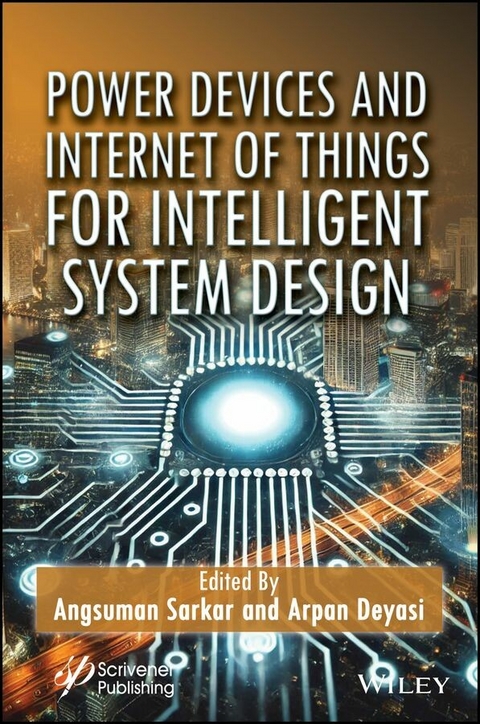
Power Devices and Internet of Things for Intelligent System Design (eBook)
623 Seiten
Wiley-Scrivener (Verlag)
978-1-394-31158-3 (ISBN)
Unlock the potential of cutting-edge advancements in power electronics and IoT with Power Devices and Internet of Things for Intelligent System Design, a vital resource that bridges the gap between industry and academia, inspiring innovative solutions across diverse fields such as agriculture, healthcare, and security.
This book explores the latest technological advancements in electrical circuits, particularly in the power electronics sector and IoT-based smart systems. The outcomes are closely aligned with current industrial applications, spanning from DC to higher-frequency spectrums. Research progress in electrical systems not only enhances power electronics and fault tolerance but also extends to internet-based surveillance systems designed to address emerging threats and develop mitigation strategies. Modern IoT-based system design incorporates numerous human-centered benefits, with the integration of blockchain architecture adding an interdisciplinary dimension to the research.
The primary goal of this book is to leverage IoT and power engineering technologies to develop practical solutions to contemporary challenges while exploring the diverse applications of the Internet of Things across fields such as agriculture, home security, data protection, construction, healthcare, wildlife monitoring, cryptology, and employment in the hospitality sector. Power Devices and Internet of Things for Intelligent System Design serves as a critical link between industry and academia, a role that underscores the success of this endeavor.
Angsuman Sarkar, PhD, is a professor and the Head of Electronics and Communication Engineering at Kalyani Government Engineering College, West Bengal. He has authored six books, 23 book chapters, 97 papers in international refereed journals, and 57 research papers in national and international conferences. He is a member of the board of editors of various journals and serves as a reviewer for various international journals. He has delivered invited expert talks and tutorial speeches at various international conferences and technical programs.
Arpan Deyasi, PhD, is an associate professor in the Department of Electronics and Communication Engineering at the RCC Institute of Information Technology, Kolkata, India with more than 18 years of professional experience in academia and industry. He has published over 200 peer-reviewed research papers and edited eight books, three of which are in press. He has completed two funded projects and has two that are currently ongoing. He has also served as a technical consultant for various industrial projects.
Unlock the potential of cutting-edge advancements in power electronics and IoT with Power Devices and Internet of Things for Intelligent System Design, a vital resource that bridges the gap between industry and academia, inspiring innovative solutions across diverse fields such as agriculture, healthcare, and security. This book explores the latest technological advancements in electrical circuits, particularly in the power electronics sector and IoT-based smart systems. The outcomes are closely aligned with current industrial applications, spanning from DC to higher-frequency spectrums. Research progress in electrical systems not only enhances power electronics and fault tolerance but also extends to internet-based surveillance systems designed to address emerging threats and develop mitigation strategies. Modern IoT-based system design incorporates numerous human-centered benefits, with the integration of blockchain architecture adding an interdisciplinary dimension to the research. The primary goal of this book is to leverage IoT and power engineering technologies to develop practical solutions to contemporary challenges while exploring the diverse applications of the Internet of Things across fields such as agriculture, home security, data protection, construction, healthcare, wildlife monitoring, cryptology, and employment in the hospitality sector. Power Devices and Internet of Things for Intelligent System Design serves as a critical link between industry and academia, a role that underscores the success of this endeavor.
1
Comparative Analysis Between PI and Model Predictive Torque-Flux Control of VSI-Fed Three-Phase Induction Motor Under Variable Loading Conditions
Sujoy Bhowmik1*, Pritam Kumar Gayen2 and Arkendu Mitra3
1Department of Electrical Engineering, Swami Vivekananda University, Kolkata, India
2Department of Electrical Engineering, Kalyani Government Engineering College, Nadia, India
3Department of Electrical Engineering, Narula Institute of Technology, Kolkata, India
Abstract
In recent years, advancements in power electronic converters and their control related to the power quality issue have become important in stand-alone applications as well as grid-integrated systems. A suitable design of control logic is very much necessary in wide industrial applications such as variable-frequency drive systems, battery charging applications, renewable energy sources, etc., to enhance the dynamic behavior of the converter. This research work has been carried out through the design of two different controllers, PI-based closed-loop control and model predictive control (MPC) of a three-phase voltage source inverter-fed induction motor drive. Here torque and flux controls have been developed to investigate the performance under torque–speed variations. A comparison study of the two is also conducted, and it is observed that MPC exhibits better dynamic responses (lower rise time, less settling time, lower percentage overshoot, etc.) than PI-based logic under variable loading conditions. Along with this, multiple practical requirements such as harmonic reduction, loss minimization, less ripple, and less EMI can be optimized under MPC logic. These types of controllers are designed based on the minimization of the cost function, for which a weighting factor is required to derive depending on the parameters of the motor, and tedious tuning of proportional–integral (PI) values is not required. All of the results presented, including steady-state as well as dynamic responses, are verified in the Simulink environment, and satisfactory performance of the motor drive system has been achieved.
Keywords: Cost function, weighting factor, induction motor, voltage source inverter, mathematical modeling
1.1 Introduction
Power quality issues have recently emerged as a major issue in a variety of distributed generation system applications. In stand-alone as well as grid-connected systems, DC-DC converters and DC-AC inverters are mostly used to improve the power conversion topologies. Designing advanced control logics for power electronic devices opens up a new era for researchers in terms of mitigating power demand and maximizing its utilization. At the earlier stage, the proportional–integral (PI) controller for the converter was very useful for tracking the desired value. In this regard, proper selection of gain values for the PI regulator is a complex task that requires much time. It exhibits either a sluggish or faster response of the converter with high or moderate overshoots under variable loading conditions. Using the Ziegler–Nichols method for tuning PI controllers results in oscillatory behavior of the control parameters. To overcome this phenomenon, a new tuning approach with the desired damping coefficient is proposed to obtain satisfactory performances [1]. Furthermore, to select the gain parameters, frequency responses are taken into consideration, which makes the design easier [2]. As a result, designing controllers has become a difficult task for researchers in order to achieve the desired inverter performance. Various nonlinear effects have not been considered for traditional PI controller-based decoupled current control actions. A control logic upgrade is required in this case. Model predictive control (MPC) is becoming increasingly useful for power electronic converters. With this approach, the voltage source inverter has been operated with a resistive–inductive load. It exhibits excellent current tracking with very fast dynamic response to step changes in variable load [3–5]. For a grid-connected system, the model-predictive direct power control method plays a major role. Flexibility in power regulation can be achieved by reducing the ripples generated by voltage vectors. Furthermore, for highpower applications, digital implementation of one step delay and switching frequency reduction provides satisfactory results in distributed power generation [6]. The model predictive voltage control algorithm for a standalone voltage source inverter provides lower harmonic distortion even under sudden load changes. It also maintains the quality of power under balanced and non-linear conditions [7]. For electrical drive systems, model predictive control topology offers MIMO control, i.e., torque and flux control, with less complexity than conventional PI-based control [8]. To avoid the nontrivial tuning of the weighting factor in conventional model predictive torque control (MPTC), model predictive flux control (MPFC) achieves better performances over a wide range of speeds with low tuning that reduces the control complexity. Furthermore, switching losses are less than MPTC, and steady-state as well as dynamic performance have been improved [9–13]. Also, a multi-objective optimization approach has been implemented, which replaces the tuning of the weighting factor. In the case of stator flux and torque tracking, the selected voltage vector allows minimization of all the objective functions in an efficient manner so that good results can be obtained from simulation as well as practical experiments [14, 15]. A simple and effective predictive torque control (PTC) algorithm has been proposed, which eliminates the need for tuning the flux weighting factor and requires only four voltage vectors to minimize the cost functions at each sampling instant. As a result, computational time as well as switching frequency were significantly reduced, and current THD, torque, and flux ripple have also been minimized [16]. A continuous control set for induction motor drives has been implemented, which acts as a proportional controller. To minimize the bias error, an integral action is required. This approach is handled due to the single-state variable as stator current being required to form the two-dimensional state equation [17]. In sequential model predictive control, the continuous weighting factor is converted into digital form. As a result, the optimization of the cost function is dynamically changed at different loading conditions [18]. To improve the efficiency of the vector control method with light loads, flux angle control is designed. The required torque and flux have to be injected in light load conditions, and nominal rotor flux is not desired [19]. In comparison with direct force control, MPC is more effective at selecting the voltage vectors. As a result, the topology becomes more precise, and better performance is achieved in controlling motor drive [20].
This proposed work is a comparative study of the performance of conventional PI control and model predictive control of a three-phase standalone voltage source inverter-fed induction motor drive system with variations in torque and speed. The system dynamics for both controllers are observed during various loading conditions. The better dynamic responses are observed in MPC logic than in PI-based control logic. Also, tuning of more parameters, like a PI-based controller, is not required in the case of MPC. This reduces the complexity of the implementation of MPC in practice. The weighting factor is required to be calculated based on the motor parameters for this optimization technique. The effectiveness of this proposed method is demonstrated with comprehensive case studies, accordingly.
1.2 Mathematical Modeling of Three-Phase Induction Motor and Voltage Source Inverter
In this section, mathematical modeling of three-phase induction motor and voltage source inverter has been developed, and a corresponding circuit diagram is illustrated.
1.2.1 Induction Motor Modeling
The dynamic model of a three-phase induction machine in stationary reference frame can be derived by the following equations:
Since the rotor of the squirrel cage-type motor is short-circuited, the induced voltage across it will be defined as:
where vdr = vqr = 0.
The corresponding equivalent circuits in stationary reference frame are depicted in Figures 1.1 and 1.2, where
Figure 1.1 d-axis equivalent circuit.
Figure 1.2 q-axis equivalent circuit.
1.2.2 Voltage Source Inverter Modeling
Space vector modulation is a control algorithm for pulse width modulation. Most commonly, it is used in a three-phase variable-speed drive system. For a three-phase two-level stand-alone voltage source inverter, the voltage vectors corresponding to eight switching states for controlling the inverter voltage are mentioned in Table 1.1. The voltage vectors are mathematically expressed in Equation 1.8.
Table 1.1 Different states of voltage...
| Erscheint lt. Verlag | 14.2.2025 |
|---|---|
| Sprache | englisch |
| Themenwelt | Mathematik / Informatik ► Informatik |
| Technik ► Elektrotechnik / Energietechnik | |
| ISBN-10 | 1-394-31158-3 / 1394311583 |
| ISBN-13 | 978-1-394-31158-3 / 9781394311583 |
| Informationen gemäß Produktsicherheitsverordnung (GPSR) | |
| Haben Sie eine Frage zum Produkt? |
 EPUB (Adobe DRM)
Kopierschutz: Adobe-DRM
Adobe-DRM ist ein Kopierschutz, der das eBook vor Mißbrauch schützen soll. Dabei wird das eBook bereits beim Download auf Ihre persönliche Adobe-ID autorisiert. Lesen können Sie das eBook dann nur auf den Geräten, welche ebenfalls auf Ihre Adobe-ID registriert sind.
Details zum Adobe-DRM
Dateiformat: EPUB (Electronic Publication)
EPUB ist ein offener Standard für eBooks und eignet sich besonders zur Darstellung von Belletristik und Sachbüchern. Der Fließtext wird dynamisch an die Display- und Schriftgröße angepasst. Auch für mobile Lesegeräte ist EPUB daher gut geeignet.
Systemvoraussetzungen:
PC/Mac: Mit einem PC oder Mac können Sie dieses eBook lesen. Sie benötigen eine
eReader: Dieses eBook kann mit (fast) allen eBook-Readern gelesen werden. Mit dem amazon-Kindle ist es aber nicht kompatibel.
Smartphone/Tablet: Egal ob Apple oder Android, dieses eBook können Sie lesen. Sie benötigen eine
Geräteliste und zusätzliche Hinweise
Buying eBooks from abroad
For tax law reasons we can sell eBooks just within Germany and Switzerland. Regrettably we cannot fulfill eBook-orders from other countries.
aus dem Bereich