


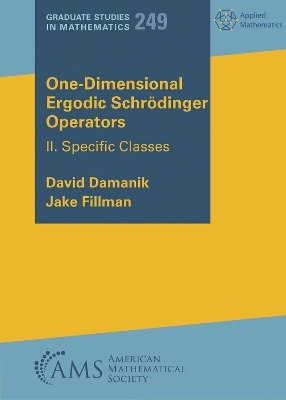
One-Dimensional Ergodic Schrodinger Operators
II. Specific Classes
Seiten
2025
American Mathematical Society (Verlag)
978-1-4704-6503-2 (ISBN)
American Mathematical Society (Verlag)
978-1-4704-6503-2 (ISBN)
Uncover the fusion of dynamical systems, topology, and analysis in one-dimensional ergodic operators that illuminate models for crystals, disordered media, and quasicrystals. Highlighting random and almost-periodic cases, the study bridges theory with physical models for emerging and experienced researchers alike.
The theory of one-dimensional ergodic operators involves a beautiful synthesis of ideas from dynamical systems, topology, and analysis. Additionally, this setting includes many models of physical interest, including those operators that model crystals, disordered media, or quasicrystals. This field has seen substantial progress in recent decades, much of which has yet to be discussed in textbooks. The current volume addresses specific classes of operators, including the important examples of random and almost-periodic operators. The text serves as a self-contained introduction to the field for junior researchers and beginning graduate students, as well as a reference text for people already working in this area. The general theory of one-dimensional ergodic operators was presented in the book by the same authors as volume 221 in the Graduate Studies in Mathematics series.
The theory of one-dimensional ergodic operators involves a beautiful synthesis of ideas from dynamical systems, topology, and analysis. Additionally, this setting includes many models of physical interest, including those operators that model crystals, disordered media, or quasicrystals. This field has seen substantial progress in recent decades, much of which has yet to be discussed in textbooks. The current volume addresses specific classes of operators, including the important examples of random and almost-periodic operators. The text serves as a self-contained introduction to the field for junior researchers and beginning graduate students, as well as a reference text for people already working in this area. The general theory of one-dimensional ergodic operators was presented in the book by the same authors as volume 221 in the Graduate Studies in Mathematics series.
David Damanik, Rice University, Houston, TX, and Jake Fillman, Texas A&M University, College Station, TX
Highlights from Part I
Part II: Specific classes
Random potentials
Almost-periodic potentials
Periodic potentials
Limit-periodic potentials
Quasi-periodic potentials
Subshift potentials
Appendices
Continued fractions
Topological groups
A crash course in combinatorial word theory
List of open problems
Glossary of notation
Bibliography
Index
| Erscheinungsdatum | 11.03.2025 |
|---|---|
| Reihe/Serie | Graduate Studies in Mathematics |
| Verlagsort | Providence |
| Sprache | englisch |
| Maße | 178 x 254 mm |
| Themenwelt | Mathematik / Informatik ► Mathematik ► Analysis |
| ISBN-10 | 1-4704-6503-5 / 1470465035 |
| ISBN-13 | 978-1-4704-6503-2 / 9781470465032 |
| Zustand | Neuware |
| Informationen gemäß Produktsicherheitsverordnung (GPSR) | |
| Haben Sie eine Frage zum Produkt? |
Mehr entdecken
aus dem Bereich

aus dem Bereich
Festigkeits- und Verformungslehre, Baudynamik, Wärmeübertragung, …
Buch | Hardcover (2025)
De Gruyter Oldenbourg (Verlag)
CHF 125,90


