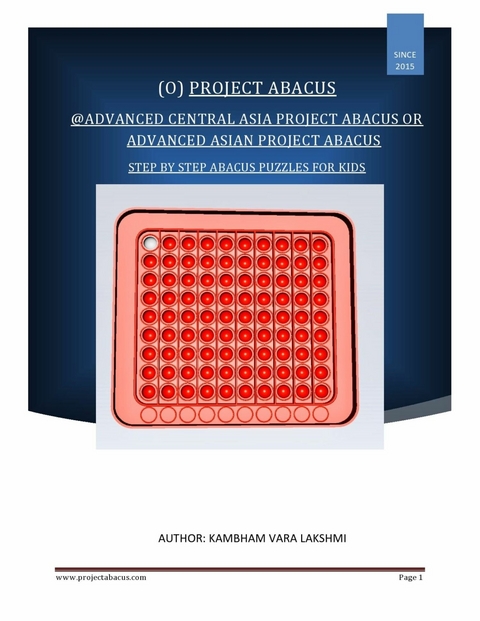
Advanced Central Asiaproject Abacus (or) Advanced Asian Project Abacus (eBook)
15 Seiten
Publishdrive (Verlag)
978-93-342-0026-3 (ISBN)
The Abacus, a humble device with a rich history, has been a companion to mathematicians for centuries. Its origins can be traced back to ancient Mesopotamia, where civilizations like the Sumerians used it for calculations. Over time, the abacus took on different forms in various cultures, but its core principle remained the same - manipulating beads on rods to represent numbers and perform arithmetic operations.
Despite the rise of modern calculators, the abacus is still used in some parts of the world, particularly in Asia. It's also gaining popularity as a mental math tool, as studies show that using an abacus can improve mental ability and calculation skills.
Example: Shepherds have used pebbles for centuries as a simple and effective way to keep track of their sheep or goats. Each time a goat passes through a gate or enclosure, the shepherd moves a pebble from one pile to another. By the end of the day, the pebbles tell the shepherd exactly how many goats they have. Once all the goats have been counted, the shepherd can simply count the pebbles in the pouch to determine the total number of goats. This method is especially useful for shepherds who may not be able to read or write, or who find it easier to manipulate physical objects than numbers.
Early counting tools evolved into the Abacus we know today. Here's a brief history of its development:
* Mud Lines and Pebbles: The earliest ancestors of the abacus were likely simple markings in mud or sand, perhaps alongside pebbles or sticks to represent quantities.
* Wooden Frame and Rods: Later, counting boards made of wood with grooves or rods emerged, allowing for a more permanent and organized way of calculating.
* Beads on Rods: Finally, beads were added to the rods, making it easier to manipulate and keep track of numbers. This is the type of abacus most commonly associated with the tool today.
Learning to use an Abacus can offer a number of benefits for children, including:
* Stronger math skills: Abacus use can help kids develop a better understanding of mathematical concepts, improve their mental math abilities, and increase their calculation speed and accuracy.
* Enhanced memory and concentration: Abacus programs often involve memorization techniques and require focused attention to manipulate the beads and solve problems. This can lead to improved memory and concentration in other areas of life as well.
* Boosted confidence: As children master Abacus skills and see their math abilities improve, their confidence can grow. This can have a positive impact on their overall academic performance.
* Improved cognitive skills: Abacus use may enhance cognitive skills such as visual-spatial reasoning, problem-solving, and critical thinking math skills and improve their confidence in math.
The Abacus, a humble device with a rich history, has been a companion to mathematicians for centuries. Its origins can be traced back to ancient Mesopotamia, where civilizations like the Sumerians used it for calculations. Over time, the abacus took on different forms in various cultures, but its core principle remained the same - manipulating beads on rods to represent numbers and perform arithmetic operations.Despite the rise of modern calculators, the abacus is still used in some parts of the world, particularly in Asia. It's also gaining popularity as a mental math tool, as studies show that using an abacus can improve mental ability and calculation skills.Example: Shepherds have used pebbles for centuries as a simple and effective way to keep track of their sheep or goats. Each time a goat passes through a gate or enclosure, the shepherd moves a pebble from one pile to another. By the end of the day, the pebbles tell the shepherd exactly how many goats they have. Once all the goats have been counted, the shepherd can simply count the pebbles in the pouch to determine the total number of goats. This method is especially useful for shepherds who may not be able to read or write, or who find it easier to manipulate physical objects than numbers. Early counting tools evolved into the Abacus we know today. Here's a brief history of its development:* Mud Lines and Pebbles: The earliest ancestors of the abacus were likely simple markings in mud or sand, perhaps alongside pebbles or sticks to represent quantities.* Wooden Frame and Rods: Later, counting boards made of wood with grooves or rods emerged, allowing for a more permanent and organized way of calculating.* Beads on Rods: Finally, beads were added to the rods, making it easier to manipulate and keep track of numbers. This is the type of abacus most commonly associated with the tool today.Learning to use an Abacus can offer a number of benefits for children, including:* Stronger math skills: Abacus use can help kids develop a better understanding of mathematical concepts, improve their mental math abilities, and increase their calculation speed and accuracy.* Enhanced memory and concentration: Abacus programs often involve memorization techniques and require focused attention to manipulate the beads and solve problems. This can lead to improved memory and concentration in other areas of life as well.* Boosted confidence: As children master Abacus skills and see their math abilities improve, their confidence can grow. This can have a positive impact on their overall academic performance.* Improved cognitive skills: Abacus use may enhance cognitive skills such as visual-spatial reasoning, problem-solving, and critical thinking math skills and improve their confidence in math.
| Erscheint lt. Verlag | 9.1.2025 |
|---|---|
| Reihe/Serie | Project Abacus |
| Sprache | englisch |
| Themenwelt | Mathematik / Informatik ► Mathematik |
| Schlagworte | Abacus • ABACUS MATHS • Maths • mental maths • PLAY ABACUS • PLAY MATHS • puzzle book |
| ISBN-10 | 93-342-0026-X / 933420026X |
| ISBN-13 | 978-93-342-0026-3 / 9789334200263 |
| Informationen gemäß Produktsicherheitsverordnung (GPSR) | |
| Haben Sie eine Frage zum Produkt? |
 EPUB (Adobe DRM)
Kopierschutz: Adobe-DRM
Adobe-DRM ist ein Kopierschutz, der das eBook vor Mißbrauch schützen soll. Dabei wird das eBook bereits beim Download auf Ihre persönliche Adobe-ID autorisiert. Lesen können Sie das eBook dann nur auf den Geräten, welche ebenfalls auf Ihre Adobe-ID registriert sind.
Details zum Adobe-DRM
Dateiformat: EPUB (Electronic Publication)
EPUB ist ein offener Standard für eBooks und eignet sich besonders zur Darstellung von Belletristik und Sachbüchern. Der Fließtext wird dynamisch an die Display- und Schriftgröße angepasst. Auch für mobile Lesegeräte ist EPUB daher gut geeignet.
Systemvoraussetzungen:
PC/Mac: Mit einem PC oder Mac können Sie dieses eBook lesen. Sie benötigen eine
eReader: Dieses eBook kann mit (fast) allen eBook-Readern gelesen werden. Mit dem amazon-Kindle ist es aber nicht kompatibel.
Smartphone/Tablet: Egal ob Apple oder Android, dieses eBook können Sie lesen. Sie benötigen eine
Geräteliste und zusätzliche Hinweise
Buying eBooks from abroad
For tax law reasons we can sell eBooks just within Germany and Switzerland. Regrettably we cannot fulfill eBook-orders from other countries.
aus dem Bereich