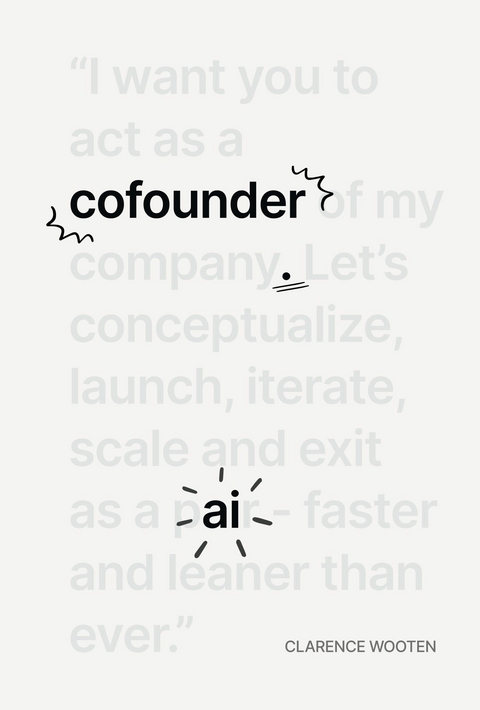
Cofounder.AI (eBook)
148 Seiten
Bookbaby (Verlag)
979-8-3509-8523-8 (ISBN)
Clarence Wooten is a Senior Executive and Entrepreneur in Residence at Google [X], Alphabet's moonshot factory where he leads talented teams in developing groundbreaking technologies to tackle some of the World's most challenging problems -creating new spin-outs and Alphabet companies in the process. Clarence is only Black American entrepreneur to have founded and led two internet startups to acquisitions by publicly traded companies-ImageCafe (acquired by Network Solutions) and Progressly (acquired by Box)-Clarence has a proven track record of innovation and leadership. At Network Solutions, he oversaw ImageCafe's platform integration and acquisitions, and his pioneering work at Progressly revolutionized enterprise workflow, forming the foundation of Box's Relay tool. At Google [X], Clarence applies his expertise in design-thinking and technology to develop groundbreaking initiatives like PurposeForProfit.org, a blockchain-based fund for affordable housing as well as various AI initiatives. A magna cum laude graduate of Johns Hopkins University and the Community College of Baltimore County, Clarence holds degrees in Business Management and Computer-Aided Design. His accolades include induction into the National Community College Hall of Fame and recognition as one of the Top 10 Blacks in Technology by Blacks in Tech. Frequently profiled by major publications, Clarence is also the author of CoFounder.AI and serves as an advisor to leading companies and ventures across SaaS, blockchain, and AI. Clarence's entrepreneurial journey has been profiled in major publications such as The Wall Street Journal, Forbes, Fast Company, and Entrepreneur. In 2010, Clarence was named a distinguished alumnus of Johns Hopkins University. His entrepreneurial journey is also the subject of a Babson College Case Study.
Clarence Wooten's CoFounder.AI is a practical guide for entrepreneurs to harness AI as a transformative "e;cofounder,"e; enabling startups to achieve 10x more with 10x fewer resources. The book outlines five stages of startup success-Conceptualize, Launch, Iterate, Scale, and Exit-and provides actionable strategies, tools, and insights tailored to each phase. Wooten shares lessons from his entrepreneurial journey, emphasizing the importance of cofounder dynamics, fundability criteria, and building a "e;minimal lovable product"e; that delights customers. He advocates a "e;shareholder first"e; mindset and highlights AI's evolving role in enhancing customer service, marketing, and product development. By leveraging AI, entrepreneurs can streamline operations, innovate faster, and gain a competitive edge. The companion CoFounder.AI platform ensures entrepreneurs stay updated with the latest AI tools and workflows, keeping the content relevant in the rapidly changing landscape. Key takeaways include AI's role in reducing startup costs, strategies for navigating funding and partnerships, and the value of creating products people truly love. This is a must-read for anyone seeking AI-powered entrepreneurship success.
Chapter 1
The Cofounder Conundrum
“The cofounder relationship is like a marriage. It requires trust, communication, and a shared vision for the future.”
—Larry Page, Cofounder of Google
The ImageCafe Story:
A Lesson in Cofounder Equity Remorse
Picture this: It’s 1998. DVDs are the hot new thing, Google just launched, and most people are still figuring out what this “internet” thing is all about. Meanwhile, my friend Andre and I are about to embark on a wild, life-changing ride that will teach us some hard lessons about the startup world.
From Agency to Product: The Birth of ImageCafe
Together, Andre and I were running a small interactive agency called Metamorphosis Studios, but we had bigger dreams. We wanted to build something that would “make money while we sleep.” After brainstorming many product ideas and building prototypes for them, we landed on an idea that seems obvious now: What if we could productize our web design skills?
That’s how ImageCafe was born. Our vision: Create an online superstore packed with customizable website templates for small business owners. Remember, this was before Wix, Shopify, or WordPress. Most small businesses had two options for getting online:
- Let your tech-savvy nephew build you a site that looked like it was designed by... well, your nephew.
- Shell out big bucks to a design agency.
We saw an opportunity to disrupt this market by offering “customizable website masters.” Which sounded more sophisticated than templates. Our slogan, “Look like the Fortune 500, for under $500.” Spoiler alert: We were right. But running a product business is a different beast than running a service agency. Suddenly, we needed investor cash to give us runway, and while we were no strangers to bootstrapping, we were a little naïve about how far scrappiness alone could take us.
The Hustle: From Idea to Investment
As CEO, I dove headfirst into the fundraising hustle. I literally went from Silicon Valley to Silicon Alley,4 pitching our vision to anyone who would listen. Investors liked what they saw, and soon, we were off to the races.
But here’s where things got tricky. While I was crisscrossing the country, managing operations, and overseeing staff at our office in Maryland, Andre worked remotely from Florida. Furthermore, he felt strongly that ImageCafe should also include personal website templates. I disagreed. I insisted that we remain focused on serving small businesses.
Ultimately, we stayed the course, but as time went on, Andre’s desire to remain in Florida and our conflicting visions started to drive a wedge between us.
The Breaking Point
A pivotal turning point for the company came when we secured representation from Wilson, Sonsini, Goodrich, and Rosati (WSGR), a powerhouse law firm in Silicon Valley. This was huge—WSGR had direct lines to top VCs and represented Internet giants including Yahoo and Netscape. Their backing gave us credibility, opened doors, and moved us closer to raising our $3 million Series A. But with every step forward, the tension between Andre and I only grew worse.
Deciding to remain in Florida and not move back to Maryland, Andre dropped a bombshell: “Let’s keep it simple—split the $3 million once the round closes. I’ll take $1.5 million and build a version of ImageCafe focused on Personal Websites, while you continue to run ImageCafe from Maryland.”
I was floored. We were less than a month away from closing our Series A and we were not aligned. I was frustrated by Andre’s unwillingness to move back to Maryland to assist with operations. Andre was frustrated by my unwillingness to expand the vision. I worried that our rift and Andre’s proposed departure would spook the investors—it almost did. ImageCafe couldn’t sustain the imbalance any longer. We were moving in different directions and our staff could feel it.
The Buyout: A Bittersweet Solution
Long story short, WSGR suggested that the company use a promissory note to buy Andre out. We structured a deal that included a promissory note, plus an ongoing equity percentage in the company that we could agree on. The entire process and Andre’s departure delayed our Series A. This turned out to be a blessing. A few months later, Network Solutions offered $23 million to acquire ImageCafe. We accepted the offer.
The Startup Standard: Vest From Day One
In the end it was a big win for everyone involved. However, if I could go back, I’d do things differently. The big lesson? All founders should vest their equity from day one. This means stock gets released over time, typically three to four years. If someone leaves early, they don’t walk away with a chunk of the company they didn’t fully earn.
Prior to structuring the buyout deal with Andre, I was feeling “cofounder equity remorse,” which could have been avoided had we known about vesting5 at the start. Thankfully it all worked out. Andre and I remain close, and we continue to do business together today. Success has a way of making everyone happy.
Quick Action: Before reading on, jot down what you think are the three most important qualities in a cofounder. We’ll revisit this later.
The Cofounder Checklist:
Questions to Ask Before You Leap
The story of ImageCafe isn’t unique—plenty of founders have experienced cofounder equity remorse. But that doesn’t mean having a cofounder is a bad idea. In fact, in many situations, a cofounder is exactly what you need to take your startup to the next level.
The challenge lies in finding the right cofounder, not just any cofounder. It’s a bit like dating—you don’t want to rush into it without asking the tough questions first. Here is a checklist:
- Vision and Mission Alignment
- Where do you see this company in five years? Ten years?
- Why are you passionate about solving this problem?
- What’s your personal endgame here—financial success, social impact, or something else?
- Values and Culture Fit
- What core values should guide our company?
- How do you balance profit with social responsibility?
- What’s your take on diversity and inclusion in building our team?
- Work Ethic and Commitment
- How many hours a week are you ready to put into this?
- What does work-life balance mean to you?
- Can you stick it out through the tough times?
- Risk Tolerance and Decision Making
- How do you handle uncertainty?
- What’s your approach to making decisions under pressure?
- Are you open to pivoting if the market tells us we’re off track?
- Roles and Responsibilities
- What’s your superpower—where do you shine?
- How should we divide responsibilities?
- How do we resolve disagreements when we clash?
- Funding and Growth
- Bootstrapping or VC funding—where do you stand?
- What are your thoughts on equity division?
- Fast scaling or steady growth—which camp are you in?
- Exit Strategy
- Are you thinking acquisition, IPO, or building a legacy company?
- What’s your timeline for an exit, if any?
- Communication and Feedback
- How do you prefer to hash out conflicts?
- How do you handle giving and receiving feedback?
- How often should we check in on each other’s performance?
AI-Powered Tip: Use the CoFounder.AI platform to generate personalized cofounder compatibility questions based on your background, skills and initial startup idea. It’s like having a seasoned startup advisor at your disposal.
The Cofounder Marriage: For Better or Worse
Choosing a cofounder is a lot like getting married. You’re in it for the long haul, through the late nights, the pivots, and the rollercoaster of startup life. Here’s how to make sure your “business marriage” doesn’t end in a messy divorce. Remember, you’re not just looking for a yes-person. You want someone whose strengths complement yours. The goal is synergy—where 1 + 1 = more than 2.
Shared Sacrifice and Commitment
Both of you need to be all in. If one person is pulling all-nighters while the other is Netflix and chilling, resentment will build faster than your user base.
Real Talk: Have the tough conversations early. How will this impact your...
| Erscheint lt. Verlag | 20.1.2025 |
|---|---|
| Sprache | englisch |
| Themenwelt | Informatik ► Theorie / Studium ► Künstliche Intelligenz / Robotik |
| ISBN-13 | 979-8-3509-8523-8 / 9798350985238 |
| Informationen gemäß Produktsicherheitsverordnung (GPSR) | |
| Haben Sie eine Frage zum Produkt? |
 EPUB (Ohne DRM)
Größe: 712 KB
Digital Rights Management: ohne DRM
Dieses eBook enthält kein DRM oder Kopierschutz. Eine Weitergabe an Dritte ist jedoch rechtlich nicht zulässig, weil Sie beim Kauf nur die Rechte an der persönlichen Nutzung erwerben.
Dateiformat: EPUB (Electronic Publication)
EPUB ist ein offener Standard für eBooks und eignet sich besonders zur Darstellung von Belletristik und Sachbüchern. Der Fließtext wird dynamisch an die Display- und Schriftgröße angepasst. Auch für mobile Lesegeräte ist EPUB daher gut geeignet.
Systemvoraussetzungen:
PC/Mac: Mit einem PC oder Mac können Sie dieses eBook lesen. Sie benötigen dafür die kostenlose Software Adobe Digital Editions.
eReader: Dieses eBook kann mit (fast) allen eBook-Readern gelesen werden. Mit dem amazon-Kindle ist es aber nicht kompatibel.
Smartphone/Tablet: Egal ob Apple oder Android, dieses eBook können Sie lesen. Sie benötigen dafür eine kostenlose App.
Geräteliste und zusätzliche Hinweise
Buying eBooks from abroad
For tax law reasons we can sell eBooks just within Germany and Switzerland. Regrettably we cannot fulfill eBook-orders from other countries.
aus dem Bereich