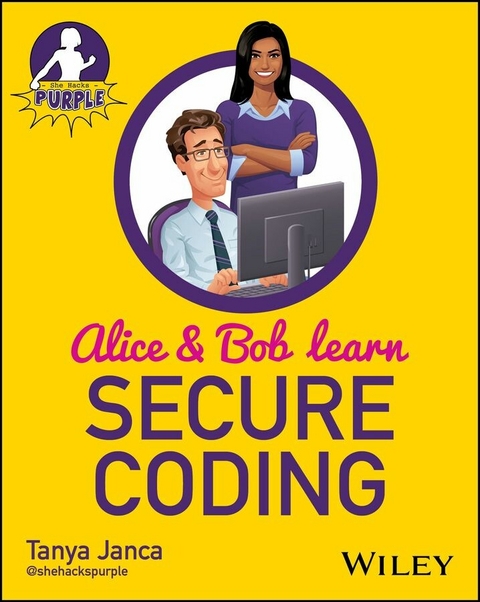
Alice and Bob Learn Secure Coding (eBook)
644 Seiten
Wiley (Verlag)
978-1-394-17171-2 (ISBN)
Unlock the power of secure coding with this straightforward and approachable guide!
Discover a game-changing resource that caters to developers of all levels with Alice and Bob Learn Secure Coding. With a refreshing approach, the book offers analogies, stories of the characters Alice and Bob, real-life examples, technical explanations and diagrams to break down intricate security concepts into digestible insights that you can apply right away. Explore secure coding in popular languages like Python, Java, JavaScript, and more, while gaining expertise in safeguarding frameworks such as Angular, .Net, and React. Uncover the secrets to combatting vulnerabilities by securing your code from the ground up!
Topics include:
- Secure coding in Python, Java, Javascript, C/C++, SQL, C#, PHP, and more
- Security for popular frameworks, including Angular, Express, React, .Net, and Spring
- Security Best Practices for APIs, Mobile, Web Sockets, Serverless, IOT, and Service Mesh
- Major vulnerability categories, how they happen, the risks, and how to avoid them
- The Secure System Development Life Cycle, in depth
- Threat modeling, testing, and code review
- The agnostic fundamentals of creating secure code that apply to any language or framework
Alice and Bob Learn Secure Coding is designed for a diverse audience, including software developers of all levels, budding security engineers, software architects, and application security professionals. Immerse yourself in practical examples and concrete applications that will deepen your understanding and retention of critical security principles.
Alice and Bob Learn Secure Coding illustrates all the included concepts with easy-to-understand examples and concrete practical applications, furthering the reader's ability to grasp and retain the foundational and advanced topics contained within. Don't miss this opportunity to strengthen your knowledge; let Alice and Bob guide you to a secure and successful coding future.
Unlock the power of secure coding with this straightforward and approachable guide! Discover a game-changing resource that caters to developers of all levels with Alice and Bob Learn Secure Coding. With a refreshing approach, the book offers analogies, stories of the characters Alice and Bob, real-life examples, technical explanations and diagrams to break down intricate security concepts into digestible insights that you can apply right away. Explore secure coding in popular languages like Python, Java, JavaScript, and more, while gaining expertise in safeguarding frameworks such as Angular, .Net, and React. Uncover the secrets to combatting vulnerabilities by securing your code from the ground up! Topics include: Secure coding in Python, Java, Javascript, C/C++, SQL, C#, PHP, and more Security for popular frameworks, including Angular, Express, React, .Net, and Spring Security Best Practices for APIs, Mobile, Web Sockets, Serverless, IOT, and Service Mesh Major vulnerability categories, how they happen, the risks, and how to avoid them The Secure System Development Life Cycle, in depth Threat modeling, testing, and code review The agnostic fundamentals of creating secure code that apply to any language or framework Alice and Bob Learn Secure Coding is designed for a diverse audience, including software developers of all levels, budding security engineers, software architects, and application security professionals. Immerse yourself in practical examples and concrete applications that will deepen your understanding and retention of critical security principles. Alice and Bob Learn Secure Coding illustrates all the included concepts with easy-to-understand examples and concrete practical applications, furthering the reader s ability to grasp and retain the foundational and advanced topics contained within. Don't miss this opportunity to strengthen your knowledge; let Alice and Bob guide you to a secure and successful coding future.
CHAPTER 1
Introductory Security Fundamentals
This chapter will focus on fundamental security concepts, the sorts of things that every security person wishes every other IT professional knew. You may not have a chance to apply all of them in your work, but understanding them can help you create more robust and defensible systems.
Assume All Other Systems and Data Are Insecure
Perhaps the most important lesson in this entire book is learning to stop trusting computer systems, data, and users by default. Human beings, in general, are quite trusting as a species.1 For creating a society with laws, safety, and general order, having most people assume trust from the start is a good thing. It's part of what makes our societal fabric work.
As a result of human beings generally assuming trust, when we design computer systems, we tend to design them in such a way that the systems have an implied trust. What this means is that rather than automatically verifying facts, our computer systems assume they must be true. And this can lead to dire consequences.
COLLEGE COPY CAT
When Alice was in college, she used to save her work files to a shared drive on the network for school. In case her computer ever failed, she knew there would be a backup. In her second year of college, she was preparing a presentation for her software engineering course as part of a class team project. During the class, when her team was going to present the project research, a classmate named Eve2 asked if she could present her own project research first. Alice didn't see anything wrong with this, so she agreed. Eve got up and presented all of Alice's findings as though they were her own! She even used Alice's slide deck and changed the name on the front page to her own. Alice thought, “Are you kidding? How could this happen!?!?!” All of their classmates applauded and were very pleased with Eve. Alice had assumed that saving her files on a shared drive at school meant they would be safe. She never thought a classmate would steal her work and present it as their own or that someone would go rifling through Alice's folders on the shared school drive. Alice had assumed trust, and she had gotten burned.
If we are trying to create a secure system, it is of the utmost importance that we never assume trust. This can mean using multifactor authentication to protect against credential stuffing attacks, double‐checking data you receive from the database to ensure that it is the correct format and size, or performing authentication and authorization against an application programming interface (API) calling a serverless app, even though they were both built by your company.
Examples of implied trust:
- Zoning in network design: once someone has entered a zone, they are able to access every other system within that zone without having to cross a firewall or reauthenticate.
- Accepting user input, not validating it, and then using that input to create an SQL query, a URL redirect, or another decision within your system.
- Exposing an API to the internet without putting a gateway in front of it or any other mechanism to perform authentication and authorization, allowing anyone to call it—including bots.
If you only learn one thing from this book, I hope it is this: design every system with as little implied trust as possible. Verify everything, including input, decisions, data, and other system integrations. Perform more than one verification if possible and several if the stakes are high (top‐secret information, systems requiring high availability, etc.). Always assume that other systems and data are potentially insecure.
The CIA Triad
The CIA triad are the three things that make up the mandate for most IT Security teams around the world. It is a cybersecurity team's job to guard the confidentiality, integrity, and availability of the systems and data they are charged with protecting. Security teams protect more than just the CIA, but those are often considered the core topics. Throughout this book, we will cover much more, including privacy, safety, authenticity, and layering our defenses.
TOP‐SECRET WORK
Bob used to work on a top‐secret case for the government of Canada. It was about antiterrorism activities, and that's all he was allowed to say about it. Keeping that sensitive data safe was of the utmost importance, and Bob took all of his training on how to protect that data very seriously. When Bob had his training with the Canadian Centre for Cyber Security, he asked what made the data “top secret” rather than secret or some other classification. The response was, “If that data got out, it could potentially harm Canada as a nation. It could potentially result in hundreds of lost lives and cause various other counterterrorism activities to fail. This information could not only harm those working for the government but also block them from uncovering various plots that could lead to the death of citizens or even, in the worst case, a successful government coup. Your most important task, no matter how complex, onerous, or difficult, is to keep this information from falling into the wrong hands. Guard it, literally, with your life.” Although Bob rarely spoke about this work assignment with his friends and family, they were all very aware of how Bob felt about the importance of his work for the Department of Justice.
NOTE
- Confidentiality: the state of keeping or being kept secret or private3
- Integrity: internal consistency or lack of corruption in electronic data3
- Availability: the quality of being able to be used or obtained at any time3
WHEN CRITICAL INFRASTRUCTURE GOES DOWN
In 2022, on July 9, the Rogers telecommunications network went down in Canada.4 Canada has only three major telecommunication companies, and the rest share or rent the lines from the main three. Canadians couldn't pay bills, surf the net, or even call 911 in large parts of the country for several days as a result of this outage. Cybersecurity generally focuses on three things: confidentiality, integrity, and availability (CIA). As you can see, when Rogers went down, it caused a lack of availability for much of the country, and therefore the outage was a security issue. If one human error can disable emergency services for a large part of the country for several days, that system is not secure. Although the outage itself was not caused by a cyber attack, it interfered with one of the CIA triad, and therefore was a security issue. The lack of contingency planning around these systems is also a security issue. This note is not meant as a critique against Rogers; it is a real‐world example of how security is a part of quality and also the importance of defense in depth, business continuity planning, and disaster recovery.
Although we have seen the definition of integrity, let's talk a little more about the meaning of that word. Often, when we speak of a person who “has integrity,” we mean that you can trust that person: you can rely on them and know they will always make the “right” decision. Integrity is similar for computer systems; when a system and its data have integrity, it means we can use that data to make decisions and know they will be good decisions. This data has already been verified; it is trustworthy.
Now imagine that you are a doctor, and you use a computer to calculate a dosage for medicine based on your patient's weight, height, any medical conditions they have, and various other factors. When you give the patient the medication, you assume it's the correct amount—that the information the computer gives you will help the patient, not harm them. When you do this (trust the output of the system), you are assuming that the system and its data have integrity. Imagine the horror for a doctor if the computer got it wrong and their patient was caused harm. For some systems, the integrity of the data is critical (measuring medicine, for instance), and for others, it's not so important (a recipe for a cake that says one egg versus two—it's not the end of the world). When you are creating a system, it's extremely helpful to know which of the CIA is most important and then to design your systems and tests with that in mind.
Least Privilege
The principle of least privilege (PoLP) refers to an information security concept in which a user is given the minimum levels of access – or permissions – needed to perform their job functions.
— CyberArk5
Although this quote implies that least privilege only applies to users, this is not true; it applies to any person or thing who may have access or privileges, including computer systems, like software or an AI. Least privilege also applies to how long the access is given, as it should only be provided during the time it is required and no longer.
NO MORE ADMIN RIGHTS
Alice remembers her first introduction to the concept of least privilege from the security...
| Erscheint lt. Verlag | 10.1.2025 |
|---|---|
| Sprache | englisch |
| Themenwelt | Mathematik / Informatik ► Informatik ► Theorie / Studium |
| Schlagworte | angular security • css security • cybersecurity • html security • javascript security • Java Security • jquery security • pandas security • Python Security • secure programming • security in java • security in javascript • security in python |
| ISBN-10 | 1-394-17171-4 / 1394171714 |
| ISBN-13 | 978-1-394-17171-2 / 9781394171712 |
| Informationen gemäß Produktsicherheitsverordnung (GPSR) | |
| Haben Sie eine Frage zum Produkt? |
 EPUB (Adobe DRM)
Kopierschutz: Adobe-DRM
Adobe-DRM ist ein Kopierschutz, der das eBook vor Mißbrauch schützen soll. Dabei wird das eBook bereits beim Download auf Ihre persönliche Adobe-ID autorisiert. Lesen können Sie das eBook dann nur auf den Geräten, welche ebenfalls auf Ihre Adobe-ID registriert sind.
Details zum Adobe-DRM
Dateiformat: EPUB (Electronic Publication)
EPUB ist ein offener Standard für eBooks und eignet sich besonders zur Darstellung von Belletristik und Sachbüchern. Der Fließtext wird dynamisch an die Display- und Schriftgröße angepasst. Auch für mobile Lesegeräte ist EPUB daher gut geeignet.
Systemvoraussetzungen:
PC/Mac: Mit einem PC oder Mac können Sie dieses eBook lesen. Sie benötigen eine
eReader: Dieses eBook kann mit (fast) allen eBook-Readern gelesen werden. Mit dem amazon-Kindle ist es aber nicht kompatibel.
Smartphone/Tablet: Egal ob Apple oder Android, dieses eBook können Sie lesen. Sie benötigen eine
Geräteliste und zusätzliche Hinweise
Buying eBooks from abroad
For tax law reasons we can sell eBooks just within Germany and Switzerland. Regrettably we cannot fulfill eBook-orders from other countries.
aus dem Bereich