


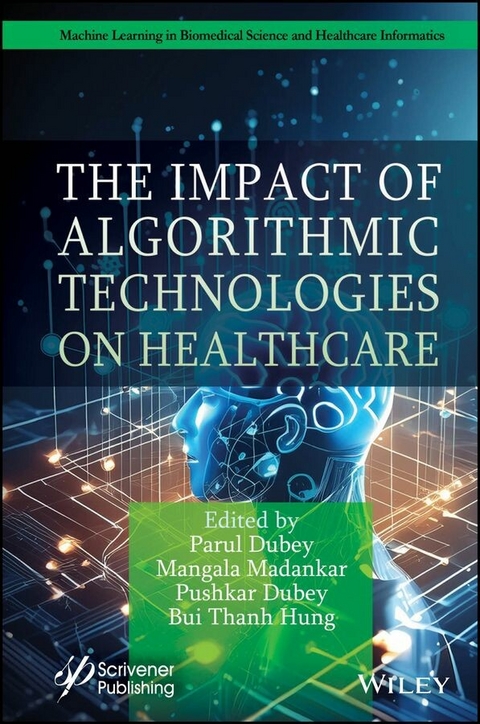
The Impact of Algorithmic Technologies on Healthcare (eBook)
664 Seiten
Wiley-Scrivener (Verlag)
978-1-394-30547-6 (ISBN)
The book explores the fundamental principles and transformative advancements in cutting-edge algorithmic technologies, detailing their application and impact on revolutionizing healthcare.
This book provides an in-depth account of how technologies such as artificial intelligence (AI), machine learning (ML), and the Internet of Things (IoT) are reshaping healthcare, transitioning from traditional diagnostic and treatment approaches to data-driven solutions that improve predictive accuracy and patient outcomes. The text also addresses the challenges and considerations associated with adopting these technologies, including ethical implications, data security concerns, and the need for human-centered approaches in algorithmic medicine.
After introducing digital twin technology and its potential to enhance healthcare delivery, the book examines the broader effects of digital technology on the healthcare system. Subsequent chapters explore topics such as innovations in medical imaging, predictive analytics for improved patient outcomes, and deep learning algorithms for brain tumor detection. Other topics include generative adversarial networks (GANs), convolutional neural networks (CNNs), smart wearables for remote patient monitoring, effective IoT solutions, telemedicine advancements, and blockchain security for healthcare systems. The integration of biometric systems driven by AI, securing cyber-physical systems in healthcare, and digitizing wellness through electronic health records (EHRs) and electronic medical records (EMRs) are also discussed. The book concludes with an extensive case study comparing the impacts of various healthcare applications, offering insights and encouraging further research and innovation in this dynamic field.
Audience
This book is suitable for academicians and professionals in health informatics, bioinformatics, biomedical science and engineering, artificial intelligence, as well as clinicians, IT specialists, and policymakers in healthcare.
Parul Dubey, PhD, is an assistant professor in the Department of Artificial Intelligence, G. H. Raisoni College of Engineering, Nagpur, India. Her academic and research focus spans various areas of computer science and IT. She has published approximately 50 works, including journal articles, conference papers, and book chapters, along with 17 Indian patents.
Mangala Madankar, PhD, is the head of the Department of Artificial Intelligence at G. H. Raisoni College of Engineering, Nagpur, India. Her research interests include natural language processing, data science, big data, and information retrieval systems. She has published over 55 research papers in international journals and conferences.
Pushkar Dubey, PhD, is an assistant professor and head of the Department of Management at Pandit Sundarlal Sharma (Open) University, Chhattisgarh, Bilaspur. He has published more than 70 research papers in reputed journals, secured 7 patents, and completed 5 research projects.
Bui Thanh Hung, PhD, is affiliated with the Data Science Laboratory, Data Science Department, Faculty of Information Technology, Industrial University of Ho Chi Minh City, Vietnam. His research focuses on natural language processing, machine learning, machine translation, and text processing. He has published two books and approximately 40 conference papers.
The book explores the fundamental principles and transformative advancements in cutting-edge algorithmic technologies, detailing their application and impact on revolutionizing healthcare. This book provides an in-depth account of how technologies such as artificial intelligence (AI), machine learning (ML), and the Internet of Things (IoT) are reshaping healthcare, transitioning from traditional diagnostic and treatment approaches to data-driven solutions that improve predictive accuracy and patient outcomes. The text also addresses the challenges and considerations associated with adopting these technologies, including ethical implications, data security concerns, and the need for human-centered approaches in algorithmic medicine. After introducing digital twin technology and its potential to enhance healthcare delivery, the book examines the broader effects of digital technology on the healthcare system. Subsequent chapters explore topics such as innovations in medical imaging, predictive analytics for improved patient outcomes, and deep learning algorithms for brain tumor detection. Other topics include generative adversarial networks (GANs), convolutional neural networks (CNNs), smart wearables for remote patient monitoring, effective IoT solutions, telemedicine advancements, and blockchain security for healthcare systems. The integration of biometric systems driven by AI, securing cyber-physical systems in healthcare, and digitizing wellness through electronic health records (EHRs) and electronic medical records (EMRs) are also discussed. The book concludes with an extensive case study comparing the impacts of various healthcare applications, offering insights and encouraging further research and innovation in this dynamic field. Audience This book is suitable for academicians and professionals in health informatics, bioinformatics, biomedical science and engineering, artificial intelligence, as well as clinicians, IT specialists, and policymakers in healthcare.
1
Introduction to Algorithmic Health: Exploring Healthcare Through Digital Twins
A.S. Vinay Raj1, N. Gopinath2*, R. Anandh3, M. Mohammed Jalaluddin4 and Lyndsay R. Buckingham5
1Information Science and Engineering, Global Academy of Technology, Bangalore, India
2Department of CINTEL, SRM Institute of Science and Technology, Kattankulathur, Tamil Nadu, India
3Department of CSE, Vel Tech Rangarajan Dr. Sagunthala R&D Institute of Science and Technology, Chennai, India
4Department of Computer Applications, B.S. Abdur Rahman Crescent Institute of Science and Technology, Vandalur, Chennai, India
5Universidad Pontificia Comillas, Mandrid, Spain
Abstract
Components from several industries can be connected over the Internet thanks to a new communication paradigm called the Internet of Things (IoT). One of the most exciting applications of IoT technology is in contemporary healthcare as the social resource requirements, such as physicians, hospital, and health monitoring devices, in the traditional healthcare system are increasing. This paper covers the development of a tiny, wearable sensor that may be used to monitor electrocardiograms, photo plethysmography, and body temperature. The anticipated sensor can constantly evaluate blood pressure (BP) and relies on the pulse arrival time devoid of needing excess devices/wires as the PPG and ECG sensors are merged into a single device. Vital sign monitoring is done using the three sensors on the sensor. A power board handles battery charging and energy supply, and a centerboard handles signal processing and acquisition. For remote health monitoring applications, affixing all components to the human body is simple, thanks to its rigid–flex structure. The centerboard’s sensors can be taken out to save energy and be used for specialized physiological signal assessments such as the ECG. The usefulness of the suggested sensor is tested through experiments, and performance is compared to a commercial reference device.
Keywords: Healthcare, Internet of Things, remote sensing, sensors, human body
1.1 Introduction
Many scientific fields have shown great interest in the Internet of Things (IoT). IoT technologies allow many components from many locations to be connected so that resources and information can be shared without being limited by time or space. The current healthcare industry is one of the most enticing uses of IoT [1]. Chronic illnesses are one of the leading global health concerns for people as life expectancy rises. Early detection and management of chronic diseases and improving people’s health depend on continuously monitoring human vital indicators such as body temperature for an extended period, breathing rate, heart rate, and blood pressure. When considering hospital beds, medical equipment, physicians, and nurses, the traditional healthcare system has fewer social resources than the aging population. One intriguing answer to the need for ongoing health monitoring is the creation of wearable technology, which is a project for the future incorporating IoT technologies [2].
A tiny, low-power, wearable sensor is suggested for vital sign monitoring with Internet of Things-connected healthcare applications. The sensor comprises three sensors, a power board, and a centerboard. Flexible, flat cables connect the sensors to the boards. Consequently, removing any unnecessary sensors from the system is simple to minimize its overall size and power usage. To measure physiological parameters, including body temperature, PPG, and ECG, the sensor rigid–flex construction makes using biocompatible tapes to secure it to the chest simple. Without additional preparations, continuous blood pressure calculation on the suggested sensor is possible with the combination of PPG and ECG sensors [3]. The sensor data will be sent to a gateway, desktop computers, or mobile through a Bluetooth module. To safeguard subjects’ confidentiality and privacy during transmission, AES-128 encryption is used. Each health data set will have a timestamp added before the gateway transfer data to a cloud server for further processing and preservation. The trade-off approach for monitoring users with movement requirements is to use a smartphone as a mobile gateway, although mobility is not the main emphasis of this study.
1.2 Related Works
Generally, three primary components are typically found in an IoT-connected healthcare system as follows: (1) wearable sensors to monitor health indicators, (2) an Internet gateway to link wearables to wearables, and (3) a cloud server for storing and processing data after they have been collected. Wearable sensors are essential for a healthcare platform with Internet of Things connectivity for remote health monitoring [4]. At the same time, gateways and cloud servers comprise the fundamental IoT infrastructure. The body’s vital signs can provide insight into an individual’s health. Scientists have suggested numerous wearable sensors to measure health data. Comprehensive wearable sensor reviews for remote healthcare applications, comprising Galvanic Skin Response (GSR), body temperature and activity, blood oxygen saturation (SpO2), and cardio-vascular monitoring are described. For instance, a ring-shaped wearable sensor that measures heart rate is proposed. It is based on photoplethysmography (PPG), which examines clinical and technological problems during long-term continuous HR monitoring. In an intelligent assisted living home, wearable motion sensors identify behavioral anomalies in senior citizens. The suggested probabilistic framework is designed to enhance the quality of life for senior citizens by utilizing wearable sensors to detect abnormalities in their everyday routines. In ref. [5], RR and the duration of apnea during sleep are measured using a tiny magnetometer-based sensor. They are transferring the sensor data to a smartphone gateway to contrast it to an airflow sensor sold commercially. As for blood pressure readings, the wearable BP-monitoring system cannot use the bulky, cuff-equipped standard sphygmomanometer because of its short measurement intervals. Several intriguing wearable blood pressure monitoring techniques have recently been developed, all based on pulse transit time (PTT) and pulse arrival time (PAT) [6].
Most wearable BP estimation systems in long-term monitoring cases could be more user friendly since they use separate devices to measure PPG (finger/earlobe) and ECG (on the body). A wristwatch design for blood pressure readings is proposed. To acquire the ECG and PPG signals, the user must wear a watch on his left wrist and contact the electrode over the right hand [7]. A suitable regression model built using the PAT’s collected ECG and PPG data can be used to determine the related BP values. Even though the bio-watch’s hardware design is more straightforward because it requires two hands to take a reading, it cannot continuously measure long-term blood pressure numbers. Since the given work integrates PPG and ECG sensors, it can be applied to a chest-based sensor for continuous, long-term blood pressure estimation. In contrast to conventional wearables based on the wrist and finger, the suggested chest-based sensor is covert enough to be worn under clothing without interfering with daily activities [8].
1.2.1 Reviews on Wearable Sensors
One important method for tying wearable sensors and IoT gateways together is wireless communication. Many wireless protocols, including Zigbee, 6LowPAN, BLE, and others, have been proposed for short- and long-range data transmission (LoRaWan, Sigfox, etc.). For IoT-connected healthcare applications, researchers have put forth several wearable health monitoring devices. For example, the Health-IoT platform incorporates an intelligent medication box and non-intrusive bio-sensors [9]. Developing a wearable biosensor for body temperature and ECG monitoring coexists with integrating RFID technology into the medicine box to facilitate patient identification and prescription reminders. The author in ref. [10] describes an inexpensive wearable SN for the IoT healthcare system. The SN can gather and send body temperature, respiration rate, and ECG data to a gateway that can send emergency alerts. A wearable ECG monitor that may be customized is displayed next to an IoT architecture. The heart rate variability (HRV) and heart rate (HR) can be evaluated when ECG data are transferred to the smartphone using a Bluetooth module. The author used mobile phone accessories to set up a wireless health-monitoring system. The ECG signals are recorded and collected using the dry electrodes. A smartphone application can then analyze and predict a patient using these data. Unfortunately, it cannot record continuous ECG data because both hands are needed to record the signal. A wearable medical gadget with IoT capabilities for measuring several physiological parameters, including HR, HRV, and RR, is presented [11]. The primary gateway for storing local data and sending it to the Internet cloud is chosen to be an Android phone. However, since the smartphone could be needed for other everyday tasks, there are better options than utilizing it as the only gateway. To obtain physiological measurements, health data can be transferred via the Internet to a cloud and kept in a local database; this work uses both a mobile and a fixed gateway.
Because of the widespread use of IoT platforms and devices, security concerns about IoT today face unique obstacles outside of the conventional...
| Erscheint lt. Verlag | 9.1.2025 |
|---|---|
| Reihe/Serie | Machine Learning in Biomedical Science and Healthcare Informatics |
| Sprache | englisch |
| Themenwelt | Mathematik / Informatik ► Informatik ► Programmiersprachen / -werkzeuge |
| Medizin / Pharmazie ► Gesundheitsfachberufe | |
| Medizin / Pharmazie ► Medizinische Fachgebiete | |
| ISBN-10 | 1-394-30547-8 / 1394305478 |
| ISBN-13 | 978-1-394-30547-6 / 9781394305476 |
| Informationen gemäß Produktsicherheitsverordnung (GPSR) | |
| Haben Sie eine Frage zum Produkt? |
 EPUB (Adobe DRM)
Kopierschutz: Adobe-DRM
Adobe-DRM ist ein Kopierschutz, der das eBook vor Mißbrauch schützen soll. Dabei wird das eBook bereits beim Download auf Ihre persönliche Adobe-ID autorisiert. Lesen können Sie das eBook dann nur auf den Geräten, welche ebenfalls auf Ihre Adobe-ID registriert sind.
Details zum Adobe-DRM
Dateiformat: EPUB (Electronic Publication)
EPUB ist ein offener Standard für eBooks und eignet sich besonders zur Darstellung von Belletristik und Sachbüchern. Der Fließtext wird dynamisch an die Display- und Schriftgröße angepasst. Auch für mobile Lesegeräte ist EPUB daher gut geeignet.
Systemvoraussetzungen:
PC/Mac: Mit einem PC oder Mac können Sie dieses eBook lesen. Sie benötigen eine
eReader: Dieses eBook kann mit (fast) allen eBook-Readern gelesen werden. Mit dem amazon-Kindle ist es aber nicht kompatibel.
Smartphone/Tablet: Egal ob Apple oder Android, dieses eBook können Sie lesen. Sie benötigen eine
Geräteliste und zusätzliche Hinweise
Buying eBooks from abroad
For tax law reasons we can sell eBooks just within Germany and Switzerland. Regrettably we cannot fulfill eBook-orders from other countries.
aus dem Bereich


