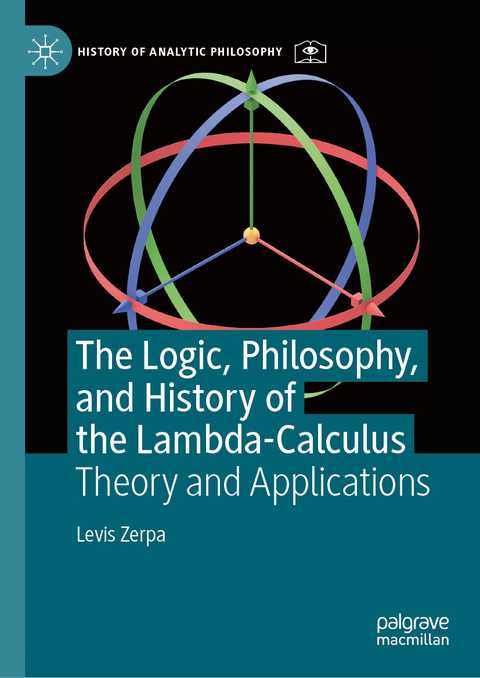
The Logic, Philosophy, and History of the Lambda-Calculus (eBook)
XXXI, 255 Seiten
Springer Nature Switzerland (Verlag)
978-3-031-72851-8 (ISBN)
This is the first book focused on the logico-philosophical aspects of the lambda-calculus since the inception of the field in 1932 in the pioneering work of Alonzo Church. The book starts a new field called 'lambda-philosophy': a branch of logic-based analytic philosophy in the tradition of Frege and Russell, directly constructed from the lambda-calculus. Another innovation of the book is a new graphical and intuitive logico-mathematical notation for the lambda-calculus called 'the container notation'.
The book covers in detail some episodes of the history of the subject, including three comparative studies of the lambda-calculus with Viète's algebra, Descartes' analytic geometry, and Wittgenstein's Tractatus. A didactic approach to the logico-mathematical aspects of the lambda-calculus, partially based on cognitive science, provides the technical basis for the analysis. In this way, the book provides a systematic and coherent treatment of diverse logico-philosophical aspects and applications of the lambda-calculus as part of the platform offered by lambda-philosophy.
The book includes the following: a detailed treatment of the ambiguities of the concept of function (under the traditional or Euler's notation); an elucidation of the notion of transformative philosophical analysis; an account of Church's methodology which shows that the lambda-calculus is an adequate solution to the problem of a philosophical analysis of functions as rules of computation; a didactic treatment of the formal aspects of the lambda-calculus through the container notation; and diverse arithmetical and logical examples of the container notation. The book questions a dogma of algorithmic thinking by arguing that the lambda-calculus is more intuitive and natural than Turing machines.
The Logic, Philosophy, and History of the Lambda-Calculus is essential reading for all scholars and researchers of the history of analytic philosophy and especially those focussing on logic-based analytic philosophy.
| Erscheint lt. Verlag | 6.1.2025 |
|---|---|
| Reihe/Serie | History of Analytic Philosophy |
| Zusatzinfo | XXXI, 255 p. 10 illus. |
| Sprache | englisch |
| Themenwelt | Geisteswissenschaften ► Philosophie ► Logik |
| Geisteswissenschaften ► Philosophie ► Philosophie der Neuzeit | |
| Mathematik / Informatik ► Informatik | |
| Mathematik / Informatik ► Mathematik | |
| Schlagworte | Alonzo Church • Analytic philosophy • Lambda-Calculus • Linguistics • symbolic logic |
| ISBN-10 | 3-031-72851-3 / 3031728513 |
| ISBN-13 | 978-3-031-72851-8 / 9783031728518 |
| Informationen gemäß Produktsicherheitsverordnung (GPSR) | |
| Haben Sie eine Frage zum Produkt? |
 PDF (Wasserzeichen)
DRM: Digitales Wasserzeichen
Dieses eBook enthält ein digitales Wasserzeichen und ist damit für Sie personalisiert. Bei einer missbräuchlichen Weitergabe des eBooks an Dritte ist eine Rückverfolgung an die Quelle möglich.
Dateiformat: PDF (Portable Document Format)
Mit einem festen Seitenlayout eignet sich die PDF besonders für Fachbücher mit Spalten, Tabellen und Abbildungen. Eine PDF kann auf fast allen Geräten angezeigt werden, ist aber für kleine Displays (Smartphone, eReader) nur eingeschränkt geeignet.
Systemvoraussetzungen:
PC/Mac: Mit einem PC oder Mac können Sie dieses eBook lesen. Sie benötigen dafür einen PDF-Viewer - z.B. den Adobe Reader oder Adobe Digital Editions.
eReader: Dieses eBook kann mit (fast) allen eBook-Readern gelesen werden. Mit dem amazon-Kindle ist es aber nicht kompatibel.
Smartphone/Tablet: Egal ob Apple oder Android, dieses eBook können Sie lesen. Sie benötigen dafür einen PDF-Viewer - z.B. die kostenlose Adobe Digital Editions-App.
Buying eBooks from abroad
For tax law reasons we can sell eBooks just within Germany and Switzerland. Regrettably we cannot fulfill eBook-orders from other countries.
aus dem Bereich