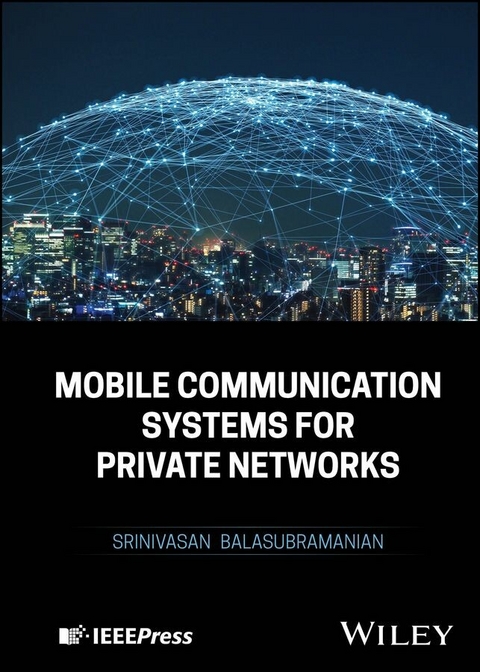
Mobile Communication Systems for Private Networks (eBook)
1178 Seiten
Wiley-IEEE Press (Verlag)
978-1-394-20179-2 (ISBN)
Understand the role of network communications in the private sector with this timely guide
4G and 5G wireless communication technologies have come to dominate network communications in recent years, and their expansion is only continuing. Most existing treatments of this key subject, however, deal with large-scale public networks, not the private networks whose deployment constitutes one of the major current growth areas in wireless technology. There is an urgent need for a guide to network communication deployment specifically for private enterprises.
Mobile Communication Systems for Private Networks meets this need with a cutting-edge but accessible overview of the subject. Alerting to the specific needs of the private enterprise network and the disruption potential of cellular network operations, it surveys the early lessons of the global private network rollout for the benefit of future operations. With an eye towards future challenges and developments, this essential text is suitable for professionals in the network communications industry and its partners.
Readers will also find:
- The background required to design, deploy, and manage enterprise private networks driven by 4G and 5G technologies
- Detailed discussion of topics including fundamentals of 4G & 5G, standards bodies and their role in defining specifications for private networks, layer 3 concepts, IP connectivity, and many more
- Solutions to the urgent need for ubiquitous 5-bar connectivity both indoor and outdoor
Mobile Communication Systems for Private Networks is an ideal reference for end user devices, network operators, chip manufacturers, researchers, and all other professionals and stakeholders with roles in the information and operational technology industries.
Srinivasan Balasubramanian is an industry expert in telecommunications, networking, and enterprise systems, with extensive experience across multiple generations of cellular technology, including both 4G and 5G. He has relationships across the network operations field, and his 532+ patents make him a proven innovator.
Understand the role of network communications in the private sector with this timely guide 4G and 5G wireless communication technologies have come to dominate network communications in recent years, and their expansion is only continuing. Most existing treatments of this key subject, however, deal with large-scale public networks, not the private networks whose deployment constitutes one of the major current growth areas in wireless technology. There is an urgent need for a guide to network communication deployment specifically for private enterprises. Mobile Communication Systems for Private Networks meets this need with a cutting-edge but accessible overview of the subject. Alerting to the specific needs of the private enterprise network and the disruption potential of cellular network operations, it surveys the early lessons of the global private network rollout for the benefit of future operations. With an eye towards future challenges and developments, this essential text is suitable for professionals in the network communications industry and its partners. Readers will also find: The background required to design, deploy, and manage enterprise private networks driven by 4G and 5G technologiesDetailed discussion of topics including fundamentals of 4G & 5G, standards bodies and their role in defining specifications for private networks, layer 3 concepts, IP connectivity, and many moreSolutions to the urgent need for ubiquitous 5-bar connectivity both indoor and outdoor Mobile Communication Systems for Private Networks is an ideal reference for end user devices, network operators, chip manufacturers, researchers, and all other professionals and stakeholders with roles in the information and operational technology industries.
Preface
Looking back at my career working in the wireless field, the initial enterprise work environment I was in used tethered (ethernet) connectivity, switching to a hybrid mode and using wireless only when tethered connectivity was not available, and finally switching to operating with only wireless connectivity. Both the reliability and the ubiquitous availability of wireless connectivity have become basic necessities now. My initial foray into wireless was on 3GPP2, developing 1xRTT and High Rate Packet Data (HRDP) systems, and I still remember attending wireless conferences discussing contributions using printed copies, given the lack of connectivity while traveling to a site to meet.
Wireless voice solutions were the first to arrive and were mainly focused on cellular wide‐area coverage‐based support, creating the cellular industry. Voice service remained the main service that dominated the wireless industry even up to the third generation, even though data connectivity was introduced. The data connectivity through wireless was expensive to deploy, required high subscription costs, and was very restricted in its use. The barrier was broken with the 4G long‐term evolution (LTE) technology, where data connectivity became a more accessible commodity. While cellular technology was evolving for wide‐area coverage, the void of wireless connectivity for in‐building home and enterprise data connectivity was filled by Wi‐Fi. Given the low costs to both deploy and manage, Wi‐Fi became the go‐to choice for shorter‐range connectivity. This resulted in the enterprise connectivity solutions industry growing in parallel with the cellular industry.
The Wi‐Fi standards have made strides to meet enterprise demands. Since its introduction in 1997, the ongoing evolution of the Institute of Electrical and Electronics Engineers (IEEE) 802.11 Wi‐Fi standards has led to much faster data transmission rates, longer ranges, and more reliable and secure connections. IEEE 802.11ax™, or Wi‐Fi 6, is the most recent standard in the IEEE 802.11 series, published in 2022. Wi‐Fi 6E is an extension of the Wi‐Fi 6 standard (which is based on the 802.11ax standard) that operates in the 6 GHz frequency band. It provides additional spectrum for Wi‐Fi devices, enabling higher data rates, lower latency, and less interference compared to operating in the crowded 2.4 GHz and 5 GHz bands. Wi‐Fi 7 is the next generation of wireless network technology that is being developed in the standards and brings with it some fundamental technical improvements over its predecessors.
One of the key aspects of Wi‐Fi was its reliance on the use of unlicensed spectrum. Wi‐Fi became and still is synonymous with “free,” at least from a user perspective. This is certainly true when compared to the costs for data connectivity on a cellular platform. 4G LTE, and now 5G NR, has provided definitions for the use of 3GPP technologies in an unlicensed spectrum. It relied on a licensed spectrum as an anchor, and the unlicensed spectrum was used to augment the capacity and is termed as licensed assisted access (LAA). Given that the base stations for both licensed and unlicensed services needed to be deployed in close proximity, this was more suitable for small cell solutions. The support of small cells in a licensed spectrum required sophisticated spectrum sharing between the macro and small cells, which made it difficult for market adoption.
All radio and telecommunications use waves of different frequencies (measured in Megahertz [MHz] and Gigahertz [GHz]) to carry data. These frequencies are grouped together to form bands, and multiple bands combine to form a spectrum of radio waves. Every successive generation of telecom has its fixed spectrum, and its bands are allocated to telecommunication companies for commercial use. Spectrum resource availability has become the biggest bottleneck, with wireless service providers paying huge sums of money to acquire spectrum resources and going through bidding wars involving large amounts of money. 3GPP‐defined 4G/5G systems offer higher reliability when compared to Wi‐Fi in terms of providing service guarantees and also deliver improved system capacity with the available spectrum. For this technology to be supported in an enterprise environment, a specific spectrum needs to be made available. Exclusive spectrum purchases by the smaller entities (both in geographic footprint and financial capacity) meant that an innovative approach was needed to address this demand. This naturally lent itself to the definition of shared spectrum use by these smaller entities.
In 2015, the Federal Communications Commission (FCC) developed a framework for the shared commercial use of the 3,550–3,700 MHz band (3.5 GHz band). The Citizens Broadband Radio Service (CBRS) was established with a tiered access and authorization framework to accommodate shared federal and non‐federal use of the band. Wi‐Fi uses unlicensed spectrum within the 2.4 GHz and 5 GHz frequency ranges, while CBRS uses shared spectrum within the 3.55 GHz and 3.70 GHz range that is regulated by a central entity and referred to as lightly licensed. The CBRS spectrum is divided into three tiers, each requiring specific licenses with strict priority based on the users (base station deployments by an enterprise) belonging to a tier. The creation of this shared spectrum use has generated momentum for lower‐cost, smaller deployments using 4G LTE and 5G NR technologies on individual campuses, which can be deployed and managed similarly to Wi‐Fi networks. With the CBRS spectrum serving as an example, several countries have defined procedures for smaller entities to acquire spectrum for enterprise‐level operations, with more and more countries following suit. The amount of spectrum bandwidth allocated varies across different countries, but it is definitely a trend that is here to stay, providing smaller footprint spectrum usage that is readily available. Much of the focus is on optimally managing the spectrum to avoid interference between the deployed smaller networks and to enable fair sharing of the available spectrum. This aspect is actively evolving, with real‐time demand‐based spectrum management being envisioned.
As of the writing of this book, private network deployments are well underway, with implementations across several verticals, including educational institutions such as colleges and K‐12 schools, offices, hospitals, ports, manufacturing industries, big‐box retail, warehouses, mining, and many more. The use of 4G LTE/5G NR has enabled increased capacity, higher reliability, and fewer network nodes compared to Wi‐Fi, supporting enterprise functions. The 3GPP standards body envisioned a set of features to support private networks and introduced these in Release 16 (published in July 2020) and Release 17 (January 2022). Most, if not all, private networks deployed now use Release 15 (June 2018), which is the initial release where 5G NR support is defined. Given that the end‐user device availability was limited to Release 15 initially, and demand for private networks was growing, deployments needed to accommodate support for Release 15 devices. It turns out that many use cases can be addressed using Release 15. Advanced scenarios of macro network operators deploying smaller footprint networks and seamlessly transitioning across macro and small cell networks require the features introduced in Release 16 and beyond. Macro network operators are actively entering this space, given that users spend a lot of time indoors and there is a lack of good coverage provided by the macro network in buildings. Distributed antenna systems (DAS) exist but are very costly to deploy. However, where DAS solutions are deployed, they can be leveraged to support both licensed and shared spectrum.
The macro network operators are used to managing complex networks and actively tune the parameters to maximize the performance of the network, accommodating different user types. 4G LTE/5G NR systems are defined to accommodate complex scenarios and are inherently difficult to manage. Enterprise networks typically have Wi‐Fi support and are very simple to deploy and manage. Take a home setting where the public at large can go and buy an access point, plug it in, and get it functioning in a matter of minutes. Granted that enterprise environments are a lot more complex, ensuring that there are no hidden spots where coverage is needed, supporting the required load, and managing the security of the system while also overseeing the enterprise applications are challenging. Now, bringing in a complex system like 4G LTE/5G NR and deploying it in the same environment becomes a tall order. The enterprise folks are not going to budge from the fact that managing this 3GPP‐based network is much more complex than a Wi‐Fi system. In fact, even if it is as straightforward as a Wi‐Fi network, it still means the enterprise information technology (IT) has to manage yet another network and an additional screen to stare at. Both the deployment and the management of the 3GPP systems for enterprises need to be simplified enough not to scare away an enterprise entity from adopting it.
At this historic crossroad, it is strongly believed that a book on covering 4G/5G technology and its adoption into private networks will serve as an enlightening guideline to spur interest and enable increased adoption among different enterprises. Such a book will also attract a broad audience in both academia and industry, creating a...
| Erscheint lt. Verlag | 3.1.2025 |
|---|---|
| Sprache | englisch |
| Themenwelt | Mathematik / Informatik ► Informatik ► Netzwerke |
| Technik ► Elektrotechnik / Energietechnik | |
| Schlagworte | 5G standardization • 6G transformation • credential management • IP connectivity • layer 3 concepts • macro networks • Operational technology • private networks • Small cells • spectrum regulation • wireless communication |
| ISBN-10 | 1-394-20179-6 / 1394201796 |
| ISBN-13 | 978-1-394-20179-2 / 9781394201792 |
| Informationen gemäß Produktsicherheitsverordnung (GPSR) | |
| Haben Sie eine Frage zum Produkt? |
 EPUB (Adobe DRM)
Kopierschutz: Adobe-DRM
Adobe-DRM ist ein Kopierschutz, der das eBook vor Mißbrauch schützen soll. Dabei wird das eBook bereits beim Download auf Ihre persönliche Adobe-ID autorisiert. Lesen können Sie das eBook dann nur auf den Geräten, welche ebenfalls auf Ihre Adobe-ID registriert sind.
Details zum Adobe-DRM
Dateiformat: EPUB (Electronic Publication)
EPUB ist ein offener Standard für eBooks und eignet sich besonders zur Darstellung von Belletristik und Sachbüchern. Der Fließtext wird dynamisch an die Display- und Schriftgröße angepasst. Auch für mobile Lesegeräte ist EPUB daher gut geeignet.
Systemvoraussetzungen:
PC/Mac: Mit einem PC oder Mac können Sie dieses eBook lesen. Sie benötigen eine
eReader: Dieses eBook kann mit (fast) allen eBook-Readern gelesen werden. Mit dem amazon-Kindle ist es aber nicht kompatibel.
Smartphone/Tablet: Egal ob Apple oder Android, dieses eBook können Sie lesen. Sie benötigen eine
Geräteliste und zusätzliche Hinweise
Buying eBooks from abroad
For tax law reasons we can sell eBooks just within Germany and Switzerland. Regrettably we cannot fulfill eBook-orders from other countries.
aus dem Bereich