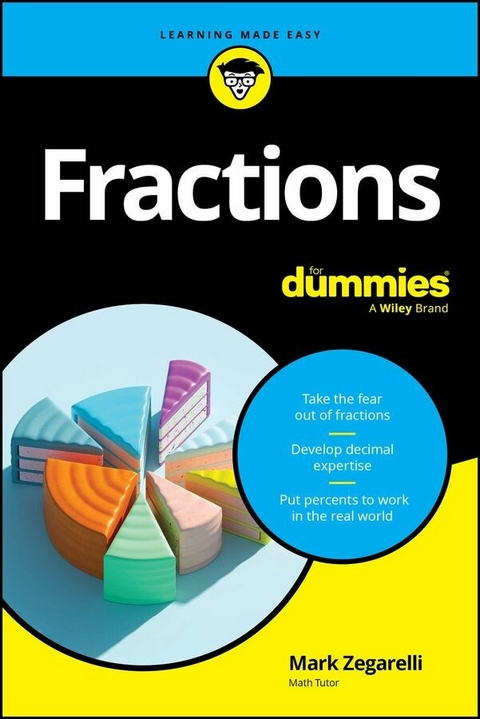
Fractions For Dummies (eBook)
350 Seiten
For Dummies (Verlag)
978-1-394-29688-0 (ISBN)
An easy, straightforward, and fun guide for learning fractions and its counterparts
Fractions For Dummies is the perfect strategy guide for both understanding and using one of math's most common (and most challenging) topic areas. You'll explore current solving strategies for fraction-related problems, and you'll also discover how to solve problems involving fractions' closely related cousins, decimals and percentages. Dive deep into the basics of these topics before moving on to more advanced uses, such as word problems, with the help of author and experienced math teacher Mark Zegarelli.
This straightforward and intuitive book also includes:
- Techniques for working with mixed numbers (numbers that include whole amounts and fractions) and more
- Ways to add, subtract, multiply, and divide fractions with whole numbers and with each other
- Strategies for helping and supporting the young student in your life who's struggling with fractions, decimals, and/or percentages
It's time you showed these math areas who's boss. Fractions For Dummies shows you just how easy fractions and the like can be!
Mark Zegarelli is a math teacher and tutor. He holds degrees in Mathematics and English from Rutgers University and is the author of several math and puzzle books, including Basic Math & Pre-Algebra For Dummies, Basic Math & Pre-Algebra Workbook For Dummies, and Logic For Dummies.
An easy, straightforward, and fun guide for learning fractions and its counterparts Fractions For Dummies is the perfect strategy guide for both understanding and using one of math's most common (and most challenging) topic areas. You'll explore current solving strategies for fraction-related problems, and you'll also discover how to solve problems involving fractions' closely related cousins, decimals and percentages. Dive deep into the basics of these topics before moving on to more advanced uses, such as word problems, with the help of author and experienced math teacher Mark Zegarelli. This straightforward and intuitive book also includes: Techniques for working with mixed numbers (numbers that include whole amounts and fractions) and more Ways to add, subtract, multiply, and divide fractions with whole numbers and with each other Strategies for helping and supporting the young student in your life who's struggling with fractions, decimals, and/or percentages It's time you showed these math areas who's boss. Fractions For Dummies shows you just how easy fractions and the like can be!
Chapter 1
What Are Fractions, Decimals, and Percents?
IN THIS CHAPTER
Expressing fractions as a numerator divided by a denominator
Working with place value in decimals
Understanding percents as a number out of 100
Representing part of a whole by using fractions, decimals, or percents
Welcome to your journey into the world of fractions! If you pick up this book, you’re probably feeling a bit unsure about fractions, and that’s completely okay. You’re not alone — many people find fractions tricky. The good news is that understanding fractions is like honing any new skill. In the same way that you may have figured out how to balance so that you could ride a bike or caught onto the basic rules of play for a new game, you can grasp the concepts and calculations associated with fractions if you have patience, practice, and the right guidance.
This book is designed to be your friendly companion while you explore fractions and their close cousins, decimals and percents. I give you the basics, breaking down what fractions are and why they matter. I also help you tackle problems one step at a time, with plenty of examples, tips, and encouragement along the way. My goal is to keep you from ever feeling lost or overwhelmed when working with fractions.
Remember, everyone figures things out at their own pace. So take your time, ask questions, and even make mistakes — you have to do all of those things to get good at anything. And with the help offered in this book, not only can you understand fractions, but you might also discover that they’re not so scary, after all.
Taking a First Look at Fractions
At a basic level, fractions give you a way to represent parts of a whole. Imagine that you have a pizza, and you cut it into eight equal slices. If you eat one slice out of eight, you’ve eaten one part of the eight slices, or of the pizza. That’s a fraction! Fractions help us understand and work with pieces of something, whether it’s food, time, money, or anything else that can be divided into equal sections.
In the following sections, I explain how fractions work to represent parts of the whole, how to read and write fractions for use in calculations, and why fractions are so useful.
Understanding how fractions work
Fractions use two numbers to show how much of an item you’re working with after you divide the whole into equal parts. For example, if you have a chocolate bar that’s divided into 4 equal pieces and you eat 3 pieces, the fraction that represents what you ate is . In this fraction, you use two numbers, 3 and 4, which you write one over the other with a vertical line in between.
Here are the names for these two numbers:
- Numerator: The top number in a fraction (3 in the chocolate bar example), which shows how many of the equal parts you’re specifically working with (in this case, you ate them)
- Denominator: The bottom number in a fraction (4 in the chocolate bar example), which shows the total number of equal parts that the whole is divided into
As another example, imagine that you have a rope that’s 10 meters long, and you cut off a 7-meter piece. The fraction representing the part of the rope that you cut off is . The numerator is 7 (because you cut 7 meters), and the denominator is 10 (because the whole rope was 10 meters long).
Making sense of equivalent fractions
Unlike whole numbers, where different numbers always represent different values (for example, 3 is always less than 5), fractions are a bit more flexible. A pair of fractions can look different, each containing a different numerator (top number) and denominator (bottom number), and yet their value can be exactly the same.
Different number combinations can represent the same value because fractions rely on the relationship between the numerator and the denominator. For example, and might seem different at first glance, but they actually represent the same amount. In both cases, you’re talking about half of something — whether it’s 1 out of 2 parts, or 2 out of 4 parts.
Pairs of fractions like this (such as the and example) are called equivalent fractions. Even though the numerators and denominators are different numbers, the value that they represent is the same. You really need to keep this idea in mind when you add, subtract, and compare fractions! (I go in depth about equivalent fractions in Chapter 4, so flip there if you want all the details.)
Understanding improper fractions
When you think about fractions, you might think of them as numbers that are less than 1 — that is, numbers that fall between 0 and 1 on the number line. These types of fractions, where the numerator is smaller than the denominator, are called proper fractions. For example, is a proper fraction because 4 is less than 5, so the value it represents is less than 1.
However, fractions can also be equal to or greater than 1, and these types of fractions are called improper fractions. In an improper fraction, the numerator is equal to or larger than the denominator, which means that the fraction represents one whole or more.
Improper fractions are common in the real world. For example, is an improper fraction. It tells us that we have 5 parts, but each whole is made up of only 4 parts. So, if you have of a cake, you have 1 whole cake and an extra of another identical cake.
Similarly, if you have 7 meters of fabric divided into 2-meter sections, you have , which is 3 and a half sections.
Seeing how improper fractions and mixed numbers relate
In the preceding section, you can explore improper fractions — fractions where the numerator is equal to or greater than the denominator. But in this section, you can find out about another way to express these fractions as mixed numbers. A mixed number is simply a combination of a whole number and a proper fraction. It gives you another way of showing the same value that an improper fraction does, but in a form that you can often more easily visualize or understand.
For example, I revisit the improper fraction that I talk about in the preceding section. This fraction tells you that you have more than one whole, but how much more? To express as a mixed number, you break it down into one whole () and the remaining . So, is the same as the mixed number . Both represent the same amount — 1 whole and of another whole.
In real life, mixed numbers come up often. Imagine that you’re baking (something really sweet) and using 2 full cups of sugar, plus another half cup. Instead of saying that you have cups, you probably say you have cups of sugar. Both expressions are valid, but the mixed number is a little easier to understand in a real-world situation.
Consider another example when measuring length: If you have a board that’s 3 full meters, plus an additional of a meter, you could express that as of a meter. However, this amount is probably easier to understand if you use the equivalent mixed number meters.
Every mixed number is just another way of writing an improper fraction, and it offers you a clearer picture of how many whole items and how many parts you have than an improper fraction does.
Seeing Why Decimals Are So User-Friendly
In this section, I want to help you explore a way to express values that fall between whole numbers, allowing you to sidestep using fractions. (See the section “Taking a First Look at Fractions,” earlier in this chapter, for an overview of fractions.) Decimals are a more user-friendly alternative to fractions because they align neatly with our base-10 number system, which makes them easier to understand and use in everyday situations.
Although fractions such as or represent parts of a whole, decimals express the same ideas, but in a different format. For example, instead of saying , you can use the decimal 0.5. Similarly, you can express as 0.75.
The digits that fall to the right of the period in a decimal represent the decimal places, which I describe in the following two sections.
Decimals are especially handy in contexts such as money, measurements (especially the metric system), and technology, where precision is a key aspect. Whether you calculate the total cost of items at the store, measure ingredients for a recipe, or read a digital scale, decimals offer a straightforward and precise way to represent values that aren’t whole numbers. And decimals also bypass many of the difficulties that calculating with fractions can carry (for example, finding a common denominator and simplifying your answer — see Chapter 4 for more on these subtleties of fractions).
In the sections that follow, you can find out how decimals work, how to convert between fractions and decimals, and how to use decimals in various real-world scenarios. And you can discover just how versatile and helpful decimals can be.
Understanding decimals that have one decimal place
Decimal place value, meaning how far each decimal digit is from the decimal point, helps you understand the value of the digits in a decimal number. For decimals that have only one decimal place (that is, one digit to the right of the period), each digit represents tenths of the whole.
For example, in the...
| Erscheint lt. Verlag | 3.1.2025 |
|---|---|
| Sprache | englisch |
| Themenwelt | Mathematik / Informatik ► Mathematik |
| Schlagworte | beginning fractions • butterfly method fractions • fraction learning techniques • fractions basics • fractions examples • fractions for beginners • fractions strategies • fractions techniques • fractions tips • GCF • greatest common factor • improper fractions • LCM • Learn fractions • learning decimals • learning fractions • learning percentages • least common multiple • Mixed Numbers |
| ISBN-10 | 1-394-29688-6 / 1394296886 |
| ISBN-13 | 978-1-394-29688-0 / 9781394296880 |
| Informationen gemäß Produktsicherheitsverordnung (GPSR) | |
| Haben Sie eine Frage zum Produkt? |
 EPUB (Adobe DRM)
Kopierschutz: Adobe-DRM
Adobe-DRM ist ein Kopierschutz, der das eBook vor Mißbrauch schützen soll. Dabei wird das eBook bereits beim Download auf Ihre persönliche Adobe-ID autorisiert. Lesen können Sie das eBook dann nur auf den Geräten, welche ebenfalls auf Ihre Adobe-ID registriert sind.
Details zum Adobe-DRM
Dateiformat: EPUB (Electronic Publication)
EPUB ist ein offener Standard für eBooks und eignet sich besonders zur Darstellung von Belletristik und Sachbüchern. Der Fließtext wird dynamisch an die Display- und Schriftgröße angepasst. Auch für mobile Lesegeräte ist EPUB daher gut geeignet.
Systemvoraussetzungen:
PC/Mac: Mit einem PC oder Mac können Sie dieses eBook lesen. Sie benötigen eine
eReader: Dieses eBook kann mit (fast) allen eBook-Readern gelesen werden. Mit dem amazon-Kindle ist es aber nicht kompatibel.
Smartphone/Tablet: Egal ob Apple oder Android, dieses eBook können Sie lesen. Sie benötigen eine
Geräteliste und zusätzliche Hinweise
Buying eBooks from abroad
For tax law reasons we can sell eBooks just within Germany and Switzerland. Regrettably we cannot fulfill eBook-orders from other countries.
aus dem Bereich