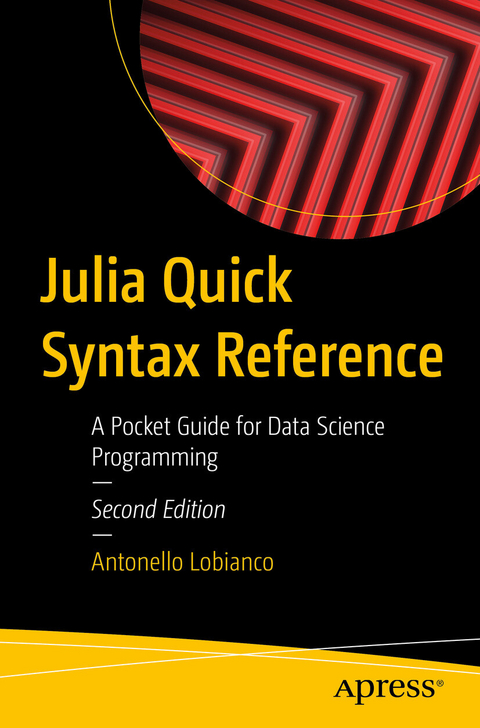
Julia Quick Syntax Reference (eBook)
361 Seiten
Apress (Verlag)
979-8-8688-0965-1 (ISBN)
Learn the Julia programming language as quickly as possible. This book is a must-have reference guide that presents the essential Julia syntax in a well-organized format, updated with the latest features of Julia’s APIs, libraries, and packages.
This book provides an introduction that reveals basic Julia structures and syntax; discusses data types, control flow, functions, input/output, exceptions, metaprogramming, performance, and more. Additionally, you'll learn to interface Julia with other programming languages such as R for statistics or Python. At a more applied level, you will learn how to use Julia packages for data analysis, numerical optimization, symbolic computation, and machine learning, and how to present your results in dynamic documents.
The Second Edition delves deeper into modules, environments, and parallelism in Julia. It covers random numbers, reproducibility in stochastic computations, and adds a section on probabilistic analysis. Finally, it provides forward-thinking introductions to AI and machine learning workflows using BetaML, including regression, classification, clustering, and more, with practical exercises and solutions for self-learners.
What You Will Learn
- Work with Julia types and the different containers for rapid development
- Use vectorized, classical loop-based code, logical operators, and blocks
- Explore Julia functions: arguments, return values, polymorphism, parameters, anonymous functions, and broadcasts
- Build custom structures in Julia
- Use C/C++, Python or R libraries in Julia and embed Julia in other code.
- Optimize performance with GPU programming, profiling and more.
- Manage, prepare, analyse and visualise your data with DataFrames and Plots
- Implement complete ML workflows with BetaML, from data coding to model evaluation, and more.
Who This Book Is For
Experienced programmers who are new to Julia, as well as data scientists who want to improve their analysis or try out machine learning algorithms with Julia.
Learn the Julia programming language as quickly as possible. This book is a must-have reference guide that presents the essential Julia syntax in a well-organized format, updated with the latest features of Julia's APIs, libraries, and packages.This book provides an introduction that reveals basic Julia structures and syntax; discusses data types, control flow, functions, input/output, exceptions, metaprogramming, performance, and more. Additionally, you'll learn to interface Julia with other programming languages such as R for statistics or Python. At a more applied level, you will learn how to use Julia packages for data analysis, numerical optimization, symbolic computation, and machine learning, and how to present your results in dynamic documents.The Second Edition delves deeper into modules, environments, and parallelism in Julia. It covers random numbers, reproducibility in stochastic computations, and adds a section on probabilistic analysis. Finally, it provides forward-thinking introductions to AI and machine learning workflows using BetaML, including regression, classification, clustering, and more, with practical exercises and solutions for self-learners.What You Will Learn Work with Julia types and the different containers for rapid development Use vectorized, classical loop-based code, logical operators, and blocks Explore Julia functions: arguments, return values, polymorphism, parameters, anonymous functions, and broadcasts Build custom structures in Julia Use C/C++, Python or R libraries in Julia and embed Julia in other code. Optimize performance with GPU programming, profiling and more. Manage, prepare, analyse and visualise your data with DataFrames and Plots Implement complete ML workflows with BetaML, from data coding to model evaluation, and more.Who This Book Is ForExperienced programmers who are new to Julia, as well as data scientists who want to improve their analysis or try out machine learning algorithms with Julia.
| Erscheint lt. Verlag | 3.1.2025 |
|---|---|
| Zusatzinfo | XV, 361 p. 83 illus. |
| Sprache | englisch |
| Themenwelt | Informatik ► Datenbanken ► Data Warehouse / Data Mining |
| Mathematik / Informatik ► Informatik ► Programmiersprachen / -werkzeuge | |
| Informatik ► Theorie / Studium ► Compilerbau | |
| Informatik ► Theorie / Studium ► Künstliche Intelligenz / Robotik | |
| Mathematik / Informatik ► Mathematik ► Angewandte Mathematik | |
| Mathematik / Informatik ► Mathematik ► Statistik | |
| Schlagworte | Analysis • Code • Computer Science • CS • Data Science • Development • Julia • language • Math • programming • Software • source • Statistics |
| ISBN-13 | 979-8-8688-0965-1 / 9798868809651 |
| Informationen gemäß Produktsicherheitsverordnung (GPSR) | |
| Haben Sie eine Frage zum Produkt? |
 PDF (Wasserzeichen)
Größe: 7,3 MB
DRM: Digitales Wasserzeichen
Dieses eBook enthält ein digitales Wasserzeichen und ist damit für Sie personalisiert. Bei einer missbräuchlichen Weitergabe des eBooks an Dritte ist eine Rückverfolgung an die Quelle möglich.
Dateiformat: PDF (Portable Document Format)
Mit einem festen Seitenlayout eignet sich die PDF besonders für Fachbücher mit Spalten, Tabellen und Abbildungen. Eine PDF kann auf fast allen Geräten angezeigt werden, ist aber für kleine Displays (Smartphone, eReader) nur eingeschränkt geeignet.
Systemvoraussetzungen:
PC/Mac: Mit einem PC oder Mac können Sie dieses eBook lesen. Sie benötigen dafür einen PDF-Viewer - z.B. den Adobe Reader oder Adobe Digital Editions.
eReader: Dieses eBook kann mit (fast) allen eBook-Readern gelesen werden. Mit dem amazon-Kindle ist es aber nicht kompatibel.
Smartphone/Tablet: Egal ob Apple oder Android, dieses eBook können Sie lesen. Sie benötigen dafür einen PDF-Viewer - z.B. die kostenlose Adobe Digital Editions-App.
Buying eBooks from abroad
For tax law reasons we can sell eBooks just within Germany and Switzerland. Regrettably we cannot fulfill eBook-orders from other countries.
aus dem Bereich