


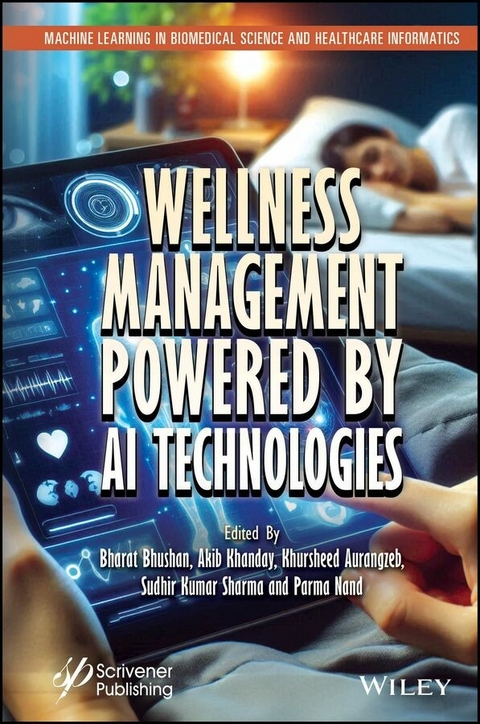
Wellness Management Powered by AI Technologies (eBook)
631 Seiten
Wiley-Scrivener (Verlag)
978-1-394-28700-0 (ISBN)
This book is an essential resource on the impact of AI in medical systems, helping readers stay ahead in the modern era with cutting-edge solutions, knowledge, and real-world case studies.
Wellness Management Powered by AI Technologies explores the intricate ways machine learning and the Internet of Things (IoT) have been woven into the fabric of healthcare solutions. From smart wearable devices tracking vital signs in real time to ML-driven diagnostic tools providing accurate predictions, readers will gain insights into how these technologies continually reshape healthcare.
The book begins by examining the fundamental principles of machine learning and IoT, providing readers with a solid understanding of the underlying concepts. Through clear and concise explanations, readers will grasp the complexities of the algorithms that power predictive analytics, disease detection, and personalized treatment recommendations. In parallel, they will uncover the role of IoT devices in collecting data that fuels these intelligent systems, bridging the gap between patients and practitioners.
In the following chapters, readers will delve into real-world case studies and success stories that illustrate the tangible benefits of this dynamic duo. This book is not merely a technical exposition; it serves as a roadmap for healthcare professionals and anyone invested in the future of healthcare.
Readers will find the book:
- Explores how AI is transforming diagnostics, treatments, and healthcare delivery, offering cutting-edge solutions for modern healthcare challenges;
- Provides practical knowledge on implementing AI in healthcare settings, enhancing efficiency and patient outcomes;
- Offers authoritative insights into current AI trends and future developments in healthcare;
- Features real-world case studies and examples showcasing successful AI integrations in various medical fields.
Audience
This book is a valuable resource for researchers, industry professionals, and engineers from diverse fields such as computer science, artificial intelligence, electronics and electrical engineering, healthcare management, and policymakers.
Bharat Bhushan, PhD, is an assistant professor in the Department of Computer Science and Engineering, School of Engineering and Technology, Sharda University, Greater Noida, India. He has published more than 150 research papers, contributed over 30 book chapters, and edited 20 books.
Akib Khanday, PhD, is a post-doctoral research fellow in the Department of Computer Science and Software Engineering-CIT, United Arab Emirates University, Abu Dhabi, United Arab Emirates. His research interests include computational social sciences, natural language processing (NLP), and machine/deep learning.
Khursheed Aurangzeb, PhD, is an associate professor in the Department of Computer Engineering, College of Computer and Information Sciences, King Saud University, Riyadh, Saudi Arabia. Over his 15 years of research, he has been involved in several projects related to machine/deep learning and embedded systems. His research interests focus on computer architecture, signal processing, and wireless sensor networks.
Sudhir Kumar Sharma, PhD, is a professor and head of the Department of Computer Science at the Institute of Information Technology & Management, affiliated with GGSIPU, New Delhi, India. His research interests include machine learning, data mining, and security. He has published more than 60 research papers in various international journals and conferences and is the author of seven books in the fields of IoT, wireless sensor networks (WSN), and blockchain.
Parma Nand, PhD, is the dean of the School of Engineering and Technology, Sharda University, Greater Noida, India. His expertise includes wireless and sensor networks, cryptography, algorithms, and computer graphics. He has published more than 85 papers in peer-reviewed journals and filed two patents.
This book is an essential resource on the impact of AI in medical systems, helping readers stay ahead in the modern era with cutting-edge solutions, knowledge, and real-world case studies. Wellness Management Powered by AI Technologies explores the intricate ways machine learning and the Internet of Things (IoT) have been woven into the fabric of healthcare solutions. From smart wearable devices tracking vital signs in real time to ML-driven diagnostic tools providing accurate predictions, readers will gain insights into how these technologies continually reshape healthcare. The book begins by examining the fundamental principles of machine learning and IoT, providing readers with a solid understanding of the underlying concepts. Through clear and concise explanations, readers will grasp the complexities of the algorithms that power predictive analytics, disease detection, and personalized treatment recommendations. In parallel, they will uncover the role of IoT devices in collecting data that fuels these intelligent systems, bridging the gap between patients and practitioners. In the following chapters, readers will delve into real-world case studies and success stories that illustrate the tangible benefits of this dynamic duo. This book is not merely a technical exposition; it serves as a roadmap for healthcare professionals and anyone invested in the future of healthcare. Readers will find the book: Explores how AI is transforming diagnostics, treatments, and healthcare delivery, offering cutting-edge solutions for modern healthcare challenges; Provides practical knowledge on implementing AI in healthcare settings, enhancing efficiency and patient outcomes; Offers authoritative insights into current AI trends and future developments in healthcare; Features real-world case studies and examples showcasing successful AI integrations in various medical fields. Audience This book is a valuable resource for researchers, industry professionals, and engineers from diverse fields such as computer science, artificial intelligence, electronics and electrical engineering, healthcare management, and policymakers.
1
Exploring Functional Modules Using Co-Clustering of Protein Interaction Networks
R. Gowri1* and R. Rathipriya2†
1Department of Computer Science, AVS College of Arts and Science (Autonomous), Salem, Tamil Nadu, India
2Department of Computer Science, Periyar University, Salem, Tamil Nadu, India
Abstract
This chapter introduces the new score-based co-clustering (SCoC) method for functional module mining (FMM) in protein interaction networks (PINs). This strategy focuses on the drawbacks of previous approaches, including computational overhead, time consumption, and a disregard for quality and overlapping modules. This chapter has proposed two revised versions of the SCoC method: MR-CoC and SCoC rand. Artificial datasets are utilized to evaluate these suggested methods’ performances. These datasets are created with the intention of imposing certain criteria, such as distributed co-cluster, matrix type, noise, and data size. This chapter discusses how these suggested ways are being implemented. Additionally, the MR-CoC was used for functional module mining in the protein interaction networks of humans. To analyze the efficiency of MR-CoC, its results are compared with those of existing protein complexes. The biological implications of these findings have been further examined.
Keywords: MapReduce, protein modules, functional modules, functional coherence, key-value pairs, molecular function
1.1 Introduction
The major problem focused on in this research work is the functional module mining in a protein interaction network (PIN). Currently, the functional modules are identified based on laboratory experiments. This process involves the selection of the initial candidates and elimination/addition of the participants to this module based on the lab experiments and analysis. The choice of the initial candidates for the functional module is made manually by the biologists using specific tools based on their requirements. Finding such candidates from the complex PIN is a tedious task to the biologists [1]. This current research is aimed to propose a computational solution to this problem as shown in Figure 1.1.
Currently, the availability of biological networks is increasing due to technological developments in bioinformatics [2]. These networks are highly useful in the medical field for studying and analyzing the behaviors and functionality of various pathogens within the host organisms [3]. They are used for early detection of disease, disease diagnosis, prognosis, drug discovery, drug target identification, and so on.
They are also used to study the functionalities of various organisms, especially in their PINs, which are used to communicate signals or information within the biological system [4]. The proteins are connected with each other to form a PIN. The protein complexes or functional modules are the groups of proteins densely connected to perform a specific biological process.
Figure 1.1 Workflow of the current research.
The major significances [5, 6] of the functional module mining are as follows:
- The central nodes of the biological networks are vulnerable to the targeted attacks by dangerous diseases.
- Predicting key targets for tackling glioma (malignant tumor) drug resistance.
- The network modularity correlated with cancer (diseased) patient survivability.
- The pathogen infection (say cancer) tend to be enriched in particular network modules.
- Finding the hallmark network modules activated predominantly in each tumor is achieved by the identification of significant network modules.
- Neurodegenerative diseases (e.g., Parkinson’s disease) are due to many dysregulated physiological processes, which are identified from the abnormalities in molecular networks.
- Identification of therapeutic targets (drug target-based functional modules) in complex disorders is a major challenge in developing effective therapies for complex diseases.
In the literature, various approaches exist for functional module (sub-networks) identification. Some approaches use graph theoretical concepts to identify these sub-networks but face issues like scalability, ignorance of overlapped sub-networks, time consumption, and computational overhead [41–44]. From the related works, it has also been found that such approaches do not consider any functional features for identifying the functional modules.
The objective of this chapter is to overcome these issues and also extract the functional modules based on their functional density measures using data-mining techniques. The score-based co-clustering with MapReduce (MR-CoC) approach is experimented with on the PIN of Homo sapiens, and the results are compared with the existing protein complexes. This approach mines the existing protein complexes efficiently. Then, the biological significances of the unknown modules are analyzed.
Biologists can use this approach for finding novel functional modules from any PIN. It reduces the complexity of manual extraction of functional modules and can be used for predicting the new drug targets for various diseases. These resultant modules can be further tested in laboratories for new functional module predictions.
This chapter is further organized as follows: Section 1.2 discusses the related research works of functional module mining and binary co-clustering approaches. Sections 1.3 to 1.8 discuss the terminologies, existing methods, datasets, experimental environment, validation measures, and biological significances. Section 1.9 presents the proposed method MR-CoC and its enhancements based on the comparative analysis. Section 1.10 elaborates the functional module mining using MR-CoC based on a comparative analysis of the results under different experimental setups, and analysis of experimental results for their biological significance. Section 1.11 summarizes the entire work carried out in this chapter.
1.2 Related Works
The functional module mining approaches in the literature show that most are performed using graph theoretical algorithms and are based on the topological properties. The various related research articles in the literature are listed in Table 1.1. They focus on MCODE, edge sampling, clustering, and optimization techniques for functional module mining. Table 1.1 highlights the approaches, measures, and various related issues (scalability, time consumption, computational overhead, functional measures, etc.). The tick mark and cross mark in Table 1.1 represent the presence and absence of the specified issue.
From the study, MCODE is the pioneer approach for protein complex detection. It detects the cliques from PIN based on the network density. The complexity of the MCODE is O(n3).
The PIN is represented using the adjacency matrix, which is a binary symmetric matrix. Thus, binary co-clustering approach is proposed in this chapter. The related works of binary co-clustering are also studied. The existing co-clustering approaches for binary data are reviewed in this section. Cheng and Church [10], Plaid [11], OPSM [12], etc. are for numerical data matrices. These approaches are using the distance measures that do not suit the binary datasets. There are some specific approaches like xMotif [13], BiMax [14], BicBin [15], BicSim [16], BMF [17], BiBit [18], BBK [19], BitTable [20], BiBinCons & BiBinAlter [21] and ParBiBit [22] that were developed at different time periods for co-clustering the binary data. The detailed reviews of these existing approaches are presented in Table 1.2. Every existing approach is reviewed based on various criteria such as method, binarization, overlapped co-clusters, scalability issue, computational overhead, parameter tuning, time consumption, parallelization, noise sensitivity, and remarks about the approach.
Table 1.1 Literature study for functional module mining.
| Title | Algorithm | Measure | Scalability issue | Ignore overlapped modules | Time consumption | Computational overhead | Functional features usage |
|---|
| An automated method for finding molecular complexes in large protein interaction networks [7] | MCODE | Network density | ✓ | ✓ | ✓ | ✓ | × |
| Detection of functional modules from protein interaction networks [4] | Clustering | Classification score | ✓ | × | ✓ | ✓ | × |
| Identifying functional modules in protein–protein interaction networks: an integrated exact approach [8] | Mathematical optimization | Modular scoring function | ✓ | ✓ | ✓ | ✓ | × |
| Protein interaction networks—more than mere modules [1] | Block method based on GO terms | Error... |
| Erscheint lt. Verlag | 31.12.2024 |
|---|---|
| Reihe/Serie | Machine Learning in Biomedical Science and Healthcare Informatics |
| Sprache | englisch |
| Themenwelt | Mathematik / Informatik ► Informatik ► Theorie / Studium |
| Schlagworte | Machine Learning, Internet of Things, Healthcare 4.0, Internet of Medical Things, Disease Predication, Disease Diagnosis, Disease Identification, IoT Devices, Privacy in Healthcare, Patient Wellbeing, Human and Technology, Future Healthcare, Smart Healthcare, Health Management, Precision Medicine |
| ISBN-10 | 1-394-28700-3 / 1394287003 |
| ISBN-13 | 978-1-394-28700-0 / 9781394287000 |
| Informationen gemäß Produktsicherheitsverordnung (GPSR) | |
| Haben Sie eine Frage zum Produkt? |
 EPUB (Adobe DRM)
Kopierschutz: Adobe-DRM
Adobe-DRM ist ein Kopierschutz, der das eBook vor Mißbrauch schützen soll. Dabei wird das eBook bereits beim Download auf Ihre persönliche Adobe-ID autorisiert. Lesen können Sie das eBook dann nur auf den Geräten, welche ebenfalls auf Ihre Adobe-ID registriert sind.
Details zum Adobe-DRM
Dateiformat: EPUB (Electronic Publication)
EPUB ist ein offener Standard für eBooks und eignet sich besonders zur Darstellung von Belletristik und Sachbüchern. Der Fließtext wird dynamisch an die Display- und Schriftgröße angepasst. Auch für mobile Lesegeräte ist EPUB daher gut geeignet.
Systemvoraussetzungen:
PC/Mac: Mit einem PC oder Mac können Sie dieses eBook lesen. Sie benötigen eine
eReader: Dieses eBook kann mit (fast) allen eBook-Readern gelesen werden. Mit dem amazon-Kindle ist es aber nicht kompatibel.
Smartphone/Tablet: Egal ob Apple oder Android, dieses eBook können Sie lesen. Sie benötigen eine
Geräteliste und zusätzliche Hinweise
Buying eBooks from abroad
For tax law reasons we can sell eBooks just within Germany and Switzerland. Regrettably we cannot fulfill eBook-orders from other countries.
aus dem Bereich


