


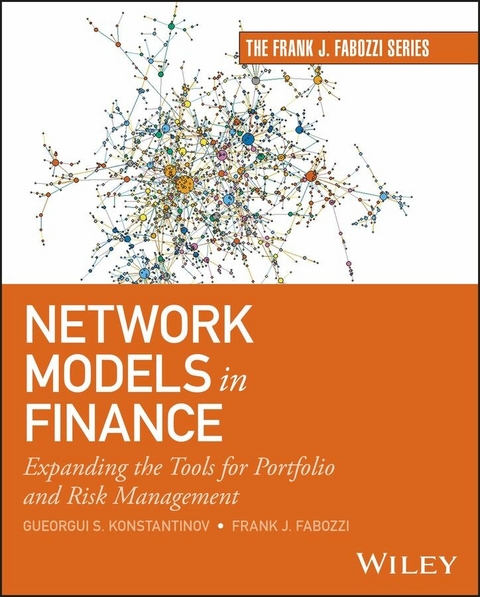
Network Models in Finance (eBook)
785 Seiten
Wiley (Verlag)
978-1-394-27969-2 (ISBN)
Expansive overview of theory and practical implementation of networks in investment management
Guided by graph theory, Network Models in Finance: Expanding the Tools for Portfolio and Risk Management provides a comprehensive overview of networks in investment management, delivering strong knowledge of various types of networks, important characteristics, estimation, and their implementation in portfolio and risk management. With insights into the complexities of financial markets with respect to how individual entities interact within the financial system, this book enables readers to construct diversified portfolios by understanding the link between price/return movements of different asset classes and factors, perform better risk management through understanding systematic, systemic risk and counterparty risk, and monitor changes in the financial system that indicate a potential financial crisis.
With a practitioner-oriented approach, this book includes coverage of:
- Practical examples of broad financial data to show the vast possibilities to visualize, describe, and investigate markets in a completely new way
- Interactions, Causal relationships and optimization within a network-based framework and direct applications of networks compared to traditional methods in finance
- Various types of algorithms enhanced by programming language codes that readers can implement and use for their own data
Network Models in Finance: Expanding the Tools for Portfolio and Risk Management is an essential read for asset managers and investors seeking to make use of networks in research, trading, and portfolio management.
GUEORGUI S. KONSTANTINOV, PHD, has over 17 years' experience in portfolio management, managing global bond portfolios and currencies for institutional investors and pension funds. He is an advisory board member of the Journal of Portfolio Management and the coauthor of Quantitative Global Bond Portfolio Management.
FRANK J. FABOZZI, PHD, is Professor of Practice at John Hopkins University's Carey Business School. He has authored over 100 books and edited The Handbook of Fixed Income Securities and The Handbook of Mortgage-Backed Securities. He holds the CFA and CPA professional designations.
Expansive overview of theory and practical implementation of networks in investment management Guided by graph theory, Network Models in Finance: Expanding the Tools for Portfolio and Risk Management provides a comprehensive overview of networks in investment management, delivering strong knowledge of various types of networks, important characteristics, estimation, and their implementation in portfolio and risk management. With insights into the complexities of financial markets with respect to how individual entities interact within the financial system, this book enables readers to construct diversified portfolios by understanding the link between price/return movements of different asset classes and factors, perform better risk management through understanding systematic, systemic risk and counterparty risk, and monitor changes in the financial system that indicate a potential financial crisis. With a practitioner-oriented approach, this book includes coverage of: Practical examples of broad financial data to show the vast possibilities to visualize, describe, and investigate markets in a completely new way Interactions, Causal relationships and optimization within a network-based framework and direct applications of networks compared to traditional methods in finance Various types of algorithms enhanced by programming language codes that readers can implement and use for their own data Network Models in Finance: Expanding the Tools for Portfolio and Risk Management is an essential read for asset managers and investors seeking to make use of networks in research, trading, and portfolio management.
Preface
Network Models in Finance: Expanding the Tools for Portfolio and Risk Management integrates network theory with asset management, delving into quantitative modeling and the simulation approaches of networks and their applications to two aspects of aspect management: portfolio and risk management. Drawing on practitioner and academic research on network theory and the theories associated with asset management, we provide a timely and comprehensive overview of innovative network-based tools and methodologies applied to asset management. The approaches discussed in this book are not necessarily novel but extend beyond traditional models and tools in asset management by incorporating causal relationships, inference, association, probabilistic structures, and optimization within a new network-based framework using time-series data.
In this book, we showcase the broad and deep knowledge of network theory and its applications. Networks provide new perspectives for asset managers, offering insights into investment management topics highly relevant for institutional investors, family offices, researchers, academics, and industry practitioners. This book stands out by providing insights that extend current knowledge in network theory to address specific needs in portfolio and risk management. It offers a unique contribution compared to the existing literature, making it a valuable resource for understanding and applying network-based methodologies in asset management.
The motivation for this book comes from our proven track record and practical experience with network models in asset management. We have successfully implemented network-based asset allocation across a broad set of portfolios. Scientifically, our motivation and background are influenced by numerous seminal works reported in the literature that highlight the connectedness in various organizational, biological, informational, financial, social, economic, technological, and physical fields. These works suggest that traditional reductionist approaches in science may benefit from more holistic methods that preserve and explain complexity. This foundational perspective drives our exploration of network theory in the context of asset management.
In this line of thought, the underlying assumption in the book is that there is a relationship between the interacting entities in financial markets. In finance, several studies have embraced these themes, where researchers have argued that economics is a science of relations and finance needs new tools to investigate financial market complexity. These works gave birth to this book.
This book distinguishes itself by implementing several graph-theoretical frameworks in asset management. Specifically, it provides an overview of various types of networks that can be investigated, implemented, and validated in practice. The techniques covered are the product of rigorous theoretical research and development by many experts and researchers in network theory, graph theory, economics, finance, mathematics, and the physical sciences. Concepts borrowed from diverse scientific research are adapted to fit the asset management framework, representing a unified approach to quantitative portfolio and risk management that extends traditional models to modern financial data science and analytics.
In addition to offering a solid theoretical foundation for network science, we emphasize the practical implementation of network modeling approaches that can be successfully applied in real-world multi-asset, bond, equity, and alternative asset allocation. This book bridges traditional investment methods, such as optimization approaches and variance-covariance frameworks, with modern financial data science applications, integrating the domain of networks into asset management.
Covering a wide range of applications relevant to both practitioners and academics, we guide the reader by first developing a robust theoretical framework, and then providing practical illustrations and codes in the programming language R for actual portfolios comprising traditional and alternative asset classes, factors, and other economic variables like payments and transaction data. A major objective is to shed light on the problems faced by practitioners in portfolio management and risk management, considering that asset classes and factors are integrated into a holistic framework. Potential solutions to these problems are provided.
The primary distinction of Network Models in Finance, compared to other books on network modeling, lies in its comprehensive coverage of the visualization, analysis, research, estimation, and computation of a wide range of networks applied in asset management. This book focuses specifically on evaluating portfolio networks and investigating their properties.
Related literature has been published that explore various aspects of networks in finance and economics. For instance, some books provide network analysis and models applied to economics, finance, corporate governance, and investments, focusing on analytical modeling and the econometric and statistical analysis of properties emerging from individual-level interactions. These authors combine observational and theoretical insights in networks and agent-based models, which are valuable for understanding nonlinear and evolving complex systems.
Other works explicitly focus on networks’ risk management advantages, discussing the risk propagation, contagion, and spillover effects that networks provide to different asset classes. Additionally, while some books offer a broad and detailed analysis of networks and their relation to markets, they often need a more focused view of asset management.
In contrast, our book integrates these various approaches to provide a detailed and specific examination of network-based methods in asset management, which makes it a unique and valuable resource in the field.
CENTRAL BOOK THEMES
A network consists of nodes and links between them. The nodes and links are the central fields of investigation. The chapters of this book cover different topics related to nodes and links and describe, explain, and apply various tools used to model and analyze financial networks in asset management. The datasets include a broad set of asset classes and factor time series. Additionally, we use datasets from country payments and other transaction data.
Network Models in Finance contains 12 chapters, which are divided into three parts. Part One comprises Chapters 1–4.
- Chapter 1 introduces the basic concepts of real networks, network science, and different network types. The importance of understanding the interactions among economic variables, individuals, and financial institutions to capture and explain complex market behaviors is explained. The chapter’s focus then shifts to data, detailing the types of datasets used in network analysis within finance.
- Chapter 2 covers network structure and description, network representation, types, and visualization. The chapter begins with an overview of both basic and complex network types and the definition of connectedness. Specific topics include metrics that explain, describe, and capture the complex relationships underlying graphs, as well as importance scores and specific node and edge properties that describe networks. The chapter features numerous examples of networks across different asset classes and topics in asset management, providing a broad overview of modeling networks at both the node and edge levels.
- Chapter 3 investigates descriptive network metrics and their application in asset management, offering descriptive statistics that characterize networks. These metrics refer to a network’s overall properties and aim to describe its underlying structure.
- Chapter 4 focuses on centrality and other importance scores, which are among the most critical nodal characteristics of networks.
Part Two comprises Chapters 5–10, focusing on the network construction for portfolio management.
- Chapter 5 provides an overview of networks and how they are constructed using mathematical models. It explains the various approaches to modeling real networks, including topics such as the Erdös–Renyi random graph model, the Albert–Barabasi preferential attachment model, and the small-world model.
- Chapter 6 covers the most widely used networks in finance, focusing on association network models constructed using statistical tests. The chapter’s primary focus is on link prediction models, which aim to use existing data and observations to generate scores that indicate the likelihood of links between vertices. While these links are not directly observable, observable market data can be leveraged to model these relationships effectively.
- Chapter 7 discusses statistical and econometric models, focusing on network construction used in portfolio allocation models based on different types of regression models. The regression models applied are both linear and nonlinear. These models may consist of multifactor or single-factor structures, incorporating one or multiple explanatory variables and possibly interaction terms governing cross-relationships between these variables.
- Chapter 8 describes probability models used to construct portfolio networks. Probability theory offers a straightforward approach to implement mathematical and statistical tools for edge prediction and simulation. The probabilistic models discussed in this chapter include Markov chain network models and Bayesian networks, which enable model generation without requiring...
| Erscheint lt. Verlag | 30.12.2024 |
|---|---|
| Reihe/Serie | Frank J. Fabozzi Series |
| Sprache | englisch |
| Themenwelt | Mathematik / Informatik ► Informatik ► Theorie / Studium |
| Schlagworte | asset classes • Counterparty Risk • graph theory • network construction, quantitative finance, quantitative models, asset allocation, factor investing, risk management • networks investment management • Portfolio Management • systemic risk |
| ISBN-10 | 1-394-27969-8 / 1394279698 |
| ISBN-13 | 978-1-394-27969-2 / 9781394279692 |
| Informationen gemäß Produktsicherheitsverordnung (GPSR) | |
| Haben Sie eine Frage zum Produkt? |
 EPUB (Adobe DRM)
Kopierschutz: Adobe-DRM
Adobe-DRM ist ein Kopierschutz, der das eBook vor Mißbrauch schützen soll. Dabei wird das eBook bereits beim Download auf Ihre persönliche Adobe-ID autorisiert. Lesen können Sie das eBook dann nur auf den Geräten, welche ebenfalls auf Ihre Adobe-ID registriert sind.
Details zum Adobe-DRM
Dateiformat: EPUB (Electronic Publication)
EPUB ist ein offener Standard für eBooks und eignet sich besonders zur Darstellung von Belletristik und Sachbüchern. Der Fließtext wird dynamisch an die Display- und Schriftgröße angepasst. Auch für mobile Lesegeräte ist EPUB daher gut geeignet.
Systemvoraussetzungen:
PC/Mac: Mit einem PC oder Mac können Sie dieses eBook lesen. Sie benötigen eine
eReader: Dieses eBook kann mit (fast) allen eBook-Readern gelesen werden. Mit dem amazon-Kindle ist es aber nicht kompatibel.
Smartphone/Tablet: Egal ob Apple oder Android, dieses eBook können Sie lesen. Sie benötigen eine
Geräteliste und zusätzliche Hinweise
Buying eBooks from abroad
For tax law reasons we can sell eBooks just within Germany and Switzerland. Regrettably we cannot fulfill eBook-orders from other countries.
aus dem Bereich


