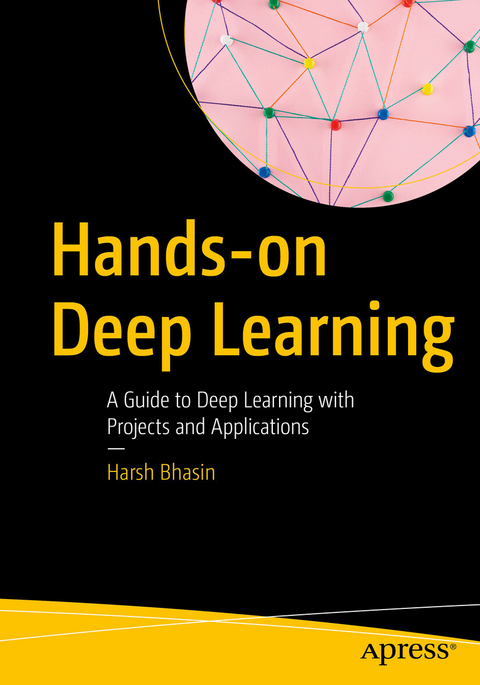
Hands-on Deep Learning (eBook)
364 Seiten
Apress (Verlag)
979-8-8688-1035-0 (ISBN)
This book discusses deep learning, from its fundamental principles to its practical applications, with hands-on exercises and coding. It focuses on deep learning techniques and shows how to apply them across a wide range of practical scenarios.
The book begins with an introduction to the core concepts of deep learning. It delves into topics such as transfer learning, multi-task learning, and end-to-end learning, providing insights into various deep learning models and their real-world applications. Next, it covers neural networks, progressing from single-layer perceptrons to multi-layer perceptrons, and solving the complexities of backpropagation and gradient descent. It explains optimizing model performance through effective techniques, addressing key considerations such as hyperparameters, bias, variance, and data division. It also covers convolutional neural networks (CNNs) through two comprehensive chapters, covering the architecture, components, and significance of kernels implementing well-known CNN models such as AlexNet and LeNet. It concludes with exploring autoencoders and generative models such as Hopfield Networks and Boltzmann Machines, applying these techniques to a diverse set of practical applications. These applications include image classification, object detection, sentiment analysis, COVID-19 detection, and ChatGPT.
By the end of this book, you will have gained a thorough understanding of deep learning, from its fundamental principles to its innovative applications, enabling you to apply this knowledge to solve a wide range of real-world problems.
What You Will Learn
- What are deep neural networks?
- What is transfer learning, multi-task learning, and end-to-end learning?
- What are hyperparameters, bias, variance, and data division?
- What are CNN and RNN?
Who This Book Is For
Machine learning engineers, data scientists, AI practitioners, software developers, and engineers interested in deep learning
This book discusses deep learning, from its fundamental principles to its practical applications, with hands-on exercises and coding. It focuses on deep learning techniques and shows how to apply them across a wide range of practical scenarios. The book begins with an introduction to the core concepts of deep learning. It delves into topics such as transfer learning, multi-task learning, and end-to-end learning, providing insights into various deep learning models and their real-world applications. Next, it covers neural networks, progressing from single-layer perceptrons to multi-layer perceptrons, and solving the complexities of backpropagation and gradient descent. It explains optimizing model performance through effective techniques, addressing key considerations such as hyperparameters, bias, variance, and data division. It also covers convolutional neural networks (CNNs) through two comprehensive chapters, covering the architecture, components, and significance of kernels implementing well-known CNN models such as AlexNet and LeNet. It concludes with exploring autoencoders and generative models such as Hopfield Networks and Boltzmann Machines, applying these techniques to a diverse set of practical applications. These applications include image classification, object detection, sentiment analysis, COVID-19 detection, and ChatGPT. By the end of this book, you will have gained a thorough understanding of deep learning, from its fundamental principles to its innovative applications, enabling you to apply this knowledge to solve a wide range of real-world problems. What You Will Learn What are deep neural networks? What is transfer learning, multi-task learning, and end-to-end learning? What are hyperparameters, bias, variance, and data division? What are CNN and RNN? Who This Book Is ForMachine learning engineers, data scientists, AI practitioners, software developers, and engineers interested in deep learning
| Erscheint lt. Verlag | 26.12.2024 |
|---|---|
| Zusatzinfo | XX, 364 p. 191 illus. |
| Sprache | englisch |
| Themenwelt | Mathematik / Informatik ► Informatik ► Programmiersprachen / -werkzeuge |
| Informatik ► Theorie / Studium ► Künstliche Intelligenz / Robotik | |
| Mathematik / Informatik ► Mathematik ► Statistik | |
| Schlagworte | convolutional neural networks • Deep learning • generative AI • Medical Imaging • Neural networks • Sequence Models • Transformers, |
| ISBN-13 | 979-8-8688-1035-0 / 9798868810350 |
| Informationen gemäß Produktsicherheitsverordnung (GPSR) | |
| Haben Sie eine Frage zum Produkt? |
 PDF (Wasserzeichen)
Größe: 25,3 MB
DRM: Digitales Wasserzeichen
Dieses eBook enthält ein digitales Wasserzeichen und ist damit für Sie personalisiert. Bei einer missbräuchlichen Weitergabe des eBooks an Dritte ist eine Rückverfolgung an die Quelle möglich.
Dateiformat: PDF (Portable Document Format)
Mit einem festen Seitenlayout eignet sich die PDF besonders für Fachbücher mit Spalten, Tabellen und Abbildungen. Eine PDF kann auf fast allen Geräten angezeigt werden, ist aber für kleine Displays (Smartphone, eReader) nur eingeschränkt geeignet.
Systemvoraussetzungen:
PC/Mac: Mit einem PC oder Mac können Sie dieses eBook lesen. Sie benötigen dafür einen PDF-Viewer - z.B. den Adobe Reader oder Adobe Digital Editions.
eReader: Dieses eBook kann mit (fast) allen eBook-Readern gelesen werden. Mit dem amazon-Kindle ist es aber nicht kompatibel.
Smartphone/Tablet: Egal ob Apple oder Android, dieses eBook können Sie lesen. Sie benötigen dafür einen PDF-Viewer - z.B. die kostenlose Adobe Digital Editions-App.
Buying eBooks from abroad
For tax law reasons we can sell eBooks just within Germany and Switzerland. Regrettably we cannot fulfill eBook-orders from other countries.
aus dem Bereich