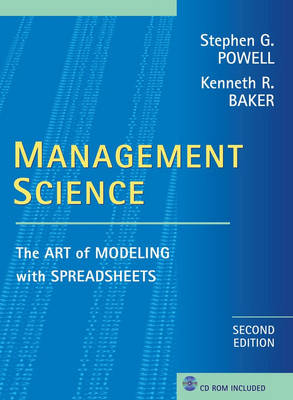
Management Science
John Wiley & Sons Ltd (Verlag)
978-0-470-03840-6 (ISBN)
- Titel ist leider vergriffen;
keine Neuauflage - Artikel merken
The second edition of Management Science: The Art of Modeling with Spreadsheets by Steve Powell and Ken Baker will expand upon the essential skills needed to develop real expertise in business modeling. By adding more coverage of management science topics, broader coverage of Excel, focused chapters, and new exercises and cases, this edition will be easier to use in a wide variety of undergraduate and MBA courses.
Stephen G. Powell has been Professor of Business Administration at Dartmouth College since 1987. He teaches courses in management science, including the core Decision Science course, and electives in the Art of Modeling and Applications of Simulation. His research interests include modeling production lines and service sector business processes, as well as how novices formulate models and use models in decision making. He is co-author of The Art of Modeling with Spreadsheets, with Ken Baker, and recipient of the 2001 INFORMS Prize for Teaching of OR/MS Practice. He is also working with the Tuck Spreadsheet Engineering Research Project, a three-year project to study how individuals and organizations use spreadsheets and to identify best practices. Ken Baker is a faculty member at Dartmouth College. He is currently Nathaniel Leverone Professor of Management at the Tuck School of Business and also Adjunct Professor at the Thayer School of Engineering. At Dartmouth, he has taught courses relating to Decision Science, Manufacturing Management, and Environmental Management. Over the years, much of his teaching and research has dealt with Production Planning and Control, and he is widely known for his textbook, Elements of Sequencing and Scheduling, in addition to a variety of technical articles. He has served as Tuck School's Associate Dean and directed the Tuck School's management development programs in the manufacturing area. In 2001, he was named a Fellow of INFORMS' Manufacturing and Service Operations Management (MSOM) Society.
CHAPTER 1 INTRODUCTION. 1.1 Models and Modeling. 1.2 The Role of Spreadsheets. 1.3 The Real World and the Model World. 1.4 Lessons from Expert and Novice Modelers. 1.5 Organization of the Book. 1.6 Summary. CHAPTER 2 MODELING IN A PROBLEM-SOLVING FRAMEWORK. 2.1 Introduction. 2.2 The Problem-Solving Process. 2.3 Influence Charts. 2.4 Craft Skills for Modeling. 2.5 Summary. CHAPTER 3 BASIC EXCEL SKILLS. 3.1 Introduction. 3.2 Excel Prerequisites. 3.3 The Excel Window. 3.4 Configuring Excel. 3.5 Manipulating Windows and Sheets. 3.6 Navigation. 3.7 Selecting Cells. 3.8 Entering Text and Data. 3.9 Editing Cells. 3.10 Formatting. 3.11 Basic Formulas. 3.12 Basic Functions. 3.13 Charting. 3.14 Printing. 3.15 Help Options. 3.16 Summary. CHAPTER 4 ADVANCED EXCEL SKILLS. 4.1 Introduction. 4.2 Keyboard Shortcuts. 4.3 Controls. 4.4 Cell Comments. 4.5 Naming Cells and Ranges. 4.6 Advanced Formulas and Functions. 4.7 Recording Macros And Using VBA. 4.8 Summary. CHAPTER 5 SPREADSHEET ENGINEERING. 5.1 Introduction. 5.2 Designing a Spreadsheet. 5.3 Designing a Workbook. 5.4 Building a Workbook. 5.5 Testing a Workbook. 5.6 Auditing Software: Spreadsheet Professional. 5.7 Summary. CHAPTER 6 ANALYSIS USING SPREADSHEETS. 6.1 Introduction. 6.2 Base-case Analysis. 6.3 What-If Analysis. 6.4 Breakeven Analysis. 6.5 Optimization Analysis. 6.6 Simulation and Risk Analysis. 6.7 Summary. CHAPTER 7 DATA ANALYSIS FOR MODELING. 7.1 Introduction. 7.2 Finding Facts from Databases. 7.3 Analyzing Sample Data. 7.4 Estimating Parameters: Point Estimates. 7.5 Estimating Parameters: Interval Estimates. 7.6 Summary. CHAPTER 8 REGRESSION ANALYSIS. 8.1 Introduction. 8.2 A Decision-Making Example. 8.3 Exploring Data: Scatter Plots and Correlation. 8.4 Simple Linear Regression. 8.5 Goodness-of-Fit. 8.6 Simple Regression in the BPI Example. 8.7 Simple Nonlinear Regression. 8.8 Multiple Linear Regression. 8.9 Multiple Regression in the BPI Example. 8.10 Regression Assumptions. 8.11Using the Excel Tools Trendline and LINEST. 8.12 Summary. CHAPTER 9 SHORT-TERM FORECASTING. 9.1 Introduction. 9.2 Forecasting with Time Series Models. 9.2.1 The Moving Average Model. 9.2.2 Measures of Forecast Accuracy. 9.3 The Exponential Smoothing Model. 9.4 Exponential Smoothing with a Trend. 9.5 Exponential Smoothing with Trend and Cyclical Factors. 9.6 Using CB Predictor. 9.6.1 Single Moving Average. 9.6.2 Single Exponential Smoothing. 9.7 Summary. CHAPTER 10 NONLINEAR OPTIMIZATION. 10.1 Introduction. 10.2 An Optimization Example. 10.3 Building Models for Solver. 10.4 Model Classification and the Nonlinear Solver. 10.5 Nonlinear Programming Examples. 10.5.1 Facility Location. 10.6 Sensitivity Analysis for Nonlinear Programs. 10.7 The Portfolio Optimization Model. 10.8 Summary. CHAPTER 11 LINEAR PROGRAMMING. 11.1 Introduction. 11.2 Allocation Models. 11.3 Covering Models. 11.4 Blending Models. 11.5 Sensitivity Analysis for Linear Programs. 11.6 Patterns in Linear Programming Solutions. 11.7 Data Envelopment Analysis. 11.8 Summary. Appendix 11.1. CHAPTER 12 NETWORK MODELS. 12.1 Introduction. 12.2 The Transportation Model. 12.3 Assignment Model. 12.4 The Transshipment Model. 12.5 A Standard Form for Network Models. 12.6 Network Models with Yields. 12.7 Network Models for Process Technologies. 12.8 Summary. CHAPTER 13 INTEGER PROGRAMMING. 13.1 Introduction. 13.2 Integer Variables and the Integer Solver. 13.3 Binary Variables and Binary Choice Models. 13.4 Binary Variables and Logical Relationships. 13.5 The Facility Location Model. 13.6 Summary. CHAPTER 14 DECISION ANALYSIS. 14.1 Introduction. 14.2 Payoff Tables and Decision Criteria. 14.3 Using Trees to Model Decisions. 14.4 Using TreePlan Software. 14.5 Maximizing Expected Utility with TreePlan. 14.6 Summary. CHAPTER 15 MONTE CARLO SIMULATION. 15.1 Introduction. 15.2 A Simple Illustration. 15.3 The Simulation Process. 15.4 Corporate Valuation Using Simulation. 15.5 Option Pricing Using Simulation. 15.6 Selecting Uncertain Parameters. 15.7 Selecting Probability Distributions. 15.8 Ensuring Precision in Outputs. 15.9 Interpreting Simulation Outcomes. 15.9.1 Forecast Charts. 15.9.2 Statistics and Percentiles. 15.10 When Not to Simulate. 15.11 Summary. Appendix 15.1 Choosing Crystal Ball Settings. Appendix 15.2 Additional features of Crystal Ball. CHAPTER 16 OPTIMIZATION IN SIMULATION. 16.1 Introduction. 16.2 Optimization with One or Two Decision Variables. 16.3 Complex Optimization Problems. 16.4 Embedded Optimization: Using Solver within Crystal Ball. 16.5 Summary. MODELING CASES. APPENDIX BASIC PROBABILITY CONCEPTS. INDEX.
| Erscheint lt. Verlag | 3.8.2007 |
|---|---|
| Zusatzinfo | ill |
| Verlagsort | Chichester |
| Sprache | englisch |
| Maße | 218 x 289 mm |
| Gewicht | 1484 g |
| Einbandart | gebunden |
| Themenwelt | Mathematik / Informatik ► Informatik ► Office Programme |
| Wirtschaft ► Betriebswirtschaft / Management | |
| ISBN-10 | 0-470-03840-3 / 0470038403 |
| ISBN-13 | 978-0-470-03840-6 / 9780470038406 |
| Zustand | Neuware |
| Informationen gemäß Produktsicherheitsverordnung (GPSR) | |
| Haben Sie eine Frage zum Produkt? |
aus dem Bereich