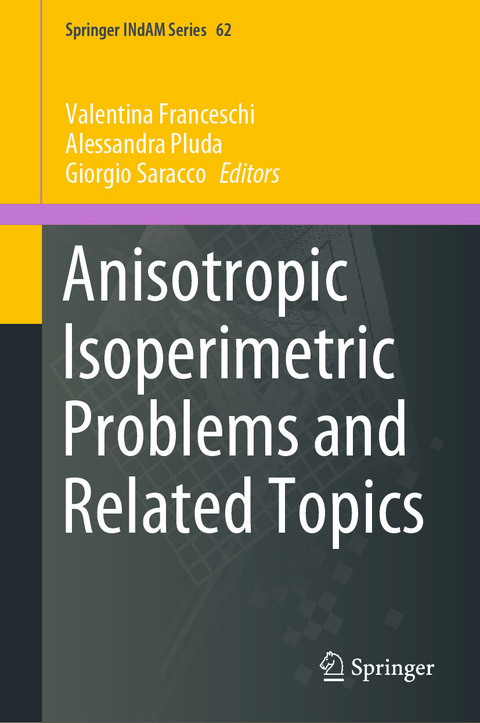
Anisotropic Isoperimetric Problems and Related Topics (eBook)
213 Seiten
Springer Nature Singapore (Verlag)
978-981-97-6984-1 (ISBN)
This book contains contributions from speakers at the "Anisotropic Isoperimetric Problems & Related Topics" conference in Rome, held from Sep 5 to 9, 2022.
The classic isoperimetric problem has fascinated mathematicians of all eras, starting from the ancient Greeks, due to its simple statement: what are the sets of a given volume with minimal perimeter? The problem is mathematically well understood, and it plays a crucial role in explaining physical phenomena such as soap bubble shapes.
Variations of the problem, including weighted counterparts with density dependencies, representing inhomogeneity and anisotropy of the medium, broaden its applicability, even in non-Euclidean environments, and they allow for descriptions, e.g., of crystal shapes.
At large, the perimeter's physical interpretation is that of an attractive force; hence, it also appears in describing systems of particles where a balance between attractive and repulsive forces appears. A prominent example is that of Gamow's liquid drop model for atomic nuclei, where protons are subject to the strong nuclear attractive force (represented by the perimeter) and the electromagnetic repulsive force (represented by a nonlocal term). Such a model has been shown to be sound, as it explains the basic characteristics of the nuclei, and it successfully predicts nuclear fission for nuclei with a large atomic number.
Similar energy functionals model various physical and biological systems, showcasing the competition between short-range interfacial and long-range nonlocal terms, leading to pattern formation. The authors mention, e.g., the Ohta–Kawasaki model for microphase separation of diblock copolymers and the Yukawa potential for colloidal systems. Despite diverse systems, the emergence of microphases follows similar patterns, although rigorously proving this phenomenon remains a challenge.
The book collects several contributions within these topics, shedding light on the current state of the art.
This book contains contributions from speakers at the "e;Anisotropic Isoperimetric Problems & Related Topics"e; conference in Rome, held from Sep 5 to 9, 2022.The classic isoperimetric problem has fascinated mathematicians of all eras, starting from the ancient Greeks, due to its simple statement: what are the sets of a given volume with minimal perimeter? The problem is mathematically well understood, and it plays a crucial role in explaining physical phenomena such as soap bubble shapes.Variations of the problem, including weighted counterparts with density dependencies, representing inhomogeneity and anisotropy of the medium, broaden its applicability, even in non-Euclidean environments, and they allow for descriptions, e.g., of crystal shapes.At large, the perimeter's physical interpretation is that of an attractive force; hence, it also appears in describing systems of particles where a balance between attractive and repulsive forces appears. A prominent example is that of Gamow's liquid drop model for atomic nuclei, where protons are subject to the strong nuclear attractive force (represented by the perimeter) and the electromagnetic repulsive force (represented by a nonlocal term). Such a model has been shown to be sound, as it explains the basic characteristics of the nuclei, and it successfully predicts nuclear fission for nuclei with a large atomic number.Similar energy functionals model various physical and biological systems, showcasing the competition between short-range interfacial and long-range nonlocal terms, leading to pattern formation. The authors mention, e.g., the Ohta Kawasaki model for microphase separation of diblock copolymers and the Yukawa potential for colloidal systems. Despite diverse systems, the emergence of microphases follows similar patterns, although rigorously proving this phenomenon remains a challenge.The book collects several contributions within these topics, shedding light on the current state of the art.
| Erscheint lt. Verlag | 18.12.2024 |
|---|---|
| Reihe/Serie | Springer INdAM Series |
| Zusatzinfo | VII, 213 p. 11 illus., 1 illus. in color. |
| Sprache | englisch |
| Themenwelt | Mathematik / Informatik ► Mathematik ► Analysis |
| Mathematik / Informatik ► Mathematik ► Angewandte Mathematik | |
| Schlagworte | crystals and periodic structures • Gamow liquid drop model • isoperimetric problems in geometric structures • isoperimetric problems with density • optimal shapes for eigenvalue problems • shape optimization |
| ISBN-10 | 981-97-6984-1 / 9819769841 |
| ISBN-13 | 978-981-97-6984-1 / 9789819769841 |
| Informationen gemäß Produktsicherheitsverordnung (GPSR) | |
| Haben Sie eine Frage zum Produkt? |
 PDF (Wasserzeichen)
DRM: Digitales Wasserzeichen
Dieses eBook enthält ein digitales Wasserzeichen und ist damit für Sie personalisiert. Bei einer missbräuchlichen Weitergabe des eBooks an Dritte ist eine Rückverfolgung an die Quelle möglich.
Dateiformat: PDF (Portable Document Format)
Mit einem festen Seitenlayout eignet sich die PDF besonders für Fachbücher mit Spalten, Tabellen und Abbildungen. Eine PDF kann auf fast allen Geräten angezeigt werden, ist aber für kleine Displays (Smartphone, eReader) nur eingeschränkt geeignet.
Systemvoraussetzungen:
PC/Mac: Mit einem PC oder Mac können Sie dieses eBook lesen. Sie benötigen dafür einen PDF-Viewer - z.B. den Adobe Reader oder Adobe Digital Editions.
eReader: Dieses eBook kann mit (fast) allen eBook-Readern gelesen werden. Mit dem amazon-Kindle ist es aber nicht kompatibel.
Smartphone/Tablet: Egal ob Apple oder Android, dieses eBook können Sie lesen. Sie benötigen dafür einen PDF-Viewer - z.B. die kostenlose Adobe Digital Editions-App.
Buying eBooks from abroad
For tax law reasons we can sell eBooks just within Germany and Switzerland. Regrettably we cannot fulfill eBook-orders from other countries.
aus dem Bereich