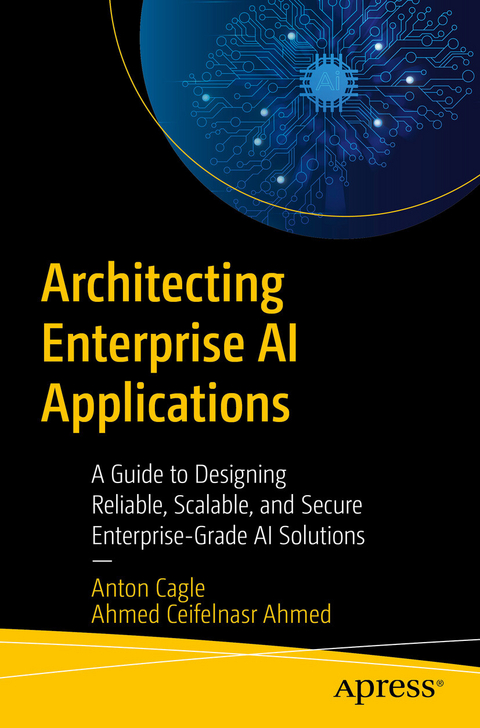
Architecting Enterprise AI Applications (eBook)
XXIII, 286 Seiten
Apress (Verlag)
979-8-8688-0902-6 (ISBN)
This book explores how to define, design, and maintain enterprise AI applications, exploring the impacts they will have on the teams who work with them.
The book is structured into four parts. In Part 1: Defining Your AI Application, you are introduced to the dynamic interplay between human adaptability and AI specialization, the concept of meta systems, and the mechanics of prediction machines. In Part 2: Designing Your AI Application, the book delves into the anatomy of an AI application, unraveling the intricate relationships among data, machine learning, and reasoners. This section introduces the building blocks and enterprise architectural framework for designing multi-agent systems. Part 3: Maintaining Your AI Application takes a closer look at the ongoing life cycle of AI systems. You are guided through the crucial aspects of testing and test automation, providing a solid foundation for effective development practices. This section covers the critical tasks of security and information curation that ensure the long-term success of enterprise AI applications. The concluding section, Part 4: AI Enabled Teams, navigates the evolving landscape of collaborative efforts between humans and AI. It explores the impact of AI on remote work dynamics and introduces the new roles of the expert persona and the AI handler. This section concludes with a deep dive into the legal and ethical dimensions that AI-enabled teams must navigate.
This book is a comprehensive guide that not only equips developers, architects, and product owners with the technical know-how of AI application development, but also delves into the broader implications for teams and society.
What You Will Learn
- Understand the algorithms and processes that enable AI to make accurate predictions and enhance decision making
- Grasp the concept of metasystems and their role in the design phase of AI applications
- Know how data, machine learning, and reasoners drive the functionality and decision-making capabilities of AI applications
- Know the architectural components necessary for scalable and maintainable multi-agent AI applications
- Understand methodologies for testing AI applications, ensuring their robustness, accuracy, and reliability in real-world applications
- Understand the evolving dynamics of human-AI coordination facing teams in the new enterprise working environment
Who This book Is For
A diverse audience, primarily targeting enterprise architects, middle managers, tech leads, and team leads entrenched in the IT sector or possessing a tech-savvy background, including professionals such as digital marketers. Additionally, tech-savvy individual contributors-ranging from digital content creators and data analysts to administrators and programmers-stand to benefit significantly.
This book explores how to define, design, and maintain enterprise AI applications, exploring the impacts they will have on the teams who work with them.The book is structured into four parts. In Part 1: Defining Your AI Application, you are introduced to the dynamic interplay between human adaptability and AI specialization, the concept of meta systems, and the mechanics of prediction machines. In Part 2: Designing Your AI Application, the book delves into the anatomy of an AI application, unraveling the intricate relationships among data, machine learning, and reasoners. This section introduces the building blocks and enterprise architectural framework for designing multi-agent systems. Part 3: Maintaining Your AI Application takes a closer look at the ongoing life cycle of AI systems. You are guided through the crucial aspects of testing and test automation, providing a solid foundation for effective development practices. This section covers the critical tasks of security and information curation that ensure the long-term success of enterprise AI applications. The concluding section, Part 4: AI Enabled Teams, navigates the evolving landscape of collaborative efforts between humans and AI. It explores the impact of AI on remote work dynamics and introduces the new roles of the expert persona and the AI handler. This section concludes with a deep dive into the legal and ethical dimensions that AI-enabled teams must navigate.This book is a comprehensive guide that not only equips developers, architects, and product owners with the technical know-how of AI application development, but also delves into the broader implications for teams and society. What You Will Learn Understand the algorithms and processes that enable AI to make accurate predictions and enhance decision making Grasp the concept of metasystems and their role in the design phase of AI applications Know how data, machine learning, and reasoners drive the functionality and decision-making capabilities of AI applications Know the architectural components necessary for scalable and maintainable multi-agent AI applications Understand methodologies for testing AI applications, ensuring their robustness, accuracy, and reliability in real-world applications Understand the evolving dynamics of human-AI coordination facing teams in the new enterprise working environment Who This book Is ForA diverse audience, primarily targeting enterprise architects, middle managers, tech leads, and team leads entrenched in the IT sector or possessing a tech-savvy background, including professionals such as digital marketers. Additionally, tech-savvy individual contributors ranging from digital content creators and data analysts to administrators and programmers stand to benefit significantly.
| Erscheint lt. Verlag | 17.12.2024 |
|---|---|
| Zusatzinfo | XXIII, 286 p. 9 illus. |
| Sprache | englisch |
| Themenwelt | Mathematik / Informatik ► Informatik ► Programmiersprachen / -werkzeuge |
| Informatik ► Theorie / Studium ► Künstliche Intelligenz / Robotik | |
| Mathematik / Informatik ► Mathematik ► Statistik | |
| Schlagworte | AI architecture • AI Observability • AI safety • Artificial Intelligence • AWS Bedrock • ChatGPT • foundational models • Large Language Models • machine learning |
| ISBN-13 | 979-8-8688-0902-6 / 9798868809026 |
| Informationen gemäß Produktsicherheitsverordnung (GPSR) | |
| Haben Sie eine Frage zum Produkt? |
 PDF (Wasserzeichen)
DRM: Digitales Wasserzeichen
Dieses eBook enthält ein digitales Wasserzeichen und ist damit für Sie personalisiert. Bei einer missbräuchlichen Weitergabe des eBooks an Dritte ist eine Rückverfolgung an die Quelle möglich.
Dateiformat: PDF (Portable Document Format)
Mit einem festen Seitenlayout eignet sich die PDF besonders für Fachbücher mit Spalten, Tabellen und Abbildungen. Eine PDF kann auf fast allen Geräten angezeigt werden, ist aber für kleine Displays (Smartphone, eReader) nur eingeschränkt geeignet.
Systemvoraussetzungen:
PC/Mac: Mit einem PC oder Mac können Sie dieses eBook lesen. Sie benötigen dafür einen PDF-Viewer - z.B. den Adobe Reader oder Adobe Digital Editions.
eReader: Dieses eBook kann mit (fast) allen eBook-Readern gelesen werden. Mit dem amazon-Kindle ist es aber nicht kompatibel.
Smartphone/Tablet: Egal ob Apple oder Android, dieses eBook können Sie lesen. Sie benötigen dafür einen PDF-Viewer - z.B. die kostenlose Adobe Digital Editions-App.
Buying eBooks from abroad
For tax law reasons we can sell eBooks just within Germany and Switzerland. Regrettably we cannot fulfill eBook-orders from other countries.
aus dem Bereich