


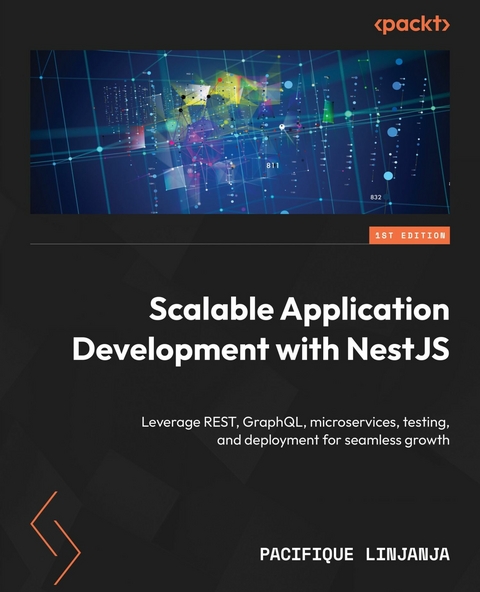
Scalable Application Development with NestJS (eBook)
614 Seiten
Packt Publishing (Verlag)
978-1-83546-395-6 (ISBN)

In this book, Pacifique Linjanja, a globally recognized software engineer and open-source contributor, shares his deep technical expertise and practical insights from his extensive experience delivering enterprise-level applications to unpack the full potential of NestJS, the cutting-edge Node.js framework.
This book covers the core concepts, design patterns, and best practices for building scalable, high-performance applications with NestJS. You'll learn REST API and GraphQL implementations, harness the power of microservices, and explore real-world case studies, including e-commerce, social networking, and ERP systems. The chapters provide step-by-step guidance for setting up your development environment with TypeScript and npm, structuring projects effectively, and using the Apollo Federation architecture to create efficient GraphQL APIs. This book offers hands-on guidance for testing and debugging APIs, handling exceptions, and validating data using pipes and guards, all while helping you build a complete NestJS application from scratch.
By the end, you'll be ready to apply DevOps principles for continuous integration and deployment, as well as secure your NestJS applications using advanced techniques.
Build production-ready, scalable applications that stand up to enterprise demands with NestJS while learning all about APIs, GraphQL, and moreKey FeaturesUnderstand the basics of robust modern apps, design patterns, and NestJS architectureBuild, test, and scale Rest APIs and GraphQL APIs using NestJSUtilize microservice architecture, DevOps, security, and communication patterns for modern API developmentPurchase of the print or Kindle book includes a free PDF eBookBook DescriptionIn this book, Pacifique Linjanja, a globally recognized software engineer and open-source contributor, shares his deep technical expertise and practical insights from his extensive experience delivering enterprise-level applications to unpack the full potential of NestJS, the cutting-edge Node.js framework. This book covers the core concepts, design patterns, and best practices for building scalable, high-performance applications with NestJS. You ll learn REST API and GraphQL implementations, harness the power of microservices, and explore real-world case studies, including e-commerce, social networking, and ERP systems. The chapters provide step-by-step guidance for setting up your development environment with TypeScript and npm, structuring projects effectively, and using the Apollo Federation architecture to create efficient GraphQL APIs. This book offers hands-on guidance for testing and debugging APIs, handling exceptions, and validating data using pipes and guards, all while helping you build a complete NestJS application from scratch. By the end, you'll be ready to apply DevOps principles for continuous integration and deployment, as well as secure your NestJS applications using advanced techniques.What you will learnMaster NestJS architecture and set up your environment with Node.js, npm, and TypeScriptApply design patterns and best practices to build robust, maintainable appsBuild REST APIs and leverage GraphQL for flexible queryingUse microservices architecture to efficiently scale your applicationsUnderstand how to test and debug APIs for optimal performanceImplement Apollo Federation for efficient GraphQL APIs in a federated systemSecure NestJS apps with advanced techniquesWho this book is forIf you are a software engineer, developer, or a tech lead looking to build scalable applications using NestJS, REST, GraphQL, and microservices, this book is for you. Whether you're new to NestJS or a seasoned developer, this guide will help you leverage NestJS for your next big project. It s also ideal for project managers and other IT professionals seeking insights into enterprise-level efficient development, testing strategies, and deployment processes. Even technology enthusiasts will find this book enlightening.]]>
Table of Contents
Preface
Free Benefits with Your Book
Part 1: Introduction to NestJS and Scalable Application Architecture
1
Overview of NestJS
Technical requirements
Introduction to NestJS
Historical context
Problem statement – the need for NestJS
NestJS versus other frameworks – a comparative analysis
Key advantages of using NestJS
The power of TypeScript
Why TypeScript?
The value proposition – what does TypeScript offer?
Code snippet – TypeScript in action
TypeScript and NestJS – a perfect synergy
Code snippet – NestJS with TypeScript
Key features of NestJS
Modularity
Dependency injection
Decorators
Guards
Exception filters
Pipes
Interceptors
The ecosystem of NestJS
Third-party modules
Nest CLI
Community support
Why choose NestJS?
Summary
2
Understanding Scalable Application Architecture Principles and Design Patterns
Technical requirements
Principles of Scalable Application Architecture
Your app as a growing city
The three Ss of scalability
The importance of modular design – a double-edged sword
Statelessness – the cornerstone of horizontal scaling
Database scalability – sharding, replication, and partitioning
The social network of microservices – event-driven architecture
Load balancing and horizontal scaling
Caching strategies for performance optimization
Types of caching – knowing your tools
The ABCs of caching strategies
Caching in the NestJS universe
Design patterns for building scalable NestJS applications
Why design patterns matter
The singleton pattern for managing global state
The factory pattern for object creation
Dependency injection for loose coupling
The decorator pattern for extending functionality in NestJS
Why decorators make NestJS outstanding
Understanding asynchronous programming for scalability
What is asynchronous programming?
Why asynchrony is important for scalability
Improved user experience
Asynchronous programming in NestJS
Event loop and non-blocking I/O
Best practices for building scalable applications
Code organization is key
Optimizing data storage and retrieval
Embracing microservices for decoupling
Automating testing and deployment
Making use of middleware and interceptors
Don’t neglect security
Leveraging load balancing
Using application metrics for insights
Summary
3
Setting Up Your NestJS Environment and Exploring NestJS – Building a Robust App
Technical requirements
Installing Node.js and NestJS
Step 1 – Install Node.js
Step 2 – Install the NestJS CLI
Scaffolding a new NestJS project
Creating a new NestJS project
The birth of a NestJS project
Understanding the NestJS project structure
Why is NestJS’s project structure important?
The src/ directory
The dist/ directory
The node_modules/ directory
The test/ directory
Configuration files – tsconfig.json and nest-cli.json
Creating and managing modules
What are modules in NestJS?
The role of the root module
Creating a new module
Managing modules
Building controllers for handling requests
What is a controller in NestJS?
Crafting your first controller
Handling requests with decorators
Dynamic routes and parameters
Implementing providers for business logic
What is a provider in NestJS?
Crafting your first provider
Dependency injection – the magic behind providers
Custom providers – beyond classes
Handling exceptions with exception filters
What are exception filters?
Crafting a basic exception filter
Validating data with pipes and guards
Pipes – transforming and validating
Guards – protecting routes
Summary
4
Advanced Concepts – Modules, Controllers, Providers, Exception Filters, Pipes, Guards, and Decorators
Technical requirements
Diving deeper into modules
The essence of modular thinking
Why it’s more than just organization
The fundamental role of modules in NestJS
Creating and initializing a module
The application module graph
Sharing modules across the application
Modular organization for large-scale applications
NestJS controller essentials and advanced practices
Creating your first controller
Basic routing in controllers
Parameterized routes
Scaling your controllers
Refined request handling
Advanced Data Transfer Objects and validation pipelines
Response transformation – interceptors in action
Middleware – the uncelebrated controller companions
Deep dive into route guards
Streaming data with NestJS controllers
Advanced WebSocket patterns
Understanding providers in depth
Brief recap – providers and modules
What constitutes a provider in NestJS?
Injecting providers into modules, controllers, and other providers
Custom providers
Asynchronous providers
Exporting providers from modules
Enhancers as a special kind of provider
Advanced techniques and best practices
Understanding request lifecycle
Summary
Part 2: REST APIs and GraphQL in NestJS
5
Building and Optimizing REST APIs with NestJS
Technical requirements
Introduction to REST APIs in NestJS
Building a basic REST API
Setting up your REST API project
Designing your first RESTful endpoint
Integrating advanced concepts into your API
Reflecting on REST API best practices
Versioning your API
Context for v2
Introduction to API versioning concepts
Setting up the version 2 infrastructure
Robust error handling in REST APIs
Understanding error handling
Key aspects of robust error handling
Implementing error handling in the user management API
Best practices for client-friendly errors
Documenting your API
The importance of API documentation
Key components of effective API documentation
Implementing documentation in the user management API
Adding Swagger annotations to DTOs and entities
Setting up Swagger in the controller
Generating Swagger documentation
Keeping documentation up to date
Example – complete user management API Swagger documentation
Best practices for maintaining API documentation
Summary
6
Unleashing the Power of GraphQL and the Apollo Federation Architecture in NestJS
Technical requirements
Understanding GraphQL fundamentals in NestJS
What is GraphQL?
GraphQL and NestJS – a perfect match
Advantages of using GraphQL with NestJS
Big companies using GraphQL in production
Building and optimizing a GraphQL API with NestJS
Contextualizing our application
Two approaches to GraphQL with NestJS
Code-first approach
Schema-first approach
Learning about GraphQL subscriptions
Implementing and testing subscriptions in NestJS
Securing GraphQL – authentication and authorization
Understanding the...
| Erscheint lt. Verlag | 3.1.2025 |
|---|---|
| Sprache | englisch |
| Themenwelt | Mathematik / Informatik ► Informatik ► Programmiersprachen / -werkzeuge |
| Mathematik / Informatik ► Informatik ► Web / Internet | |
| ISBN-10 | 1-83546-395-9 / 1835463959 |
| ISBN-13 | 978-1-83546-395-6 / 9781835463956 |
| Informationen gemäß Produktsicherheitsverordnung (GPSR) | |
| Haben Sie eine Frage zum Produkt? |
 EPUB (Ohne DRM)
Digital Rights Management: ohne DRM
Dieses eBook enthält kein DRM oder Kopierschutz. Eine Weitergabe an Dritte ist jedoch rechtlich nicht zulässig, weil Sie beim Kauf nur die Rechte an der persönlichen Nutzung erwerben.
Dateiformat: EPUB (Electronic Publication)
EPUB ist ein offener Standard für eBooks und eignet sich besonders zur Darstellung von Belletristik und Sachbüchern. Der Fließtext wird dynamisch an die Display- und Schriftgröße angepasst. Auch für mobile Lesegeräte ist EPUB daher gut geeignet.
Systemvoraussetzungen:
PC/Mac: Mit einem PC oder Mac können Sie dieses eBook lesen. Sie benötigen dafür die kostenlose Software Adobe Digital Editions.
eReader: Dieses eBook kann mit (fast) allen eBook-Readern gelesen werden. Mit dem amazon-Kindle ist es aber nicht kompatibel.
Smartphone/Tablet: Egal ob Apple oder Android, dieses eBook können Sie lesen. Sie benötigen dafür eine kostenlose App.
Geräteliste und zusätzliche Hinweise
Buying eBooks from abroad
For tax law reasons we can sell eBooks just within Germany and Switzerland. Regrettably we cannot fulfill eBook-orders from other countries.
aus dem Bereich


